QUESTION IMAGE
Question
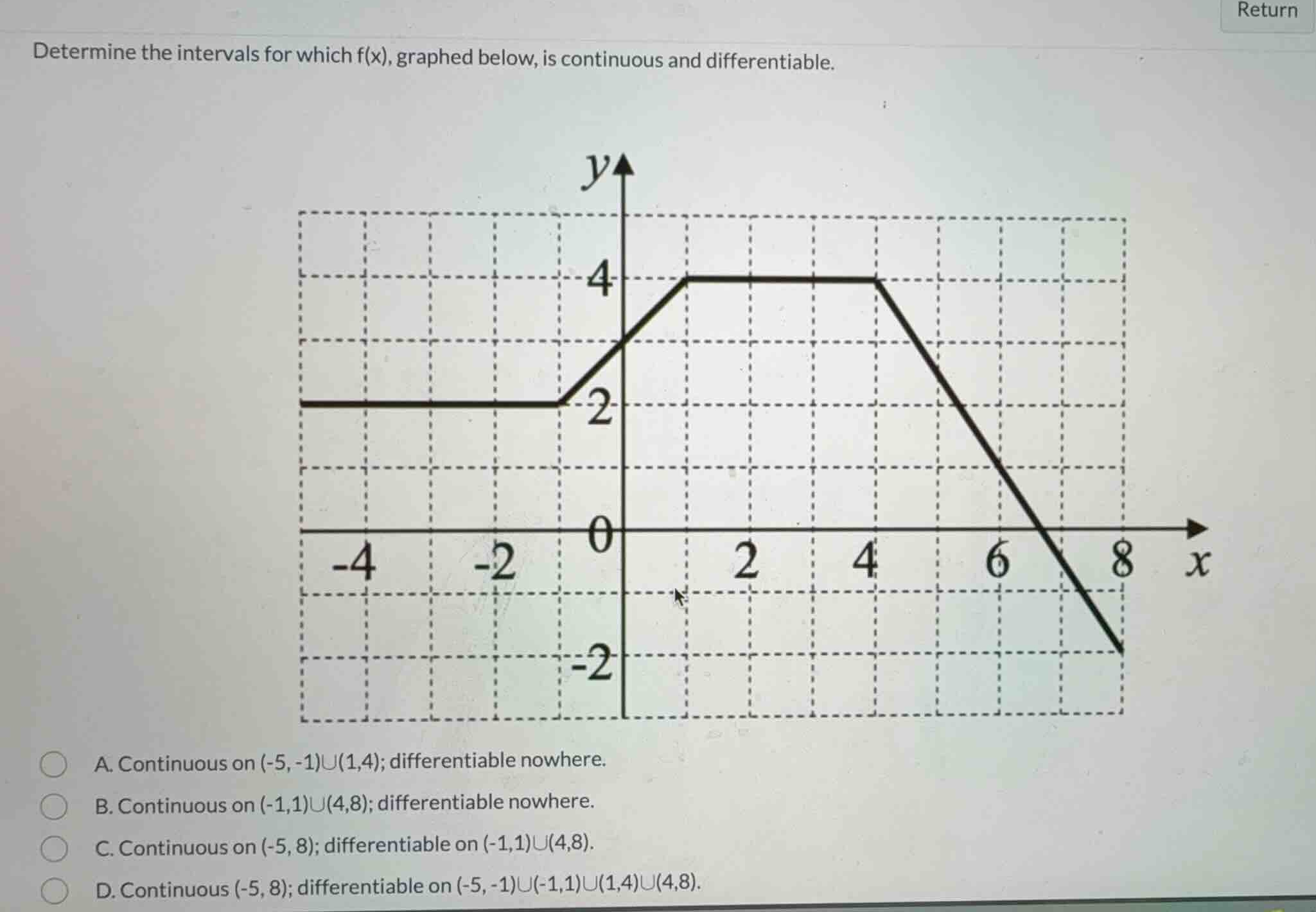
determine the intervals for which f(x), graphed below, is continuous and differentiable.
a. continuous on \\((-5, -1) \cup (1, 4)\\); differentiable nowhere.
b. continuous on \\((-1, 1) \cup (4, 8)\\); differentiable nowhere.
c. continuous on \\((-5, 8)\\); differentiable on \\((-1, 1) \cup (4, 8)\\).
d. continuous on \\((-5, 8)\\); differentiable on \\((-5, -1) \cup (-1, 1) \cup (1, 4) \cup (4, 8)\\).
<pre_analysis>
{
"quality": "clear",
"question_count": 1,
"skills_matched": [
"step_cot",
"multiple_choice_formatter",
"explain_then_answer",
"tutor"
],
"needs_drawing": false,
"concepts_used": [],
"new_concepts": [
"Intervals of Continuity",
"Intervals of Differentiability",
"Corner Points"
],
"current_concepts": [
"Intervals of Continuity",
"Intervals of Differentiability",
"Corner Points"
]
}
</pre_analysis>
<reasoning>
Analyze continuity of the function
The graph of \(f(x)\) is defined on the interval \((-5, 8)\). Looking at the graph, there are no breaks, holes, vertical asymptotes, or jumps. The curve is drawn in a single continuous stroke. Therefore, \(f(x)\) is continuous on the entire domain \((-5, 8)\).
Identify points of non-differentiability
A continuous function is not differentiable at sharp corners, cusps, or vertical tangents. Looking at the graph, there are sharp turns (corners) where the slope changes abruptly:
- At \(x = -1\), the graph transitions from a horizontal line to a line with a positive slope.
- At \(x = 1\), the graph transitions from a positive slope to a horizontal line.
- At \(x = 4\), the graph transitions from a horizontal line to a line with a negative slope.
Thus, \(f(x)\) is not differentiable at \(x = -1\), \(x = 1\), and \(x = 4\).
Determine intervals of differentiability
Since the function is continuous on \((-5, 8)\) but not differentiable at the corner points \(x = -1\), \(x = 1\), and \(x = 4\), we exclude these points from the domain of differentiability. This splits the domain into four open intervals:
- \((-5, -1)\)
- \((-1, 1)\)
- \((1, 4)\)
- \((4, 8)\)
Thus, \(f(x)\) is differentiable on \((-5, -1) \cup (-1, 1) \cup (1, 4) \cup (4, 8)\).
Match with the given options
Let's evaluate the options:
- Option A states continuous on \((-5, -1) \cup (1, 4)\), which is incorrect.
- Option B states continuous on \((-1, 1) \cup (4, 8)\), which is incorrect.
- Option C states differentiable on \((-1, 1) \cup (4, 8)\), which misses two intervals.
- Option D states continuous on \((-5, 8)\) and differentiable on \((-5, -1) \cup (-1, 1) \cup (1, 4) \cup (4, 8)\). This matches our findings perfectly.
</reasoning>
<answer>
<mcq-option>A. Continuous on (-5, -1)\(\cup\)(1,4); differentiable nowhere.</mcq-option>
<mcq-option>B. Continuous on (-1,1)\(\cup\)(4,8); differentiable nowhere.</mcq-option>
<mcq-option>C. Continuous on (-5, 8); differentiable on (-1,1)\(\cup\)(4,8).</mcq-option>
<mcq-correct>D. Continuous on (-5, 8); differentiable on (-5, -1)\(\cup\)(-1,1)\(\cup\)(1,4)\(\cup\)(4,8).</mcq-correct>
</answer>
<post_analysis>
{
"subject": "Mathematics",
"question_type": "Multiple Choice",
"knowledge_point": [
"Mathematics",
"Calculus",
"Intervals of Continuity and Differentiability"
]
}
</post_analysis>
Snap & solve any problem in the app
Get step-by-step solutions on Sovi AI
Photo-based solutions with guided steps
Explore more problems and detailed explanations
<pre_analysis>
{
"quality": "clear",
"question_count": 1,
"skills_matched": [
"step_cot",
"multiple_choice_formatter",
"explain_then_answer",
"tutor"
],
"needs_drawing": false,
"concepts_used": [],
"new_concepts": [
"Intervals of Continuity",
"Intervals of Differentiability",
"Corner Points"
],
"current_concepts": [
"Intervals of Continuity",
"Intervals of Differentiability",
"Corner Points"
]
}
</pre_analysis>
<reasoning>
Analyze continuity of the function
The graph of \(f(x)\) is defined on the interval \((-5, 8)\). Looking at the graph, there are no breaks, holes, vertical asymptotes, or jumps. The curve is drawn in a single continuous stroke. Therefore, \(f(x)\) is continuous on the entire domain \((-5, 8)\).
Identify points of non-differentiability
A continuous function is not differentiable at sharp corners, cusps, or vertical tangents. Looking at the graph, there are sharp turns (corners) where the slope changes abruptly:
- At \(x = -1\), the graph transitions from a horizontal line to a line with a positive slope.
- At \(x = 1\), the graph transitions from a positive slope to a horizontal line.
- At \(x = 4\), the graph transitions from a horizontal line to a line with a negative slope.
Thus, \(f(x)\) is not differentiable at \(x = -1\), \(x = 1\), and \(x = 4\).
Determine intervals of differentiability
Since the function is continuous on \((-5, 8)\) but not differentiable at the corner points \(x = -1\), \(x = 1\), and \(x = 4\), we exclude these points from the domain of differentiability. This splits the domain into four open intervals:
- \((-5, -1)\)
- \((-1, 1)\)
- \((1, 4)\)
- \((4, 8)\)
Thus, \(f(x)\) is differentiable on \((-5, -1) \cup (-1, 1) \cup (1, 4) \cup (4, 8)\).
Match with the given options
Let's evaluate the options:
- Option A states continuous on \((-5, -1) \cup (1, 4)\), which is incorrect.
- Option B states continuous on \((-1, 1) \cup (4, 8)\), which is incorrect.
- Option C states differentiable on \((-1, 1) \cup (4, 8)\), which misses two intervals.
- Option D states continuous on \((-5, 8)\) and differentiable on \((-5, -1) \cup (-1, 1) \cup (1, 4) \cup (4, 8)\). This matches our findings perfectly.
</reasoning>
<answer>
<mcq-option>A. Continuous on (-5, -1)\(\cup\)(1,4); differentiable nowhere.</mcq-option>
<mcq-option>B. Continuous on (-1,1)\(\cup\)(4,8); differentiable nowhere.</mcq-option>
<mcq-option>C. Continuous on (-5, 8); differentiable on (-1,1)\(\cup\)(4,8).</mcq-option>
<mcq-correct>D. Continuous on (-5, 8); differentiable on (-5, -1)\(\cup\)(-1,1)\(\cup\)(1,4)\(\cup\)(4,8).</mcq-correct>
</answer>
<post_analysis>
{
"subject": "Mathematics",
"question_type": "Multiple Choice",
"knowledge_point": [
"Mathematics",
"Calculus",
"Intervals of Continuity and Differentiability"
]
}
</post_analysis>