QUESTION IMAGE
Question
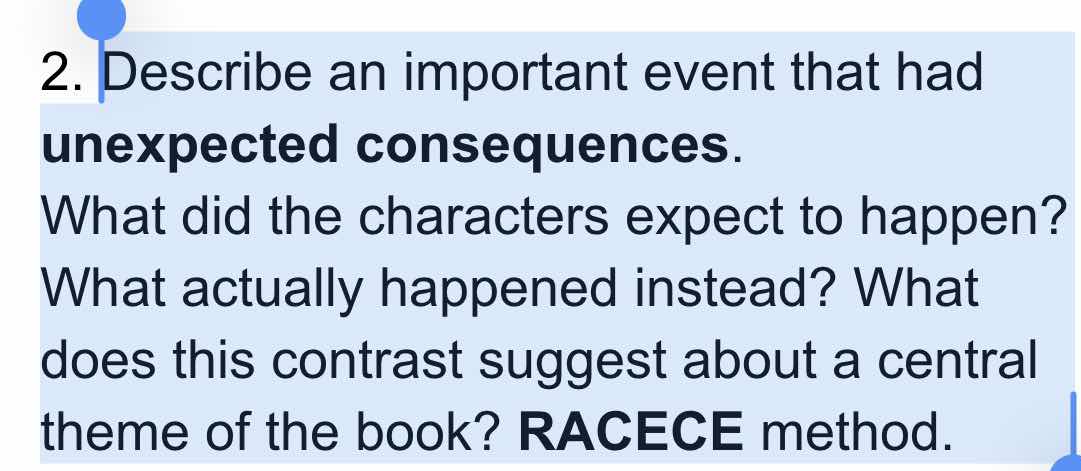
- describe an important event that had unexpected consequences. what did the characters expect to happen? what actually happened instead? what does this contrast suggest about a central theme of the book? racece method.
To answer this, we'll use the RACECE method (Restate, Answer, Cite Evidence, Explain, Cite Evidence, Explain) and pick a literary work, say Romeo and Juliet.
Step 1: Restate the Question
We need to describe an important event with unexpected consequences in Romeo and Juliet, analyze expectations vs. reality, and connect it to a central theme.
Step 2: Answer (Event & Expectations)
An important event is Friar Laurence’s plan for Juliet to fake her death. Juliet and Friar Laurence expected Romeo to receive the message explaining her fake death, rush to her tomb, and escape with her once she wakes.
Step 3: Cite Evidence (Expectations)
Friar Laurence says, “A cold and drowsy humor, for no pulse / Shall keep his native progress, but surcease. / No warmth, no breath, shall testify thou liv’st; / The roses in thy lips and cheeks shall fade / To paly ashes, thy eyes’ windows fall, / Like death, when he shuts up the day of life” (Act 4, Scene 1), outlining the fake - death plan. He then sends Friar John to “go hence to Mantua, / And give this letter to my friend Romeo” (Act 4, Scene 1) to ensure Romeo knows.
Step 4: Explain (Expectations)
The plan relies on clear communication. Juliet trusts the message will reach Romeo, so she takes the potion, believing he’ll be at the tomb to save her. Friar Laurence expects the message to bridge the gap between the feuding families’ hatred and the lovers’ escape.
Step 5: Cite Evidence (Reality)
Friar John returns, saying, “I could not send it—here it is again— / Nor get a messenger to bring it thee, / So fearful were they of infection” (Act 5, Scene 2). Romeo, not receiving the message, hears of Juliet’s “death” and buys poison: “Come, bitter conduct, come, unsavory guide! / Thou desperate pilot, now at once run on / The dashing rocks thy sea - sick weary bark!” (Act 5, Scene 3) before drinking it at Juliet’s tomb. Juliet wakes to find Romeo dead: “O, my love, my husband! / I drink to thee, my love, my only love!” (Act 5, Scene 3) and stabs herself.
Step 6: Explain (Reality & Theme)
Instead of a happy escape, both lovers die. This contrast suggests the central theme of the destructive power of fate (or the feud) against human plans. The feud and miscommunication (fueled by fate - like obstacles, e.g., the plague stopping the message) override the lovers’ and Friar Laurence’s attempts to control their destiny, showing how fate can thwart even well - intentioned human efforts.

Snap & solve any problem in the app
Get step-by-step solutions on Sovi AI
Photo-based solutions with guided steps
Explore more problems and detailed explanations
- Event: Friar Laurence’s plan for Juliet to fake her death to reunite with Romeo.
- Expectations: Juliet and Friar Laurence expected Romeo to get the message, meet Juliet at the tomb, and escape with her.
- Reality: Friar John fails to deliver the message; Romeo, believing Juliet is dead, kills himself. Juliet wakes, sees Romeo dead, and kills herself.
- Theme Suggestion: This contrast suggests the central theme of Romeo and Juliet—the inescapable power of fate (or the destructive feud) to derail human plans, as even well - intentioned schemes are destroyed by miscommunication and the forces of fate/hatred.