QUESTION IMAGE
Question
decide whether the events shown in the accompanying venn diagram are mutually exclusive. explain your reasoning.
click the icon to view the venn diagram.
the events mutually exclusive, since there and
dropdown options visible in image:
are no presidential candidates who won the state of california
is at least 1 presidential candidate who won the state of california
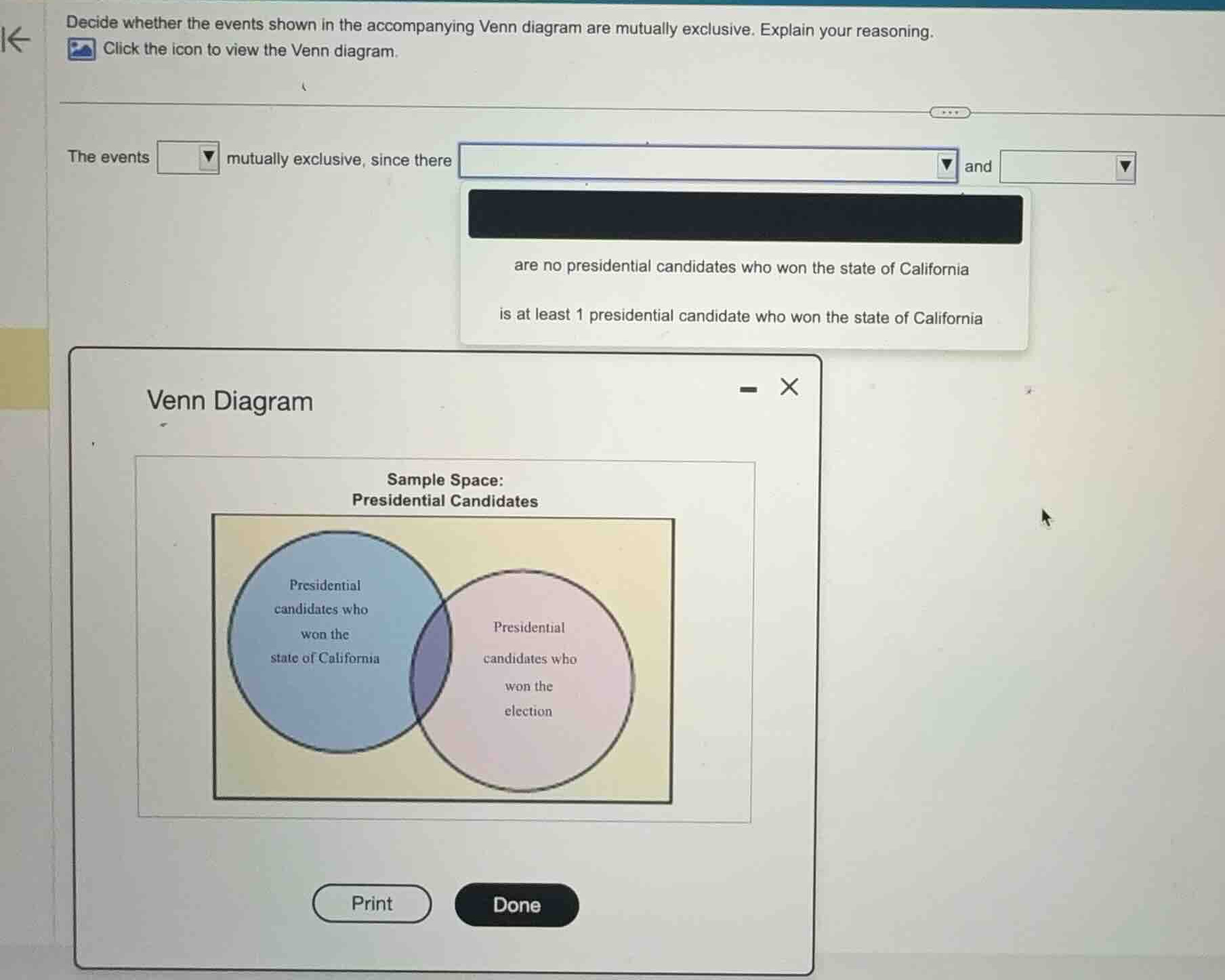
venn diagram:
sample space: presidential candidates
left circle: presidential candidates who won the state of california
right circle: presidential candidates who won the election
(the two circles overlap)
Analyze the Venn diagram
Using the Mutually Exclusive Events knowledge point
The Venn diagram shows two overlapping circles representing the events:
- "Presidential candidates who won the state of California"
- "Presidential candidates who won the election"
Because the circles overlap, there is a shared region (intersection) between the two events.
Determine mutual exclusivity
Using the Mutually Exclusive Events knowledge point
Events are mutually exclusive if they cannot occur at the same time (i.e., their intersection is empty). Since the circles overlap, the events can occur simultaneously. Thus, the events are not mutually exclusive.
Identify the reasoning options
Using the Mutually Exclusive Events knowledge point
- First blank: "are not"
- Second blank: "is at least 1 presidential candidate who won the state of California"
- Third blank: "won the election"
This is because the overlapping region represents candidates who achieved both outcomes.

Snap & solve any problem in the app
Get step-by-step solutions on Sovi AI
Photo-based solutions with guided steps
Explore more problems and detailed explanations
Decide whether the events shown in the accompanying Venn diagram are mutually exclusive. Explain your reasoning.
The events <blank>are not</blank> mutually exclusive, since there <blank>is at least 1 presidential candidate who won the state of California</blank> and <blank>won the election</blank>.