QUESTION IMAGE
Question
5 - cultural differences
learning objective: differentiate cultural dimensions and the impact they have on the workplace.
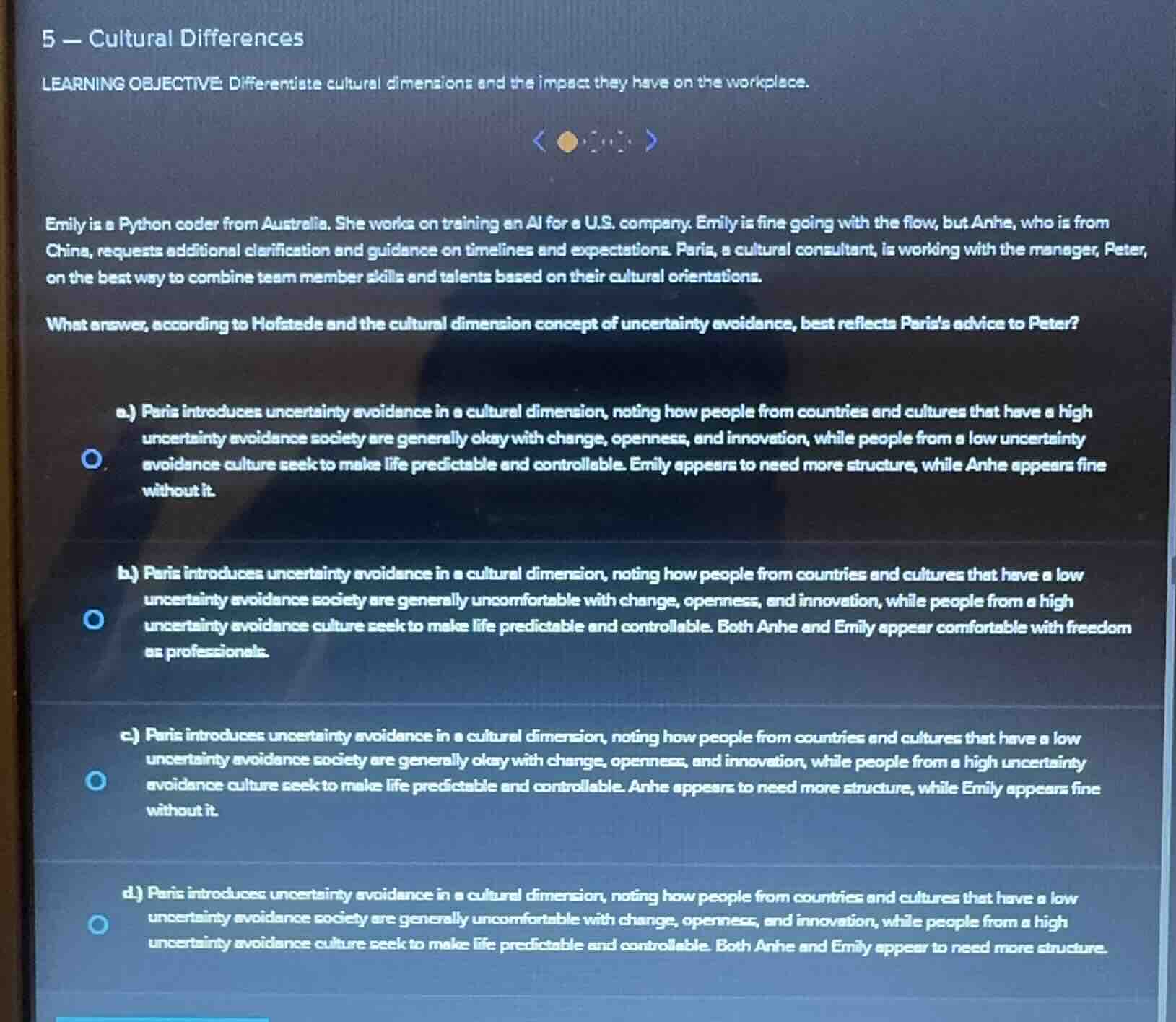
emily is a python coder from australia. she works on training an ai for a u.s. company. emily is fine going with the flow, but anhe, who is from china, requests additional clarification and guidance on timelines and expectations. paris, a cultural consultant, is working with the manager, peter, on the best way to combine team member skills and talents based on their cultural orientations.
what answer, according to hofstede and the cultural dimension concept of uncertainty avoidance, best reflects pariss advice to peter?
a.) paris introduces uncertainty avoidance in a cultural dimension, noting how people from countries and cultures that have a high uncertainty avoidance society are generally okay with change, openness, and innovation, while people from a low uncertainty avoidance culture seek to make life predictable and controllable. emily appears to need more structure, while anhe appears fine without it.
b.) paris introduces uncertainty avoidance in a cultural dimension, noting how people from countries and cultures that have a low uncertainty avoidance society are generally uncomfortable with change, openness, and innovation, while people from a high uncertainty avoidance culture seek to make life predictable and controllable. both anhe and emily appear comfortable with freedom as professionals.
c.) paris introduces uncertainty avoidance in a cultural dimension, noting how people from countries and cultures that have a low uncertainty avoidance society are generally okay with change, openness, and innovation, while people from a high uncertainty avoidance culture seek to make life predictable and controllable. anhe appears to need more structure, while emily appears fine without it.
d.) paris introduces uncertainty avoidance in a cultural dimension, noting how people from countries and cultures that have a low uncertainty avoidance society are generally uncomfortable with change, openness, and innovation, while people from a high uncertainty avoidance culture seek to make life predictable and controllable. both anhe and emily appear to need more structure.
Analyze the concept of Uncertainty Avoidance
The problem asks us to apply Hofstede's cultural dimension of Uncertainty Avoidance to the scenario.
- Low Uncertainty Avoidance: Cultures comfortable with ambiguity, change, openness, and innovation. They are generally okay with "going with the flow" and require less formal structure.
- High Uncertainty Avoidance: Cultures that prefer predictability, clear rules, structured guidelines, and explicit expectations to minimize anxiety and control the future.
Evaluate the team members' behaviors
- Emily (from Australia) is described as "fine going with the flow." This behavior aligns with a low uncertainty avoidance orientation, where she is comfortable without rigid structures.
- Anhe (from China) "requests additional clarification and guidance on timelines and expectations." This behavior aligns with a high uncertainty avoidance orientation, where she seeks predictability, structure, and clear guidelines.
Assess the given options
- Option a: Incorrectly defines high uncertainty avoidance as being okay with change/innovation, and low uncertainty avoidance as seeking predictability. It also mischaracterizes Emily as needing more structure.
- Option b: Incorrectly defines low uncertainty avoidance as being uncomfortable with change, and high uncertainty avoidance as seeking predictability. It also incorrectly states both are comfortable with freedom.
- Option c: Correctly defines low uncertainty avoidance societies as generally okay with change, openness, and innovation, and high uncertainty avoidance cultures as seeking to make life predictable and controllable. It also correctly identifies that Anhe appears to need more structure, while Emily appears fine without it.
- Option d: Incorrectly defines low uncertainty avoidance as being uncomfortable with change, and states both need more structure.
Therefore, option (c) is the correct choice.

Snap & solve any problem in the app
Get step-by-step solutions on Sovi AI
Photo-based solutions with guided steps
Explore more problems and detailed explanations
- (a) Paris introduces uncertainty avoidance in a cultural dimension, noting how people from countries and cultures that have a high uncertainty avoidance society are generally okay with change, openness, and innovation, while people from a low uncertainty avoidance culture seek to make life predictable and controllable. Emily appears to need more structure, while Anhe appears fine without it.
- (b) Paris introduces uncertainty avoidance in a cultural dimension, noting how people from countries and cultures that have a low uncertainty avoidance society are generally uncomfortable with change, openness, and innovation, while people from a high uncertainty avoidance culture seek to make life predictable and controllable. Both Anhe and Emily appear comfortable with freedom as professionals.
- (c) Paris introduces uncertainty avoidance in a cultural dimension, noting how people from countries and cultures that have a low uncertainty avoidance society are generally okay with change, openness, and innovation, while people from a high uncertainty avoidance culture seek to make life predictable and controllable. Anhe appears to need more structure, while Emily appears fine without it. (Correct answer)
- (d) Paris introduces uncertainty avoidance in a cultural dimension, noting how people from countries and cultures that have a low uncertainty avoidance society are generally uncomfortable with change, openness, and innovation, while people from a high uncertainty avoidance culture seek to make life predictable and controllable. Both Anhe and Emily appear to need more structure.