QUESTION IMAGE
Question
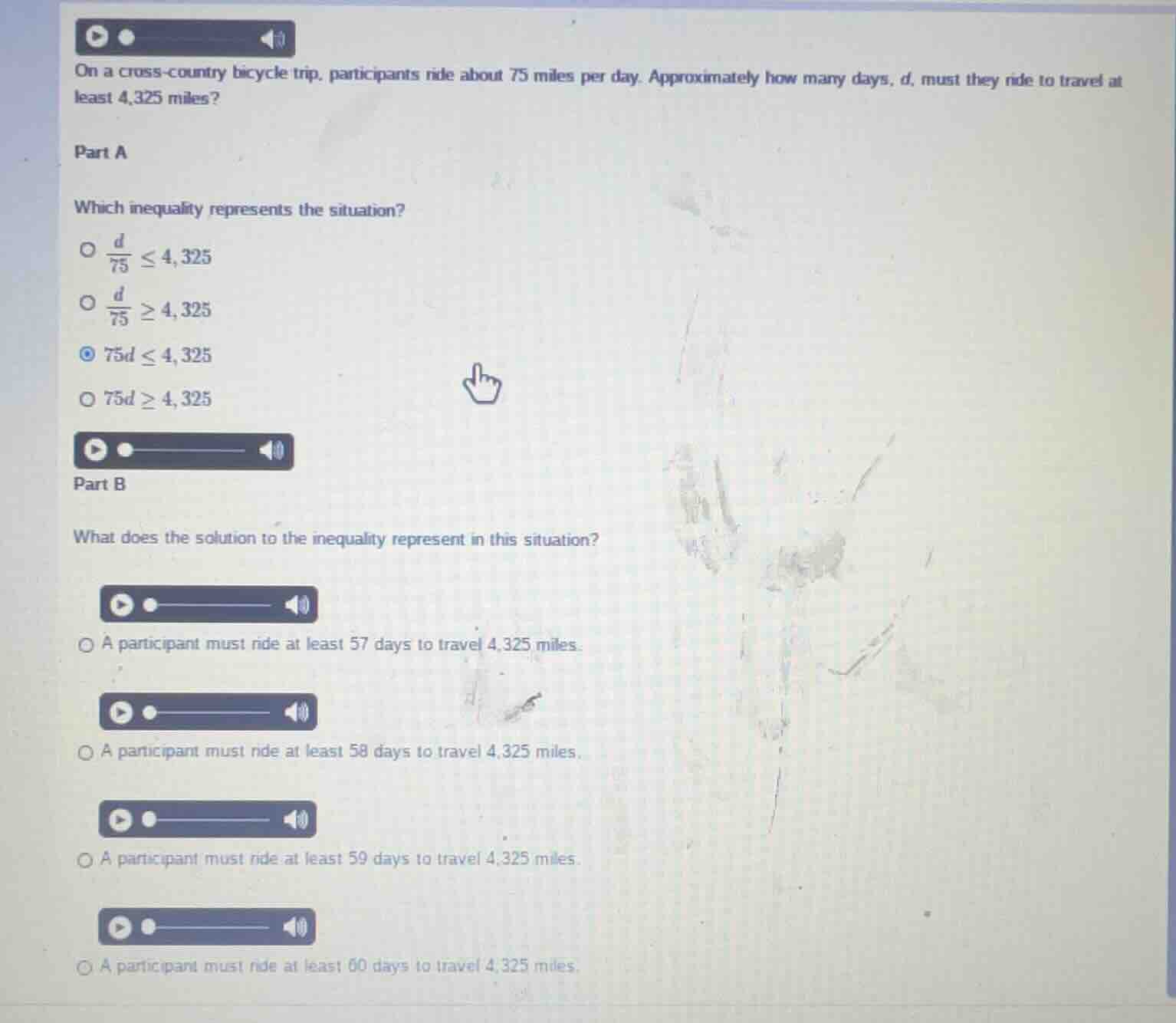
on a cross-country bicycle trip, participants ride about 75 miles per day. approximately how many days, (d), must they ride to travel at least 4,325 miles?
part a
which inequality represents the situation?
\\(\frac{d}{75} \le 4,325\\)
\\(\frac{d}{75} \ge 4,325\\)
\\(75d \le 4,325\\)
\\(75d \ge 4,325\\)
part b
what does the solution to the inequality represent in this situation?
a participant must ride at least 57 days to travel 4,325 miles.
a participant must ride at least 58 days to travel 4,325 miles.
a participant must ride at least 59 days to travel 4,325 miles.
a participant must ride at least 60 days to travel 4,325 miles.
Set up the inequality for Part A
Solve the inequality for Part B
Interpret the solution in context

Snap & solve any problem in the app
Get step-by-step solutions on Sovi AI
Photo-based solutions with guided steps
Explore more problems and detailed explanations
Question 1
- (A) \(\frac{d}{75} \le 4,325\)
- (B) \(\frac{d}{75} \ge 4,325\)
- (C) \(75d \le 4,325\)
- (D) \(75d \ge 4,325\) (Correct answer)
Question 2
- (A) A participant must ride at least 57 days to travel 4,325 miles.
- (B) A participant must ride at least 58 days to travel 4,325 miles. (Correct answer)
- (C) A participant must ride at least 59 days to travel 4,325 miles.
- (D) A participant must ride at least 60 days to travel 4,325 miles.