QUESTION IMAGE
Question
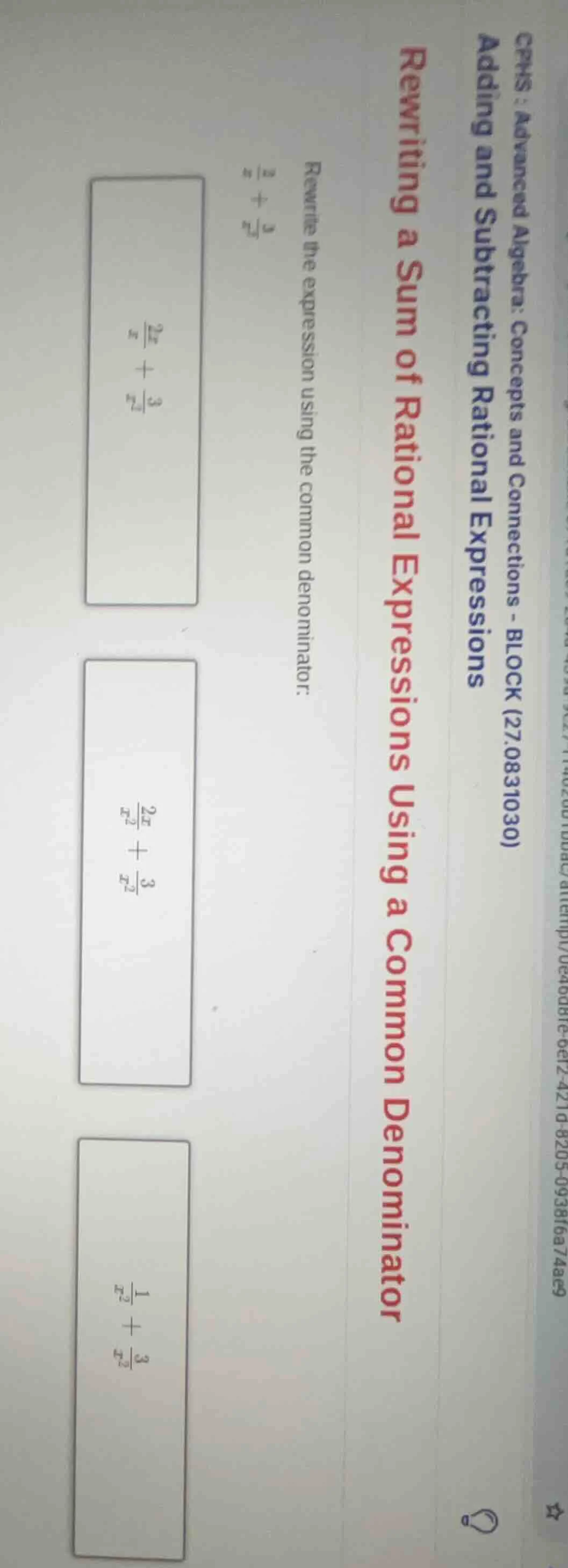
cphs : advanced algebra: concepts and connections - block (27.0831030)
adding and subtracting rational expressions
rewriting a sum of rational expressions using a common denominator
rewrite the expression using the common denominator:
\\(\frac{2}{x} + \frac{3}{x^2}\\)
\\(\frac{2x}{x} + \frac{3}{x^2}\\)
\\(\frac{2x}{x^2} + \frac{3}{x^2}\\)
\\(\frac{1}{x^2} + \frac{3}{x^2}\\)
Step1: Find the least common denominator (LCD) of the two fractions. The denominators are \( x \) and \( x^2 \). The LCD of \( x \) and \( x^2 \) is \( x^2 \) (since \( x^2 \) is a multiple of \( x \)).
Step2: Rewrite each fraction with the LCD as the denominator. For the first fraction \( \frac{2}{x} \), multiply the numerator and denominator by \( x \) to get a denominator of \( x^2 \). So, \( \frac{2}{x} = \frac{2 \times x}{x \times x} = \frac{2x}{x^2} \). The second fraction \( \frac{3}{x^2} \) already has a denominator of \( x^2 \), so it remains \( \frac{3}{x^2} \).
Step3: Now, the sum of the two fractions with the common denominator is \( \frac{2x}{x^2} + \frac{3}{x^2} \).

Snap & solve any problem in the app
Get step-by-step solutions on Sovi AI
Photo-based solutions with guided steps
Explore more problems and detailed explanations
\(\frac{2x}{x^2} + \frac{3}{x^2}\) (which corresponds to the second option among the given choices)