QUESTION IMAGE
Question
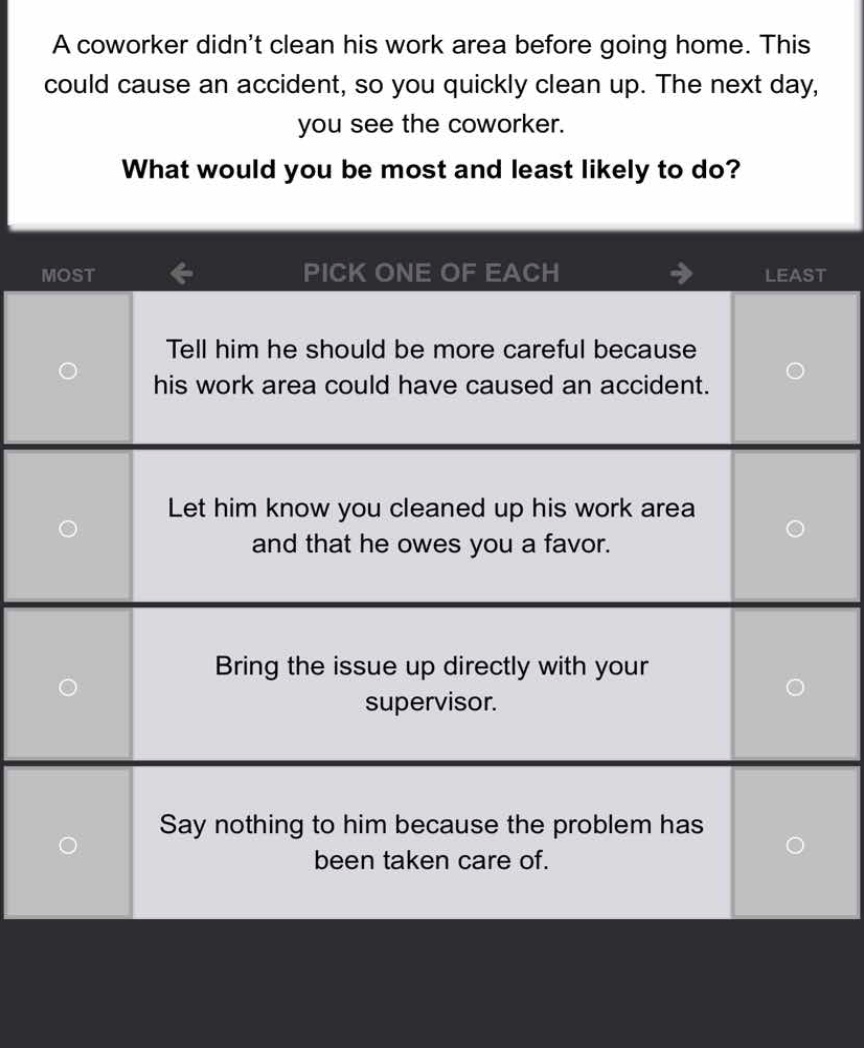
a coworker didnt clean his work area before going home. this could cause an accident, so you quickly clean up. the next day, you see the coworker.
what would you be most and least likely to do?
pick one of each
tell him he should be more careful because his work area could have caused an accident.
let him know you cleaned up his work area and that he owes you a favor.
bring the issue up directly with your supervisor.
say nothing to him because the problem has been taken care of.
Analyze the workplace scenario
Using the Situational Judgment knowledge point, we evaluate a safety hazard caused by a peer. The immediate hazard was mitigated by cleaning it up, but the underlying behavioral issue (leaving a messy, unsafe area) must be addressed constructively to prevent future risks.
Evaluate the constructive option
Using the Constructive Feedback knowledge point, we assess the first option: "Tell him he should be more careful because his work area could have caused an accident." This directly addresses the safety concern with the coworker in a professional, non-confrontational manner, promoting long-term safety awareness. This is the Most Likely action.
Evaluate the transactional option
Using the Conflict Resolution knowledge point, we assess the second option: "Let him know you cleaned up his work area and that he owes you a favor." Demanding personal favors for safety-related tasks is unprofessional, creates unnecessary tension, and fails to address the actual safety hazard constructively. This is highly ineffective.
Evaluate the escalatory option
We assess the third option: "Bring the issue up directly with your supervisor." Escalating a first-time or minor peer issue to management without speaking to the coworker first is generally considered premature and damaging to team trust, though not the most unprofessional choice.
Evaluate the passive option
We assess the fourth option: "Say nothing to him because the problem has been taken care of." Ignoring the issue entirely fails to prevent future safety hazards, making it highly ineffective. However, demanding a personal favor (Option 2) is actively unprofessional and manipulative, making Option 2 the Least Likely professional response.

Snap & solve any problem in the app
Get step-by-step solutions on Sovi AI
Photo-based solutions with guided steps
Explore more problems and detailed explanations
Question 1
- MOST: Tell him he should be more careful because his work area could have caused an accident. (Correct answer)
- LEAST: Let him know you cleaned up his work area and that he owes you a favor.
- Bring the issue up directly with your supervisor.
- Say nothing to him because the problem has been taken care of.