QUESTION IMAGE
Question
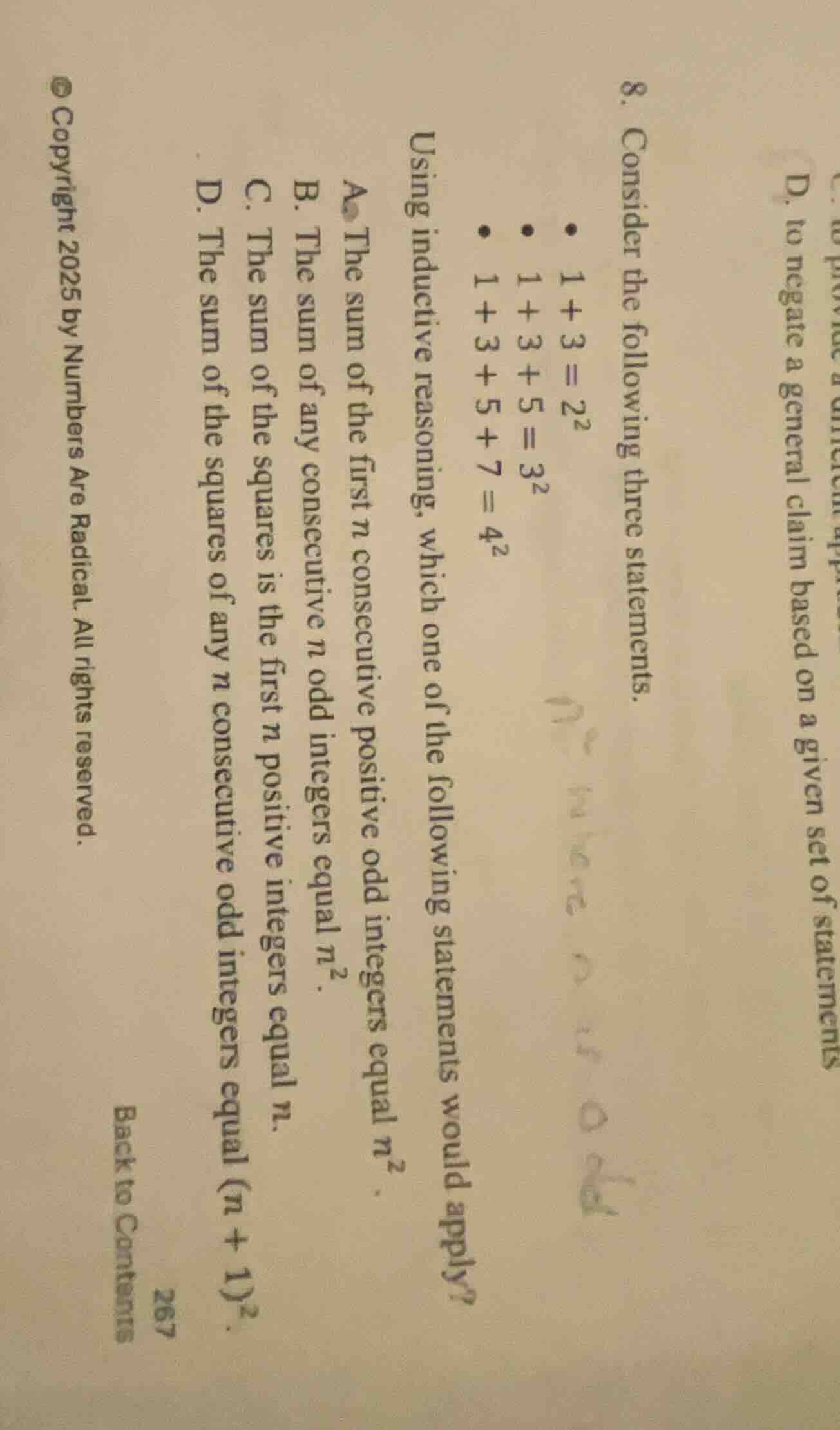
- consider the following three statements.
- \\(1 + 3 = 2^2\\)
- \\(1 + 3 + 5 = 3^2\\)
- \\(1 + 3 + 5 + 7 = 4^2\\)
using inductive reasoning, which one of the following statements would apply?
a. the sum of the first \\(n\\) consecutive positive odd integers equal \\(n^2\\).
b. the sum of any consecutive \\(n\\) odd integers equal \\(n^2\\).
c. the sum of the squares is the first \\(n\\) positive integers equal \\(n\\).
d. the sum of the squares of any \\(n\\) consecutive odd integers equal \\((n + 1)^2\\).
⚡ Using what you learned: Inductive and Deductive Reasoning
Step 1: Analyze the given pattern
Observe the structure of the three given statements:
- \( 1 + 3 = 2^2 \) (Sum of the first 2 positive odd integers is \( 2^2 \))
- \( 1 + 3 + 5 = 3^2 \) (Sum of the first 3 positive odd integers is \( 3^2 \))
- \( 1 + 3 + 5 + 7 = 4^2 \) (Sum of the first 4 positive odd integers is \( 4^2 \))
Step 2: Generalize the pattern
Following this pattern, the sum of the first \( n \) consecutive positive odd integers is equal to \( n^2 \).
Step 3: Match with the options
- A. The sum of the first n consecutive positive odd integers equal \( n^2 \). (Matches our generalization)
- B. The sum of any consecutive \( n \) odd integers equal \( n^2 \). (Incorrect, must start from 1)
- C. The sum of the squares is the first \( n \) positive integers equal \( n \). (Incorrect)
- D. The sum of the squares of any \( n \) consecutive odd integers equal \( (n + 1)^2 \). (Incorrect)

Snap & solve any problem in the app
Get step-by-step solutions on Sovi AI
Photo-based solutions with guided steps
Explore more problems and detailed explanations
A. The sum of the first n consecutive positive odd integers equal \( n^2 \).