QUESTION IMAGE
Question
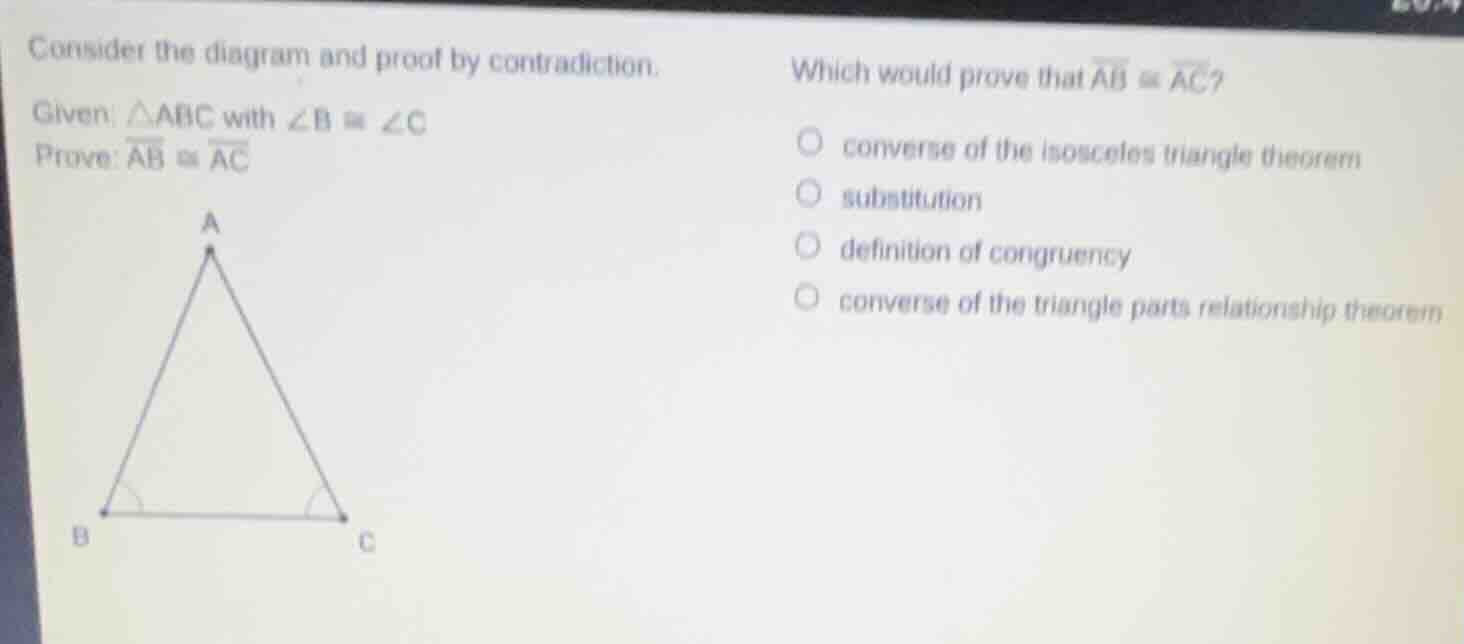
consider the diagram and proof by contradiction.
given: \\(\triangle abc\\) with \\(\angle b \cong \angle c\\)
prove: \\(\overline{ab} \cong \overline{ac}\\)
which would prove that \\(\overline{ab} \cong \overline{ac}\\)?
- converse of the isosceles triangle theorem
- substitution
- definition of congruency
- converse of the triangle parts relationship theorem
Identify the given conditions and the target statement
Given: \(\triangle ABC\) with \(\angle B \cong \angle C\)
Prove: \(\overline{AB} \cong \overline{AC}\)
Analyze the geometric theorems relating angles and sides
The Isosceles Triangle Theorem states that if two sides of a triangle are congruent, then the angles opposite those sides are congruent.
The converse of this theorem states that if two angles of a triangle are congruent, then the sides opposite those angles are congruent.
Match the converse theorem to the target proof
Since we are given \(\angle B \cong \angle C\) and want to prove \(\overline{AB} \cong \overline{AC}\), we are using the converse of the isosceles triangle theorem.

Snap & solve any problem in the app
Get step-by-step solutions on Sovi AI
Photo-based solutions with guided steps
Explore more problems and detailed explanations
- converse of the isosceles triangle theorem (Correct answer)
- substitution
- definition of congruency
- converse of the triangle parts relationship theorem