QUESTION IMAGE
Question
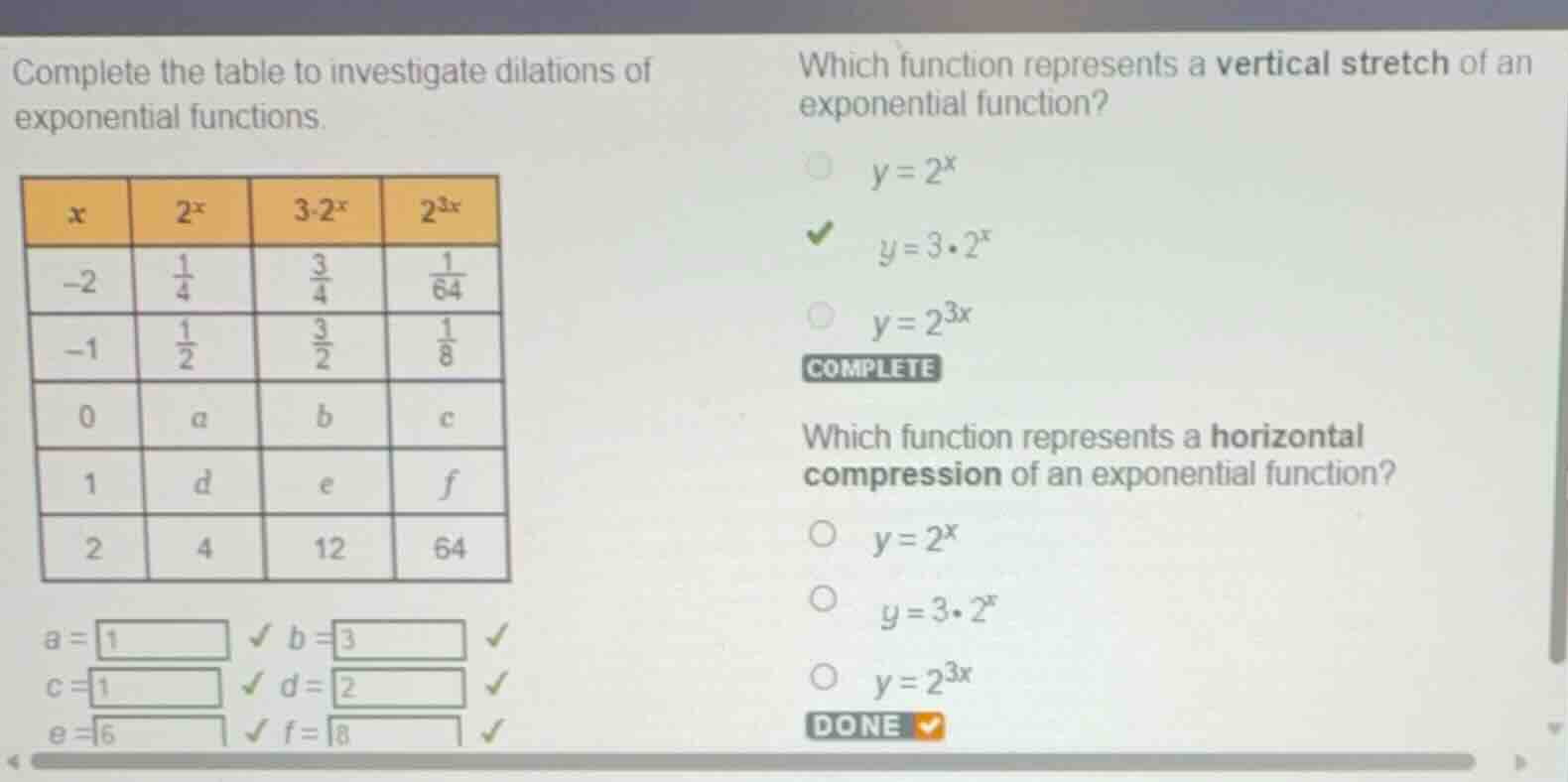
complete the table to investigate dilations of exponential functions.
\\(\
\\)
which function represents a vertical stretch of an exponential function?
\\(y = 2^x\\)
\\(y = 3 \cdot 2^x\\)
\\(y = 2^{3x}\\)
which function represents a horizontal compression of an exponential function?
\\(y = 2^x\\)
\\(y = 3 \cdot 2^x\\)
\\(y = 2^{3x}\\)
Evaluate the table values at x = 0
Using the Exponential Evaluation knowledge point
Evaluate the table values at x = 1
Using the Exponential Evaluation knowledge point
Identify the vertical stretch
Using the Exponential Function Transformations knowledge point
A vertical stretch of a parent function \(y = f(x)\) is represented by \(y = a \cdot f(x)\) where \(|a| > 1\).
Comparing \(y = 3 \cdot 2^x\) to the parent function \(y = 2^x\), the factor \(3\) multiplies the output values, representing a vertical stretch by a factor of \(3\).
Identify the horizontal compression
Using the Exponential Function Transformations knowledge point
A horizontal compression of a parent function \(y = f(x)\) is represented by \(y = f(b \cdot x)\) where \(|b| > 1\).
Comparing \(y = 2^{3x}\) to the parent function \(y = 2^x\), the input \(x\) is multiplied by \(3\), representing a horizontal compression by a factor of \(\frac{1}{3}\).

Snap & solve any problem in the app
Get step-by-step solutions on Sovi AI
Photo-based solutions with guided steps
Explore more problems and detailed explanations
Question 1
- \(a = 1\)
- \(b = 3\)
- \(c = 1\)
- \(d = 2\)
- \(e = 6\)
- \(f = 8\)
Question 2
- (A) \(y = 2^x\)
- (B) \(y = 3 \cdot 2^x\) (Correct answer)
- (C) \(y = 2^{3x}\)
Question 3
- (A) \(y = 2^x\)
- (B) \(y = 3 \cdot 2^x\)
- (C) \(y = 2^{3x}\) (Correct answer)