QUESTION IMAGE
Question
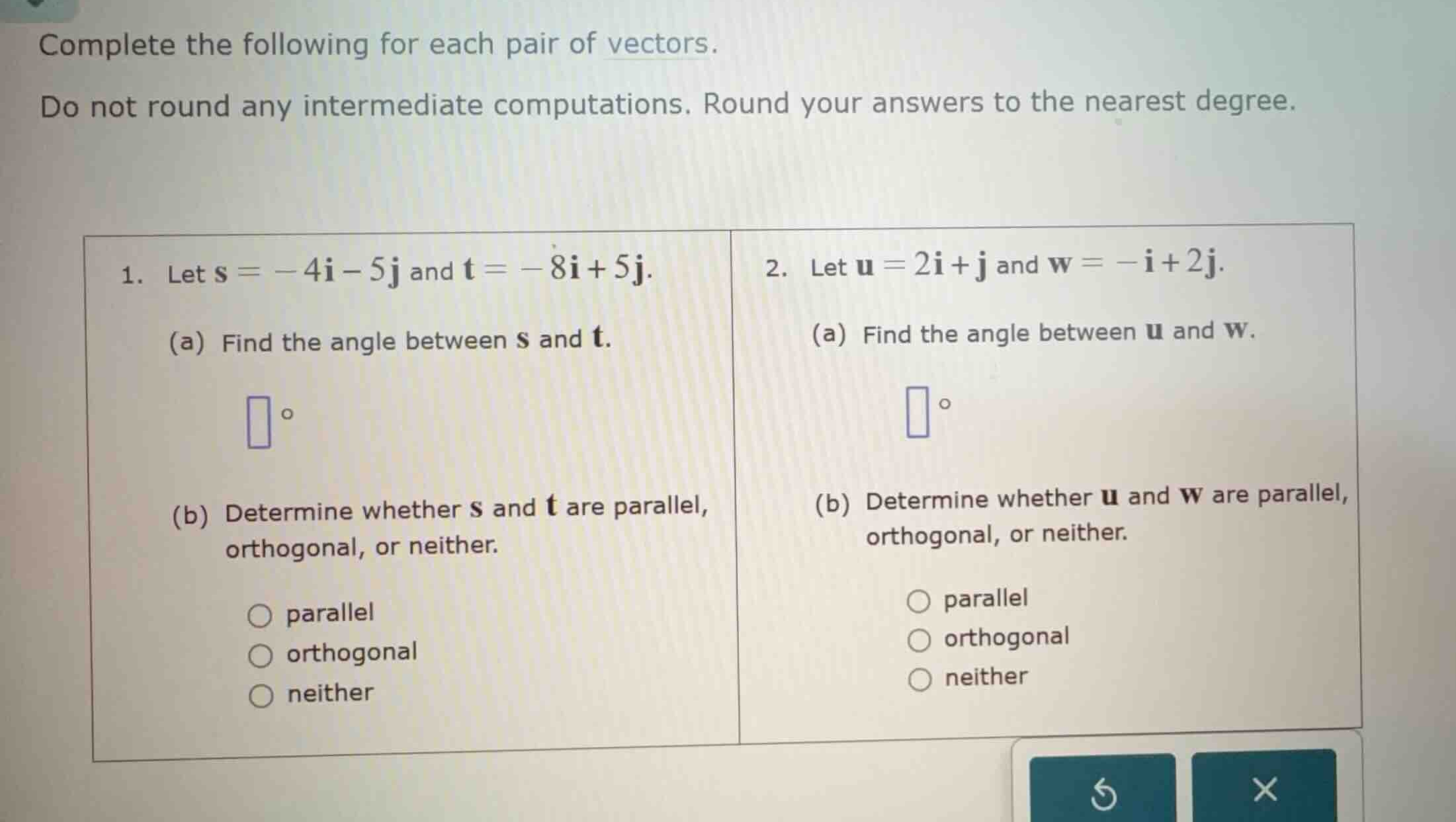
complete the following for each pair of vectors.
do not round any intermediate computations. round your answers to the nearest degree.
- let \\(\mathbf{s} = -4\mathbf{i} - 5\mathbf{j}\\) and \\(\mathbf{t} = -8\mathbf{i} + 5\mathbf{j}\\).
(a) find the angle between \\(\mathbf{s}\\) and \\(\mathbf{t}\\).
\\(\square^{\circ}\\)
(b) determine whether \\(\mathbf{s}\\) and \\(\mathbf{t}\\) are parallel, orthogonal, or neither.
parallel
orthogonal
neither
- let \\(\mathbf{u} = 2\mathbf{i} + \mathbf{j}\\) and \\(\mathbf{w} = -\mathbf{i} + 2\mathbf{j}\\).
(a) find the angle between \\(\mathbf{u}\\) and \\(\mathbf{w}\\).
\\(\square^{\circ}\\)
(b) determine whether \\(\mathbf{u}\\) and \\(\mathbf{w}\\) are parallel, orthogonal, or neither.
parallel
orthogonal
neither
Calculate dot product and magnitudes for Question 1
Using the Vector Dot Product and Vector Magnitude knowledge points
Find angle and relationship for Question 1
Using the Angle Between Vectors knowledge point
Since the angle is not \(0^\circ\), \(180^\circ\), or \(90^\circ\), the vectors are neither parallel nor orthogonal.
Calculate dot product and magnitudes for Question 2
Using the Vector Dot Product and Vector Magnitude knowledge points
Find angle and relationship for Question 2
Using the Angle Between Vectors knowledge point
Since the dot product is \(0\), the angle is exactly \(90^\circ\), which means the vectors are orthogonal.

Snap & solve any problem in the app
Get step-by-step solutions on Sovi AI
Photo-based solutions with guided steps
Explore more problems and detailed explanations
Question 1
(a) The angle between \(\mathbf{s}\) and \(\mathbf{t}\) is <blank>\(83\)</blank>\(^\circ\).
(b) Determine whether \(\mathbf{s}\) and \(\mathbf{t}\) are parallel, orthogonal, or neither.
- parallel
- orthogonal
- neither (Correct answer)
Question 2
(a) Find the angle between \(\mathbf{u}\) and \(\mathbf{w}\).
The angle between \(\mathbf{u}\) and \(\mathbf{w}\) is <blank>\(90\)</blank>\(^\circ\).
(b) Determine whether \(\mathbf{u}\) and \(\mathbf{w}\) are parallel, orthogonal, or neither.
- parallel
- orthogonal (Correct answer)
- neither