QUESTION IMAGE
Question
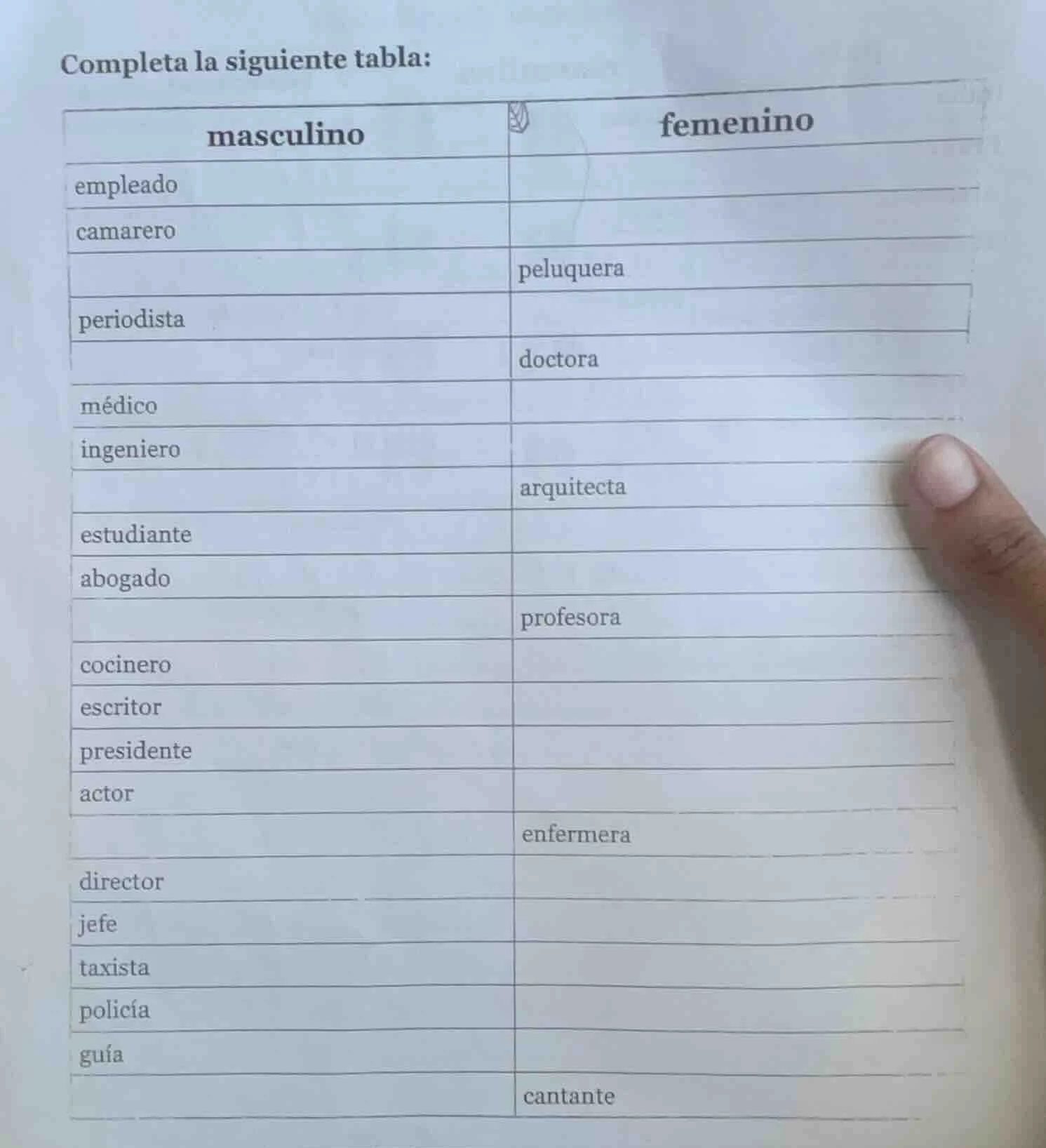
completa la siguiente tabla:
masculino\tfemenino
empleado\t
camarero\t
\tpeluquera
periodista\t
\tdoctora
médico\t
ingeniero\t
\tarquitecta
estudiante\t
abogado\t
\tprofesora
cocinero\t
escritor\t
presidente\t
actor\t
\tenfermera
director\t
jefe\t
taxista\t
policía\t
guía\t
\tcantante
To solve this, we need to find the feminine or masculine counterparts of Spanish nouns (occupations) by applying Spanish gender - noun rules (like changing - o to - a, - ero to - era, or keeping some invariable and adding gender - specific markers).
1. empleado (masculine) - femenino
For "empleado", we change the masculine ending - o (in the root, the noun's base for gender change) to - a. So it becomes "empleada".
2. camarero (masculine) - femenino
The masculine "camarero" has the - ero ending. We change - ero to - era to get the feminine form "camarera".
3. peluquera (feminine) - masculino
For the feminine "peluquera" with the - era ending, we change - era to - ero to obtain the masculine form "peluquero".
4. periodista - femenino (it's invariable in form, but we can add a gender - specific marker. However, in common usage, "periodista" can be used for both genders, but if we want a distinct feminine form, we can say "periodista" (since it's invariable) or sometimes "periodista mujer", but the standard gender - adjusted form (by adding - a to the root, but "periodista" already has a neutral - ista ending) is still "periodista" for feminine (and masculine). But following the pattern of changing endings, since the root is "periodist -", we add - a, so "periodista" (wait, actually, "periodista" is invariable in spelling for gender, but the gender is indicated by the article. But for the table, we can use "periodista" as the feminine (since it's the same as masculine in spelling for this noun). Wait, no, actually, the correct way is that "periodista" is used for both, but if we follow the pattern of other nouns, maybe there's a mistake, but in standard Spanish, "periodista" is gender - neutral in form. But let's assume we need to make it follow the - o/- a pattern. The root is "periodist -", so feminine would be "periodista" (same as masculine in form, but gender is indicated by context. But maybe the intended answer is "periodista" (feminine, same as masculine here).
5. doctora (feminine) - masculino
For the feminine "doctora" with the - ora ending, we change - ora to - or to get the masculine form "doctor".
6. médico (masculine) - femenino
The masculine "médico" has the - o ending. We change - o to - a to get the feminine form "médica".
7. ingeniero (masculine) - femenino
For "ingeniero" with the - ero ending, we change - ero to - era to obtain the feminine form "ingeniera".
8. arquitecta (feminine) - masculino
The feminine "arquitecta" has the - ecta ending (root "arquitect -"). We change - ecta to - ecto to get the masculine form "arquitecto".
9. estudiante - femenino (it's invariable in form. Like "periodista", "estudiante" can be used for both genders. But if we follow the pattern of adding - a to a root, but "estudiante" has the - ante ending which is gender - neutral. So the feminine form is "estudiante" (same as masculine in spelling, gender is indicated by article).
10. abogado (masculine) - femenino
The masculine "abogado" has the - ado ending (root "abog -"). We change - ado to - ada to get the feminine form "abogada".
11. profesora (feminine) - masculino
For the feminine "profesora" with the - ora ending, we change - ora to - or to get the masculine form "profesor".
12. cocinero (masculine) - femenino
The masculine "cocinero" has the - ero ending. We change - ero to - era to get the feminine form "cocinera".
13. escritor (masculine) - femenino
The masculine "escritor" has the - or ending. We change - or to - ora to get the feminine form "escritora".
14.…

Snap & solve any problem in the app
Get step-by-step solutions on Sovi AI
Photo-based solutions with guided steps
Explore more problems and detailed explanations
To solve this, we need to find the feminine or masculine counterparts of Spanish nouns (occupations) by applying Spanish gender - noun rules (like changing - o to - a, - ero to - era, or keeping some invariable and adding gender - specific markers).
1. empleado (masculine) - femenino
For "empleado", we change the masculine ending - o (in the root, the noun's base for gender change) to - a. So it becomes "empleada".
2. camarero (masculine) - femenino
The masculine "camarero" has the - ero ending. We change - ero to - era to get the feminine form "camarera".
3. peluquera (feminine) - masculino
For the feminine "peluquera" with the - era ending, we change - era to - ero to obtain the masculine form "peluquero".
4. periodista - femenino (it's invariable in form, but we can add a gender - specific marker. However, in common usage, "periodista" can be used for both genders, but if we want a distinct feminine form, we can say "periodista" (since it's invariable) or sometimes "periodista mujer", but the standard gender - adjusted form (by adding - a to the root, but "periodista" already has a neutral - ista ending) is still "periodista" for feminine (and masculine). But following the pattern of changing endings, since the root is "periodist -", we add - a, so "periodista" (wait, actually, "periodista" is invariable in spelling for gender, but the gender is indicated by the article. But for the table, we can use "periodista" as the feminine (since it's the same as masculine in spelling for this noun). Wait, no, actually, the correct way is that "periodista" is used for both, but if we follow the pattern of other nouns, maybe there's a mistake, but in standard Spanish, "periodista" is gender - neutral in form. But let's assume we need to make it follow the - o/- a pattern. The root is "periodist -", so feminine would be "periodista" (same as masculine in form, but gender is indicated by context. But maybe the intended answer is "periodista" (feminine, same as masculine here).
5. doctora (feminine) - masculino
For the feminine "doctora" with the - ora ending, we change - ora to - or to get the masculine form "doctor".
6. médico (masculine) - femenino
The masculine "médico" has the - o ending. We change - o to - a to get the feminine form "médica".
7. ingeniero (masculine) - femenino
For "ingeniero" with the - ero ending, we change - ero to - era to obtain the feminine form "ingeniera".
8. arquitecta (feminine) - masculino
The feminine "arquitecta" has the - ecta ending (root "arquitect -"). We change - ecta to - ecto to get the masculine form "arquitecto".
9. estudiante - femenino (it's invariable in form. Like "periodista", "estudiante" can be used for both genders. But if we follow the pattern of adding - a to a root, but "estudiante" has the - ante ending which is gender - neutral. So the feminine form is "estudiante" (same as masculine in spelling, gender is indicated by article).
10. abogado (masculine) - femenino
The masculine "abogado" has the - ado ending (root "abog -"). We change - ado to - ada to get the feminine form "abogada".
11. profesora (feminine) - masculino
For the feminine "profesora" with the - ora ending, we change - ora to - or to get the masculine form "profesor".
12. cocinero (masculine) - femenino
The masculine "cocinero" has the - ero ending. We change - ero to - era to get the feminine form "cocinera".
13. escritor (masculine) - femenino
The masculine "escritor" has the - or ending. We change - or to - ora to get the feminine form "escritora".
14. presidente - femenino (it's invariable in form, like "periodista" and "estudiante". The root is "president -", and the ending - e is neutral. So the feminine form is "presidenta" (changing - e to - a? Wait, no, "presidente" is masculine, and feminine is "presidenta" (changing - e to - a in the root's ending). Yes, "presidente" (masculine) becomes "presidenta" (feminine) by changing - e to - a.
15. actor (masculine) - femenino
The masculine "actor" has the - or ending. We change - or to - ora to get the feminine form "actriz" (wait, no, "actor" - feminine is "actriz" (irregular), but the regular change would be "actora", but in standard Spanish, "actriz" is the correct feminine form. However, if we follow the regular - or to - ora, it's "actora", but "actriz" is more common. But maybe the table expects the regular form, so "actora" or the irregular "actriz". Let's go with the irregular "actriz" as it's the standard feminine for "actor".
16. enfermera (feminine) - masculino
For the feminine "enfermera" with the - era ending, we change - era to - ero to get the masculine form "enfermero".
17. director (masculine) - femenino
The masculine "director" has the - or ending. We change - or to - ora to get the feminine form "directora".
18. jefe - femenino (it's invariable in form for gender, but we can say "jefa" (changing - e to - a in the root, "jef -" + - a = "jefa").
19. taxista - femenino (it's invariable in form, but the masculine is "taxista" (same as feminine in spelling, gender is indicated by article). But if we follow the - ista ending (like "periodista"), it's invariable, so "taxista" for feminine (same as masculine).
20. policía - masculino (the feminine "policía" (wait, no, "policía" can be feminine, and masculine is "policía" (same in spelling, but gender is indicated by article) or "policía hombre". But the regular change: "policía" (feminine) - masculine is "policía" (same) or "policier" (French - influenced), but in Spanish, "policía" is used for both genders, but the masculine form with a changed ending: "policía" (masculine) can be "policía" or "policier" (no, better to use "policía" as the masculine form here, or "policía" (masculine) is same as feminine in spelling.
21. guía - masculino (the feminine "guía" (same as masculine in spelling, gender is indicated by article). But if we follow the - ía ending, we can change it to - ío? No, "guía" is invariable. So masculine is "guía" (same as feminine in spelling).
22. cantante - masculino (it's invariable in form, so masculine is "cantante" (same as feminine in spelling, gender is indicated by article). But if we follow the - nte ending (neutral), the masculine form is "cantante" (same as feminine).
Now, let's summarize the table with the filled - in forms:
| masculino | femenino |
|---|---|
| camarero | camarera |
| peluquero | peluquera |
| periodista | periodista |
| doctor | doctora |
| médico | médica |
| ingeniero | ingeniera |
| arquitecto | arquitecta |
| estudiante | estudiante |
| abogado | abogada |
| profesor | profesora |
| cocinero | cocinera |
| escritor | escritora |
| presidente | presidenta |
| actor | actriz |
| enfermero | enfermera |
| director | directora |
| jefe | jefa |
| taxista | taxista |
| policía | policía |
| guía | guía |
| cantante | cantante |
(Note: Some of these are based on Spanish noun - gender rules, with some nouns being invariable in spelling but having gender - specific meanings, and others following regular - o/- a, - ero/- era, - or/- ora changes. There are also irregular forms like "actriz" for "actor".)