QUESTION IMAGE
Question
the commutative property practice
complete this assessment to review what youve learned. it will not count toward your grade.
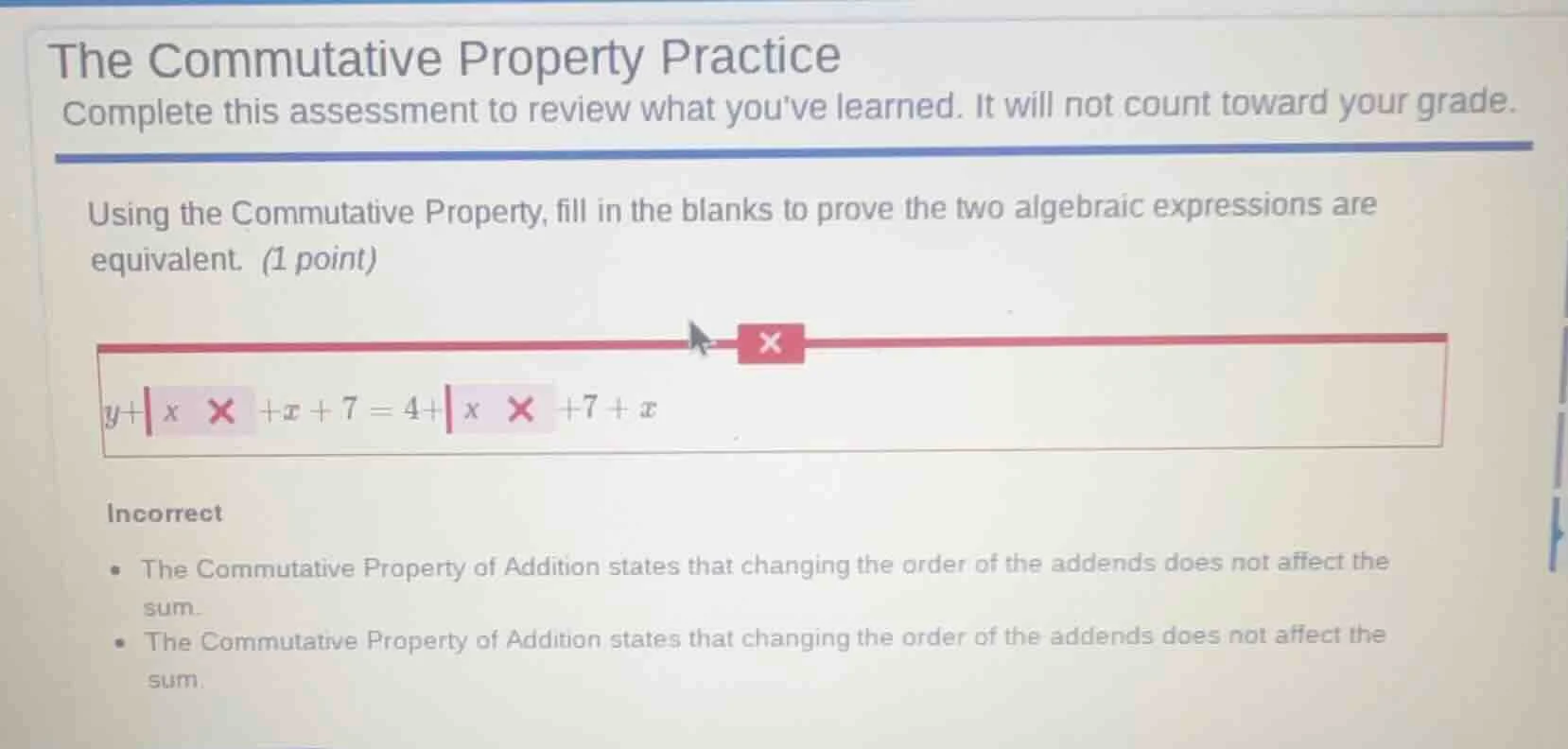
using the commutative property, fill in the blanks to prove the two algebraic expressions are equivalent. (1 point)
$y + \boldsymbol{\times} + x + 7 = 4 + \boldsymbol{\times} + 7 + x$
incorrect
- the commutative property of addition states that changing the order of the addends does not affect the sum.
- the commutative property of addition states that changing the order of the addends does not affect the sum.
Step1: Analyze the left - hand side expression
The left - hand side expression is \(y+\square+x + 7\). We want to match the structure of the right - hand side expression \(4+\square+7 + x\) using the Commutative Property of Addition (which states that \(a + b=b + a\) for addition). Looking at the right - hand side, the first term is 4. So, to make the left - hand side have a term of 4 (by using the Commutative Property to re - order the terms), the blank on the left should be 4. Let's check: If we put 4 in the left blank, the left - hand side becomes \(4+x + 7+y\) (wait, no, the original left - hand side is \(y+\square+x + 7\), if we put 4 in the blank, it's \(y + 4+x + 7\)). Then, using the Commutative Property of Addition, we can re - order the terms \(y+4+x + 7=4 + y+7 + x\)? Wait, no, the right - hand side is \(4+\square+7 + x\). Wait, maybe I misread. Let's look again. The right - hand side is \(4+\square+7 + x\), and the left - hand side is \(y+\square+x + 7\). Wait, no, the correct approach: The Commutative Property of Addition says that the order of addends can be changed. So, for the left - hand side \(y+\square+x + 7\) and the right - hand side \(4+\square+7 + x\), we need to find the missing number. Let's assume the blank is a number. Let's look at the terms. On the right - hand side, the non - variable, non - 7 term is 4. On the left - hand side, the non - variable, non - 7 term (before re - ordering) should be 4. Wait, maybe the left - hand side was supposed to be \(4+\square+x + 7\) and the right - hand side is \(4+\square+7 + x\)? No, the original left - hand side has a \(y\)? Wait, no, maybe there is a typo, and the \(y\) is a mistake, or maybe I missee. Wait, the problem is to make \(y+\square+x + 7=4+\square+7 + x\) using the Commutative Property. Wait, no, that can't be. Wait, maybe the \(y\) is a 4. Maybe it's a typo, and the left - hand side is \(4+\square+x + 7\). Let's proceed with the Commutative Property. The Commutative Property of Addition: \(a + b=b + a\). So, for the expression \(4+x + 7\) (if we correct the left - hand side's \(y\) to 4), we can re - order the terms \(x\) and 7. So \(4+x + 7=4 + 7+x\) (by Commutative Property, \(x+7 = 7 + x\)). Wait, the blanks: Let's look at the original problem again. The left - hand side is \(y+\square+x + 7\), the right - hand side is \(4+\square+7 + x\). Wait, maybe the first blank (on the left) is 4, and the second blank (on both sides) is \(y\)? No, that doesn't make sense. Wait, maybe the \(y\) is a mistake, and it's supposed to be 4. Let's assume that the left - hand side is \(4+\square+x + 7\) and the right - hand side is \(4+\square+7 + x\). Then, using the Commutative Property of Addition, \(4+x + 7=4 + 7+x\) because \(x+7 = 7 + x\) (Commutative Property of Addition: \(a + b=b + a\), here \(a=x\), \(b = 7\)). So the blank on the left (the first blank) should be 4, and the blank on the right (the second blank) should be \(x\)? Wait, no, the blanks are the same? Wait, the problem has two blanks, both with \(x\) crossed out. Wait, maybe the blanks are for numbers. Wait, let's start over. The Commutative Property of Addition: For any real numbers \(a\) and \(b\), \(a + b=b + a\). So, we have an expression on the left: \(y+\underline{\quad}+x + 7\) and on the right: \(4+\underline{\quad}+7 + x\). We need to find the value of the underlined part. Let's equate the two expressions. \(y+\underline{\quad}+x + 7=4+\underline{\quad}+7 + x\). Subtract \(\underline{\quad}+x + 7\) from both sides: \(y = 4\). So the first blank (on the left) should be 4, and the second bl…

Snap & solve any problem in the app
Get step-by-step solutions on Sovi AI
Photo-based solutions with guided steps
Explore more problems and detailed explanations
The blank should be filled with 4. So the left - hand side blank is 4 and the right - hand side blank is also 4. (Assuming the \(y\) is a typo and should be 4)