QUESTION IMAGE
Question
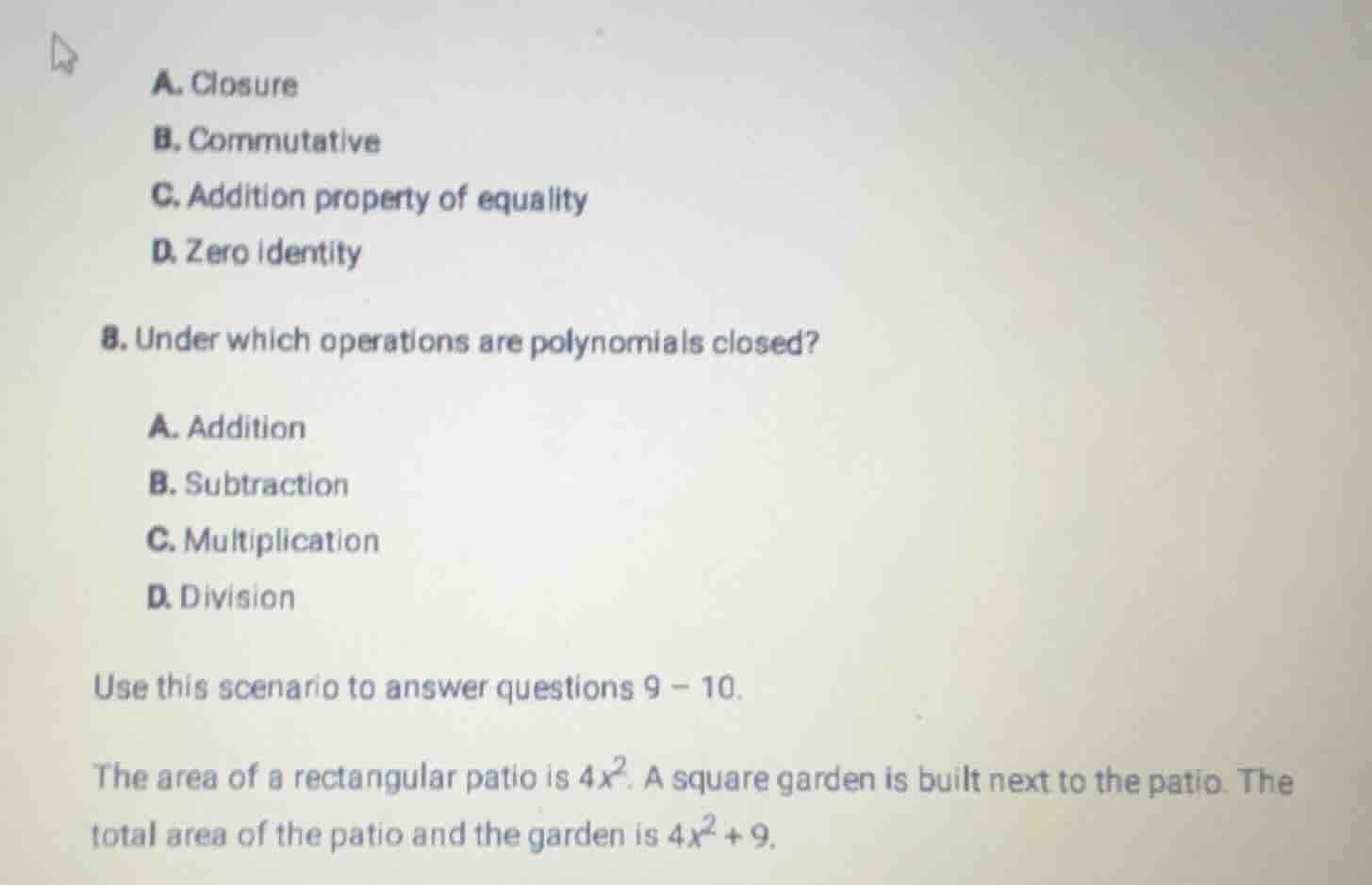
a. closure
b. commutative
c. addition property of equality
d. zero identity
- under which operations are polynomials closed?
a. addition
b. subtraction
c. multiplication
d. division
use this scenario to answer questions 9 – 10.
the area of a rectangular patio is $4x^2$. a square garden is built next to the patio. the total area of the patio and the garden is $4x^2 + 9$.
Question 8
To determine under which operations polynomials are closed, we analyze each operation:
- Addition: When adding two polynomials, we combine like terms. The sum of two polynomials (e.g., \( (a_nx^n+\dots+a_1x + a_0)+(b_nx^n+\dots+b_1x + b_0)=(a_n + b_n)x^n+\dots+(a_1 + b_1)x+(a_0 + b_0) \)) is also a polynomial, so polynomials are closed under addition.
- Subtraction: Subtracting two polynomials (\( (a_nx^n+\dots+a_1x + a_0)-(b_nx^n+\dots+b_1x + b_0)=(a_n - b_n)x^n+\dots+(a_1 - b_1)x+(a_0 - b_0) \)) results in a polynomial, so they are closed under subtraction.
- Multiplication: Multiplying two polynomials (using the distributive property) results in a sum of terms with non - negative integer exponents and coefficients, which is a polynomial. For example, \( (ax + b)(cx + d)=acx^2+(ad + bc)x+bd \).
- Division: If we divide two polynomials, we may get a non - polynomial (e.g., dividing \( x \) by \( x^2 \) gives \( \frac{1}{x} \), which is not a polynomial). So polynomials are not closed under division.
So the operations under which polynomials are closed are addition, subtraction, and multiplication. The options A (Addition), B (Subtraction), and C (Multiplication) are correct.

Snap & solve any problem in the app
Get step-by-step solutions on Sovi AI
Photo-based solutions with guided steps
Explore more problems and detailed explanations
A. Addition, B. Subtraction, C. Multiplication