QUESTION IMAGE
Question
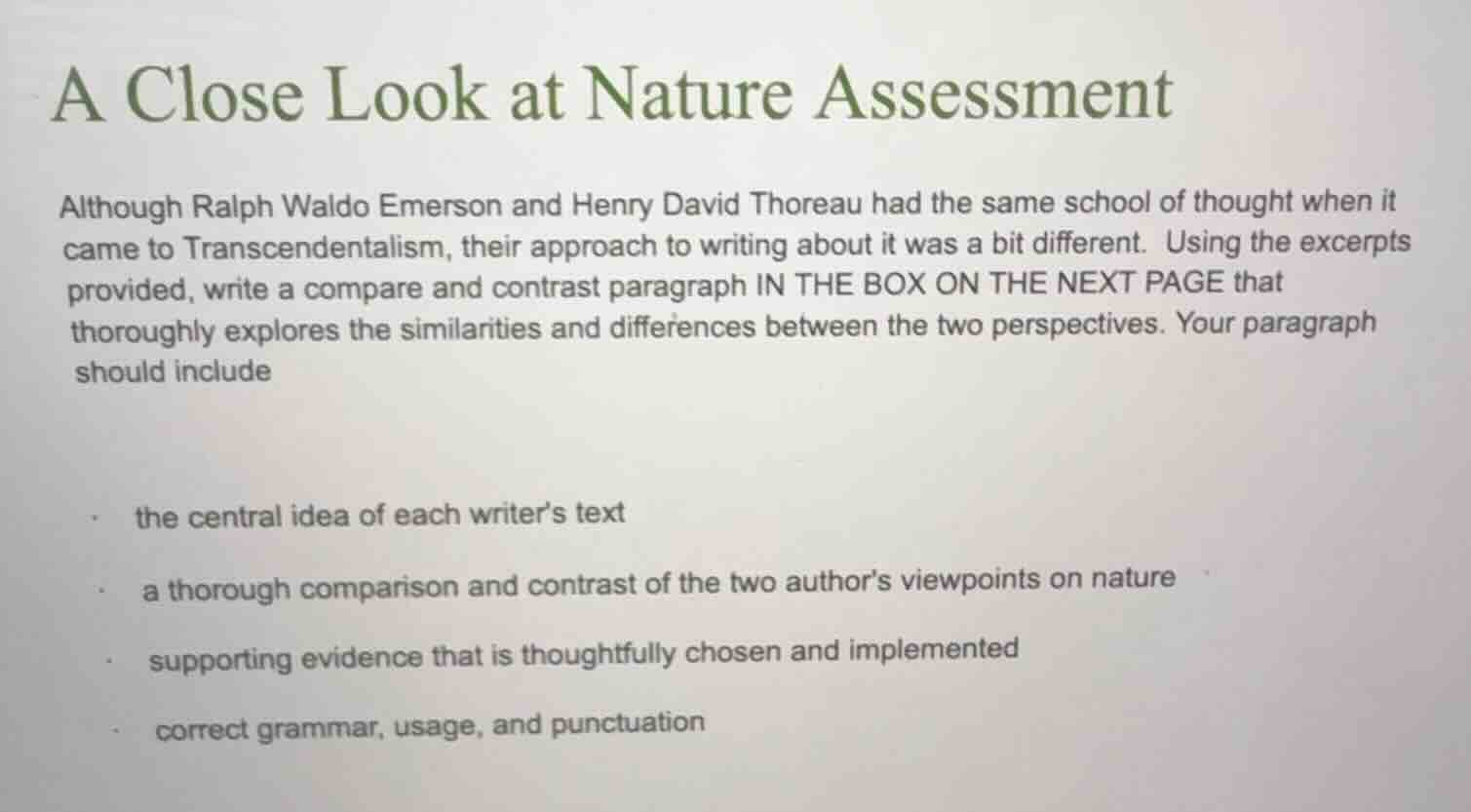
a close look at nature assessment
although ralph waldo emerson and henry david thoreau had the same school of thought when it
came to transcendentalism, their approach to writing about it was a bit different. using the excerpts
provided, write a compare and contrast paragraph in the box on the next page that
thoroughly explores the similarities and differences between the two perspectives. your paragraph
should include
- the central idea of each writer’s text
- a thorough comparison and contrast of the two author’s viewpoints on nature
- supporting evidence that is thoughtfully chosen and implemented
- correct grammar, usage, and punctuation
To complete this task, we first identify the central ideas of Emerson and Thoreau's works on Transcendentalism and nature. Emerson often emphasizes the spiritual connection between humans and nature, seeing nature as a source of universal truth and the "Over - Soul" (a spiritual force that connects all beings). Thoreau, on the other hand, focuses more on personal experience in nature, like his time at Walden Pond, using nature as a means to explore self - reliance and simple living.
For the comparison, both view nature as a vital, spiritual, and transformative force. Emerson sees it as a grand, universal spiritual entity, while Thoreau's perspective is more grounded in his direct, day - to - day interactions with nature. Emerson's writing is more philosophical and abstract, using broad concepts to explain the relationship between humanity and nature. Thoreau's writing is more narrative and personal, sharing his own experiences like building a cabin, growing beans, and observing the natural world around Walden Pond to convey his ideas about nature and self - sufficiency.
We can use evidence from their works: for Emerson, quotes from "Nature" about the "delightful mystery" of nature's connection to the soul; for Thoreau, descriptions from "Walden" about his life at the pond, such as "I went to the woods because I wished to live deliberately, to front only the essential facts of life, and see if I could not learn what it had to teach, and not, when I came to die, discover that I had not lived."
Then, we structure a paragraph that includes these central ideas, the comparison and contrast of their viewpoints, and the supporting evidence, while ensuring correct grammar, usage, and punctuation.

Snap & solve any problem in the app
Get step-by-step solutions on Sovi AI
Photo-based solutions with guided steps
Explore more problems and detailed explanations
Both Ralph Waldo Emerson and Henry David Thoreau were Transcendentalists, but their approaches to writing about nature differed. Emerson’s central idea in works like “Nature” is that nature is a spiritual mirror reflecting the “Over - Soul,” a universal force that unites all beings; he views nature as a source of profound, abstract truth, writing in a philosophical tone (e.g., “In the woods, we return to reason and faith”). Thoreau’s central idea, seen in “Walden,” is that nature enables self - discovery and simple living; he focuses on his personal, practical experiences (like living at Walden Pond) to show how nature fosters self - reliance (e.g., “I went to the woods... to learn what it had to teach”).
In terms of similarities, both believe nature is spiritually transformative and essential for human growth. However, Emerson’s perspective is more universal and abstract, framing nature as a cosmic spiritual entity. Thoreau’s is more personal and concrete, rooted in his daily interactions with nature. Emerson’s writing is broad and philosophical, while Thoreau’s is narrative and experiential, using his own life as evidence. Together, their works offer complementary views: Emerson’s grand philosophy and Thoreau’s intimate exploration, both celebrating nature’s power to inspire and transform.