QUESTION IMAGE
Question
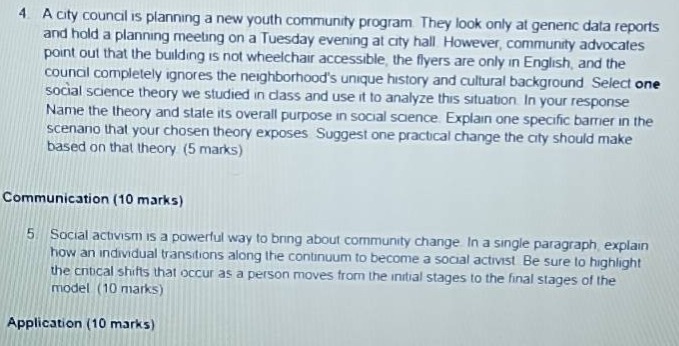
- a city council is planning a new youth community program. they look only at generic data reports and hold a planning meeting on a tuesday evening at city hall. however, community advocates point out that the building is not wheelchair accessible, the flyers are only in english, and the council completely ignores the neighborhoods unique history and cultural background. select one social science theory we studied in class and use it to analyze this situation. in your response: name the theory and state its overall purpose in social science. explain one specific barrier in the scenario that your chosen theory exposes. suggest one practical change the city should make based on that theory. (5 marks)
communication (10 marks)
- social activism is a powerful way to bring about community change. in a single paragraph, explain how an individual transitions along the continuum to become a social activist. be sure to highlight the critical shifts that occur as a person moves from the initial stages to the final stages of the model. (10 marks)
application (10 marks)
🆕 New Concept Discovered: Social Science Theories & Activism Models
Analyzing systemic barriers and the stages of civic engagement.
Step 1: Analyze Question 4 (Social Science Theory Application)
To analyze the city council's planning situation, we can apply Critical Theory (specifically focusing on intersectionality or anti-oppressive practice).
- Theory Name & Purpose: Critical Theory aims to identify, critique, and challenge power structures and systemic inequalities in society to promote social justice and emancipation.
- Specific Barrier Exposed: The theory exposes the barrier of systemic exclusion/ableism and linguistic exclusion. By holding meetings in a non-wheelchair-accessible building and distributing flyers only in English, the council privileges able-bodied, English-speaking residents while systematically silencing and excluding marginalized groups (people with physical disabilities and English language learners).
- Practical Change: The city council should adopt a participatory planning framework by moving meetings to fully accessible community spaces, translating all promotional materials into the primary languages spoken in the neighborhood, and actively consulting local community advocates before drafting program plans.
Step 2: Analyze Question 5 (Social Activism Continuum)
To explain how an individual transitions into a social activist, we use the developmental continuum of civic engagement (often moving from personally responsible to participatory, and finally to justice-oriented citizenship).
- Initial Stage: An individual starts at a passive or personally responsible level, where they follow laws and perhaps donate to charity but do not question the root causes of social issues.
- Critical Shift 1 (Awareness to Participation): The first major shift occurs when the individual experiences a "disorienting dilemma" or gains critical consciousness about an injustice. They transition to a participatory level, joining community groups, attending meetings, and organizing local efforts.
- Critical Shift 2 (Participation to Justice-Oriented Activism): The final shift occurs when the individual moves from merely addressing the symptoms of a problem to analyzing and challenging systemic, structural root causes. They become a social activist by organizing collective action, advocating for policy changes, and directly challenging established power dynamics to achieve systemic equity.

Snap & solve any problem in the app
Get step-by-step solutions on Sovi AI
Photo-based solutions with guided steps
Explore more problems and detailed explanations
Question 4 Response
- Theory and Purpose: Critical Theory. Its overall purpose in social science is to critique and challenge power structures, reveal hidden inequalities, and advocate for social change and liberation for marginalized groups.
- Specific Barrier Exposed: The theory exposes systemic exclusion and institutional barriers (specifically ableism and linguistic discrimination). By choosing a venue that is not wheelchair accessible and distributing flyers only in English, the council creates structural barriers that prevent disabled individuals and non-English speakers from participating in civic life.
- Practical Change: The city should implement an inclusive engagement policy. This includes moving all public meetings to fully accessible, transit-connected community venues, translating all outreach materials into the dominant languages of the neighborhood, and establishing a community advisory board representing the local demographic.
---
Question 5 Response
An individual transitions along the continuum to become a social activist by undergoing key cognitive and behavioral shifts. Initially, a person typically exists in a state of passive or personally responsible citizenship, where they focus on individual actions like recycling or obeying laws without questioning societal structures. The first critical shift occurs through critical consciousness, where exposure to injustice or systemic inequality prompts the individual to move into participatory citizenship. In this stage, they begin actively participating in community affairs, attending meetings, and addressing immediate local needs. The final, most crucial shift occurs when the individual transitions from merely managing the symptoms of an issue to analyzing its structural root causes. This justice-oriented shift transforms them into a social activist who engages in collective advocacy, challenges established power dynamics, and works to dismantle systemic barriers to achieve long-term institutional change.