QUESTION IMAGE
Question
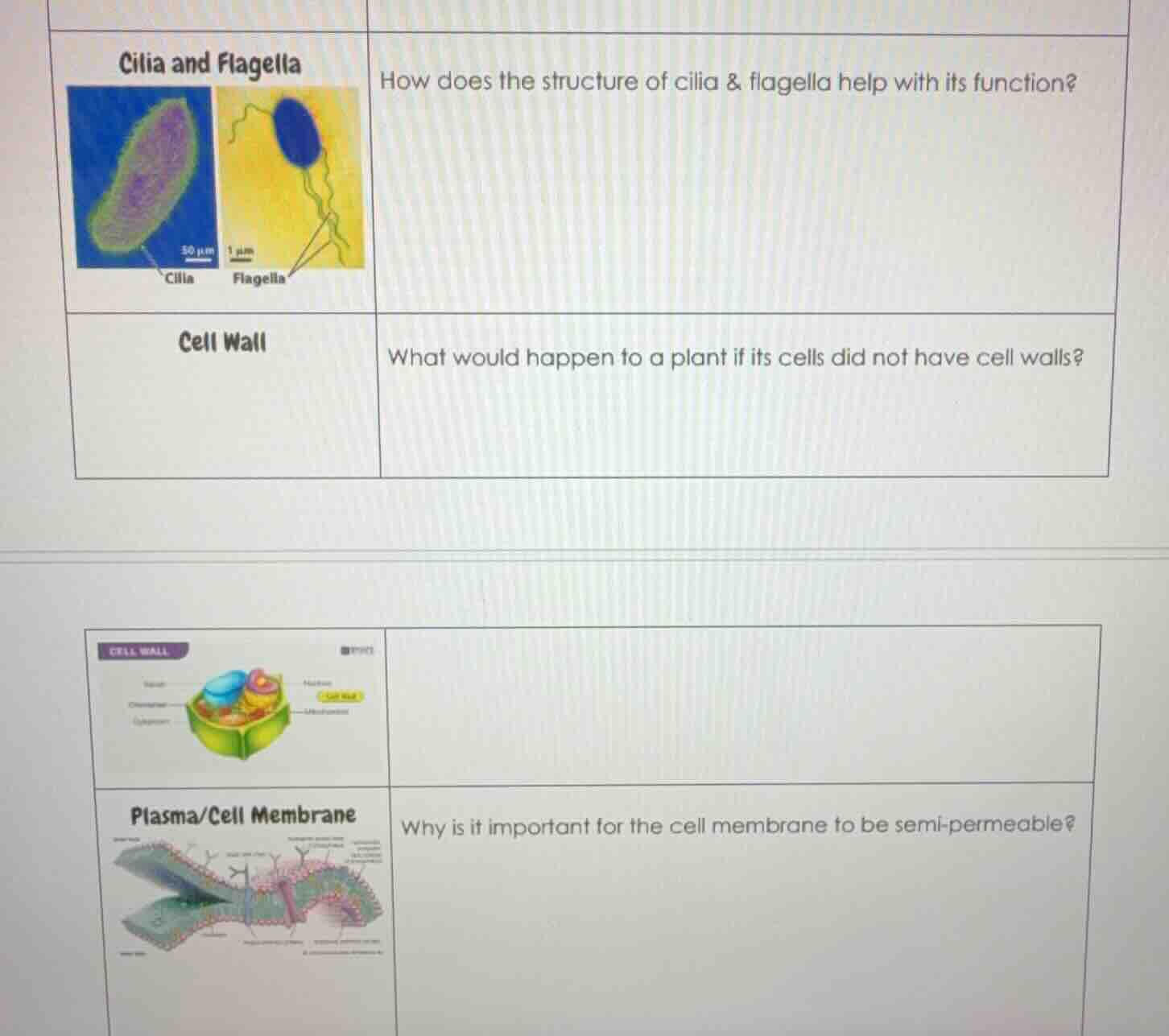
cilia and flagella
how does the structure of cilia & flagella help with its function?
cell wall
what would happen to a plant if its cells did not have cell walls?
plasma/cell membrane
why is it important for the cell membrane to be semi-permeable?
<pre_analysis>
{
"quality": "clear",
"question_count": 3,
"skills_matched": [
"direct_cot",
"explain_then_answer",
"quick"
],
"needs_drawing": false,
"concepts_used": [],
"new_concepts": [
"Cilia and Flagella Structure",
"Cell Wall Function",
"Cell Membrane Permeability"
],
"current_concepts": [
"Cilia and Flagella Structure",
"Cell Wall Function",
"Cell Membrane Permeability"
]
}
</pre_analysis>
<reasoning>
Structure and function of cilia and flagella
Cilia and flagella are hair-like, microtubule-based structures extending from the cell surface. Their flexible, whip-like or oar-like design allows them to beat or rotate, generating the mechanical force needed for cellular movement or moving fluids across the cell surface.
Consequences of lacking cell walls in plants
Without rigid cell walls made of cellulose, plant cells would lose structural support and turgor pressure, causing the plant to wilt and collapse. Additionally, the cells would be highly susceptible to bursting (lysis) in hypotonic environments.
Importance of semi-permeable cell membranes
A semi-permeable membrane allows the cell to selectively regulate the entry and exit of substances. This selective transport is essential for maintaining internal homeostasis, importing nutrients, exporting wastes, and preventing harmful substances from entering.
</reasoning>
<answer>
Question 1
Their hair-like, flexible microtubule structure allows them to beat or whip, generating the mechanical force needed for cellular movement or moving fluids across the cell surface.
Question 2
The plant would lose structural support and wilt or collapse, and its cells would easily burst (lyse) due to osmotic pressure.
Question 3
It allows the cell to selectively regulate what enters and exits, which is essential for maintaining internal homeostasis and importing nutrients while keeping out harmful substances.
</answer>
<post_analysis>
{
"subject": "Natural Science",
"question_type": "Multi-part",
"knowledge_point": [
"Natural Science",
"Biology",
"Cell Structure and Function"
]
}
</post_analysis>
Snap & solve any problem in the app
Get step-by-step solutions on Sovi AI
Photo-based solutions with guided steps
Explore more problems and detailed explanations
<pre_analysis>
{
"quality": "clear",
"question_count": 3,
"skills_matched": [
"direct_cot",
"explain_then_answer",
"quick"
],
"needs_drawing": false,
"concepts_used": [],
"new_concepts": [
"Cilia and Flagella Structure",
"Cell Wall Function",
"Cell Membrane Permeability"
],
"current_concepts": [
"Cilia and Flagella Structure",
"Cell Wall Function",
"Cell Membrane Permeability"
]
}
</pre_analysis>
<reasoning>
Structure and function of cilia and flagella
Cilia and flagella are hair-like, microtubule-based structures extending from the cell surface. Their flexible, whip-like or oar-like design allows them to beat or rotate, generating the mechanical force needed for cellular movement or moving fluids across the cell surface.
Consequences of lacking cell walls in plants
Without rigid cell walls made of cellulose, plant cells would lose structural support and turgor pressure, causing the plant to wilt and collapse. Additionally, the cells would be highly susceptible to bursting (lysis) in hypotonic environments.
Importance of semi-permeable cell membranes
A semi-permeable membrane allows the cell to selectively regulate the entry and exit of substances. This selective transport is essential for maintaining internal homeostasis, importing nutrients, exporting wastes, and preventing harmful substances from entering.
</reasoning>
<answer>
Question 1
Their hair-like, flexible microtubule structure allows them to beat or whip, generating the mechanical force needed for cellular movement or moving fluids across the cell surface.
Question 2
The plant would lose structural support and wilt or collapse, and its cells would easily burst (lyse) due to osmotic pressure.
Question 3
It allows the cell to selectively regulate what enters and exits, which is essential for maintaining internal homeostasis and importing nutrients while keeping out harmful substances.
</answer>
<post_analysis>
{
"subject": "Natural Science",
"question_type": "Multi-part",
"knowledge_point": [
"Natural Science",
"Biology",
"Cell Structure and Function"
]
}
</post_analysis>