QUESTION IMAGE
Question
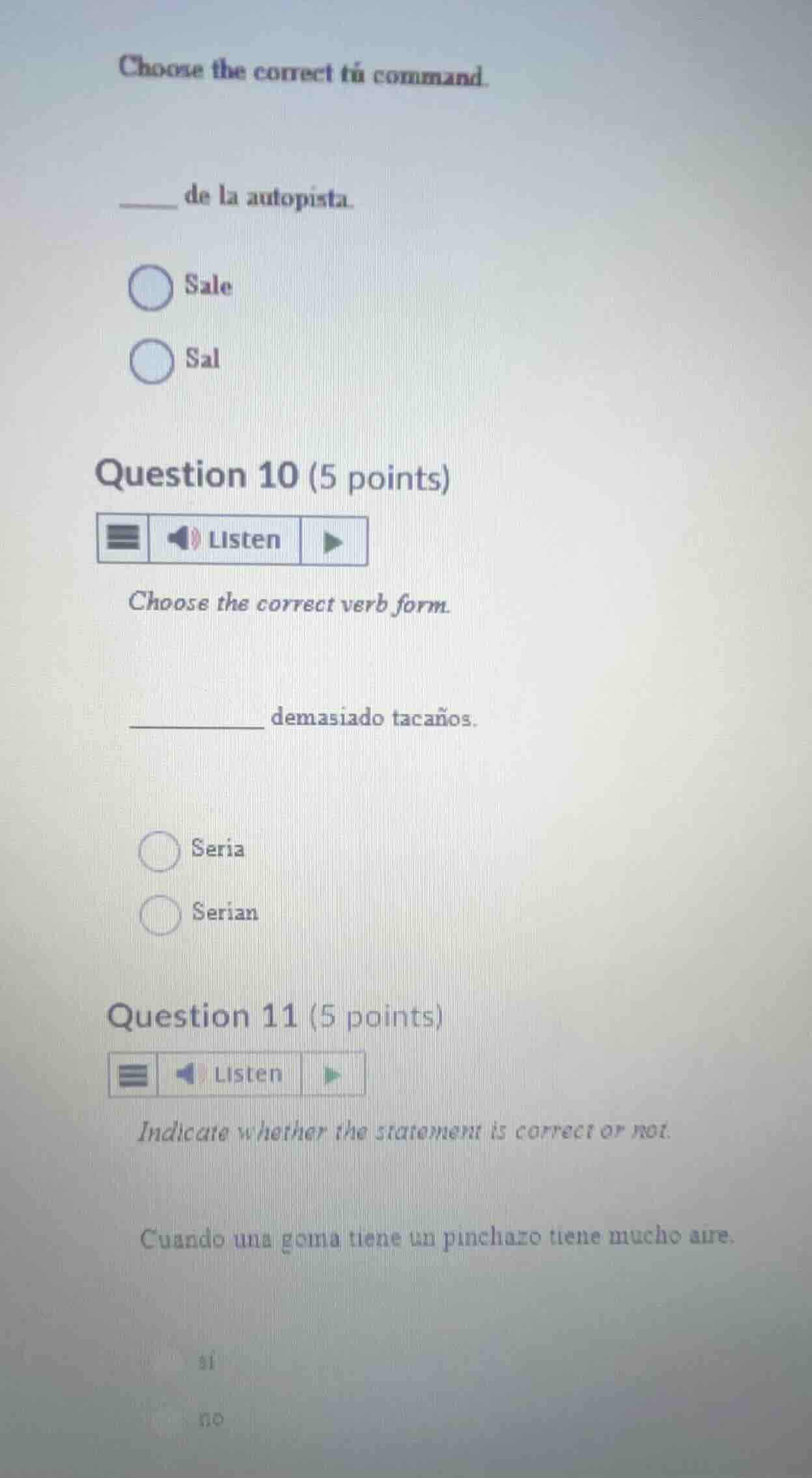
choose the correct tú command.
____ de la autopista.
sale
sal
question 10 (5 points)
choose the correct verb form.
____ demasiado tacaños.
seria
serian
question 11 (5 points)
indicate whether the statement is correct or not.
cuando una goma tiene un pinchazo tiene mucho aire.
sí
no
<pre_analysis>
{
"quality": "clear",
"question_count": 3,
"skills_matched": [
"direct_cot",
"multiple_choice_formatter",
"explain_then_answer",
"quick"
],
"needs_drawing": false,
"concepts_used": [
"Spanish Imperative Mood",
"Spanish Verb Conjugation",
"Spanish Driving Vocabulary"
],
"new_concepts": [
"Spanish Conditional Tense",
"Spanish Vocabulary"
],
"current_concepts": [
"Spanish Imperative Mood",
"Spanish Verb Conjugation",
"Spanish Driving Vocabulary",
"Spanish Conditional Tense",
"Spanish Vocabulary"
]
}
</pre_analysis>
<reasoning>
Analyze the first question (tú command)
The prompt asks to "Choose the correct tú command" for the sentence "\_\_\_\_\_ de la autopista."
The verb is salir (to leave/exit).
The informal affirmative tú command of salir is irregular: sal.
Analyze Question 10 (correct verb form)
The prompt asks to "Choose the correct verb form" for the sentence "\_\_\_\_\_ demasiado tacaños."
The adjective tacaños (stingy) is plural.
The verb forms provided are sería (singular conditional of ser) and serían (plural conditional of ser).
Since the subject must agree with the plural adjective tacaños, the plural verb form serían is correct.
Analyze Question 11 (correct or not)
The statement is: "Cuando una goma tiene un pinchazo tiene mucho aire." (When a tire has a puncture, it has a lot of air.)
A punctured tire loses air, so it does not have a lot of air.
Therefore, the statement is incorrect ("no").
</reasoning>
<answer>
Question 1
<mcq-option>Sale</mcq-option>
<mcq-correct>Sal</mcq-correct>
Question 10
<mcq-option>Seria</mcq-option>
<mcq-correct>Serian</mcq-correct>
Question 11
<mcq-option>sí</mcq-option>
<mcq-correct>no</mcq-correct>
</answer>
<post_analysis>
{
"subject": "Others",
"question_type": "Multiple Choice",
"knowledge_point": [
"Others",
"Spanish",
"Spanish Grammar and Vocabulary"
]
}
</post_analysis>
Snap & solve any problem in the app
Get step-by-step solutions on Sovi AI
Photo-based solutions with guided steps
Explore more problems and detailed explanations
<pre_analysis>
{
"quality": "clear",
"question_count": 3,
"skills_matched": [
"direct_cot",
"multiple_choice_formatter",
"explain_then_answer",
"quick"
],
"needs_drawing": false,
"concepts_used": [
"Spanish Imperative Mood",
"Spanish Verb Conjugation",
"Spanish Driving Vocabulary"
],
"new_concepts": [
"Spanish Conditional Tense",
"Spanish Vocabulary"
],
"current_concepts": [
"Spanish Imperative Mood",
"Spanish Verb Conjugation",
"Spanish Driving Vocabulary",
"Spanish Conditional Tense",
"Spanish Vocabulary"
]
}
</pre_analysis>
<reasoning>
Analyze the first question (tú command)
The prompt asks to "Choose the correct tú command" for the sentence "\_\_\_\_\_ de la autopista."
The verb is salir (to leave/exit).
The informal affirmative tú command of salir is irregular: sal.
Analyze Question 10 (correct verb form)
The prompt asks to "Choose the correct verb form" for the sentence "\_\_\_\_\_ demasiado tacaños."
The adjective tacaños (stingy) is plural.
The verb forms provided are sería (singular conditional of ser) and serían (plural conditional of ser).
Since the subject must agree with the plural adjective tacaños, the plural verb form serían is correct.
Analyze Question 11 (correct or not)
The statement is: "Cuando una goma tiene un pinchazo tiene mucho aire." (When a tire has a puncture, it has a lot of air.)
A punctured tire loses air, so it does not have a lot of air.
Therefore, the statement is incorrect ("no").
</reasoning>
<answer>
Question 1
<mcq-option>Sale</mcq-option>
<mcq-correct>Sal</mcq-correct>
Question 10
<mcq-option>Seria</mcq-option>
<mcq-correct>Serian</mcq-correct>
Question 11
<mcq-option>sí</mcq-option>
<mcq-correct>no</mcq-correct>
</answer>
<post_analysis>
{
"subject": "Others",
"question_type": "Multiple Choice",
"knowledge_point": [
"Others",
"Spanish",
"Spanish Grammar and Vocabulary"
]
}
</post_analysis>