QUESTION IMAGE
Question
check your knowledge
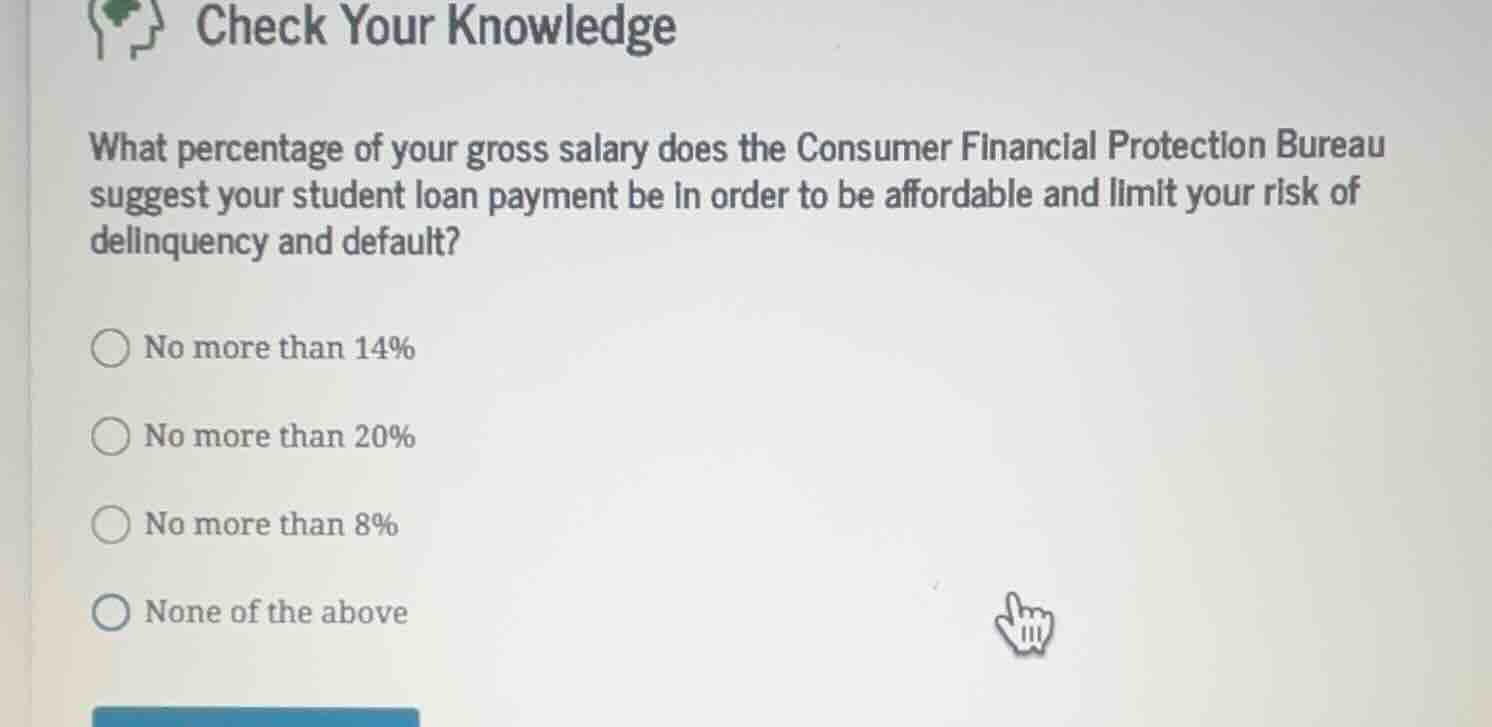
what percentage of your gross salary does the consumer financial protection bureau suggest your student loan payment be in order to be affordable and limit your risk of delinquency and default?
no more than 14%
no more than 20%
no more than 8%
none of the above
<pre_analysis>
{
"quality": "clear",
"question_count": 1,
"skills_matched": [
"direct_cot",
"multiple_choice_formatter",
"explain_then_answer",
"tutor"
],
"needs_drawing": false,
"concepts_used": [
"Student Loan Repayment"
],
"new_concepts": [
"CFPB Guidelines",
"Debt-to-Income Ratio"
],
"current_concepts": [
"Student Loan Repayment",
"CFPB Guidelines",
"Debt-to-Income Ratio"
]
}
</pre_analysis>
<reasoning>
Identify the CFPB recommendation
The Consumer Financial Protection Bureau (CFPB) provides guidelines to help borrowers manage student debt. To keep payments affordable and minimize delinquency risks, they recommend limiting monthly student loan payments to a specific percentage of gross monthly income.
Recall the standard threshold
Using the Student Loan Repayment knowledge point, we recall that the CFPB suggests keeping student loan payments at or below 8% of your gross monthly salary. This is a standard benchmark used to ensure that borrowers have sufficient remaining income to cover other essential living expenses and savings goals.
Evaluate the given options
We compare the 8% guideline against the provided multiple-choice options:
- "No more than 14%" is higher than the recommended threshold.
- "No more than 20%" is generally considered too high for student debt alone.
- "No more than 8%" matches the CFPB recommendation perfectly.
- "None of the above" is incorrect because a matching option exists.
</reasoning>
<answer>
<mcq-option>(A) No more than 14%</mcq-option>
<mcq-option>(B) No more than 20%</mcq-option>
<mcq-correct>(C) No more than 8%</mcq-correct>
<mcq-option>(D) None of the above</mcq-option>
</answer>
<post_analysis>
{
"subject": "Business",
"question_type": "Multiple Choice",
"knowledge_point": [
"Business",
"Finance",
"Personal Finance"
]
}
</post_analysis>
Snap & solve any problem in the app
Get step-by-step solutions on Sovi AI
Photo-based solutions with guided steps
Explore more problems and detailed explanations
<pre_analysis>
{
"quality": "clear",
"question_count": 1,
"skills_matched": [
"direct_cot",
"multiple_choice_formatter",
"explain_then_answer",
"tutor"
],
"needs_drawing": false,
"concepts_used": [
"Student Loan Repayment"
],
"new_concepts": [
"CFPB Guidelines",
"Debt-to-Income Ratio"
],
"current_concepts": [
"Student Loan Repayment",
"CFPB Guidelines",
"Debt-to-Income Ratio"
]
}
</pre_analysis>
<reasoning>
Identify the CFPB recommendation
The Consumer Financial Protection Bureau (CFPB) provides guidelines to help borrowers manage student debt. To keep payments affordable and minimize delinquency risks, they recommend limiting monthly student loan payments to a specific percentage of gross monthly income.
Recall the standard threshold
Using the Student Loan Repayment knowledge point, we recall that the CFPB suggests keeping student loan payments at or below 8% of your gross monthly salary. This is a standard benchmark used to ensure that borrowers have sufficient remaining income to cover other essential living expenses and savings goals.
Evaluate the given options
We compare the 8% guideline against the provided multiple-choice options:
- "No more than 14%" is higher than the recommended threshold.
- "No more than 20%" is generally considered too high for student debt alone.
- "No more than 8%" matches the CFPB recommendation perfectly.
- "None of the above" is incorrect because a matching option exists.
</reasoning>
<answer>
<mcq-option>(A) No more than 14%</mcq-option>
<mcq-option>(B) No more than 20%</mcq-option>
<mcq-correct>(C) No more than 8%</mcq-correct>
<mcq-option>(D) None of the above</mcq-option>
</answer>
<post_analysis>
{
"subject": "Business",
"question_type": "Multiple Choice",
"knowledge_point": [
"Business",
"Finance",
"Personal Finance"
]
}
</post_analysis>