QUESTION IMAGE
Question
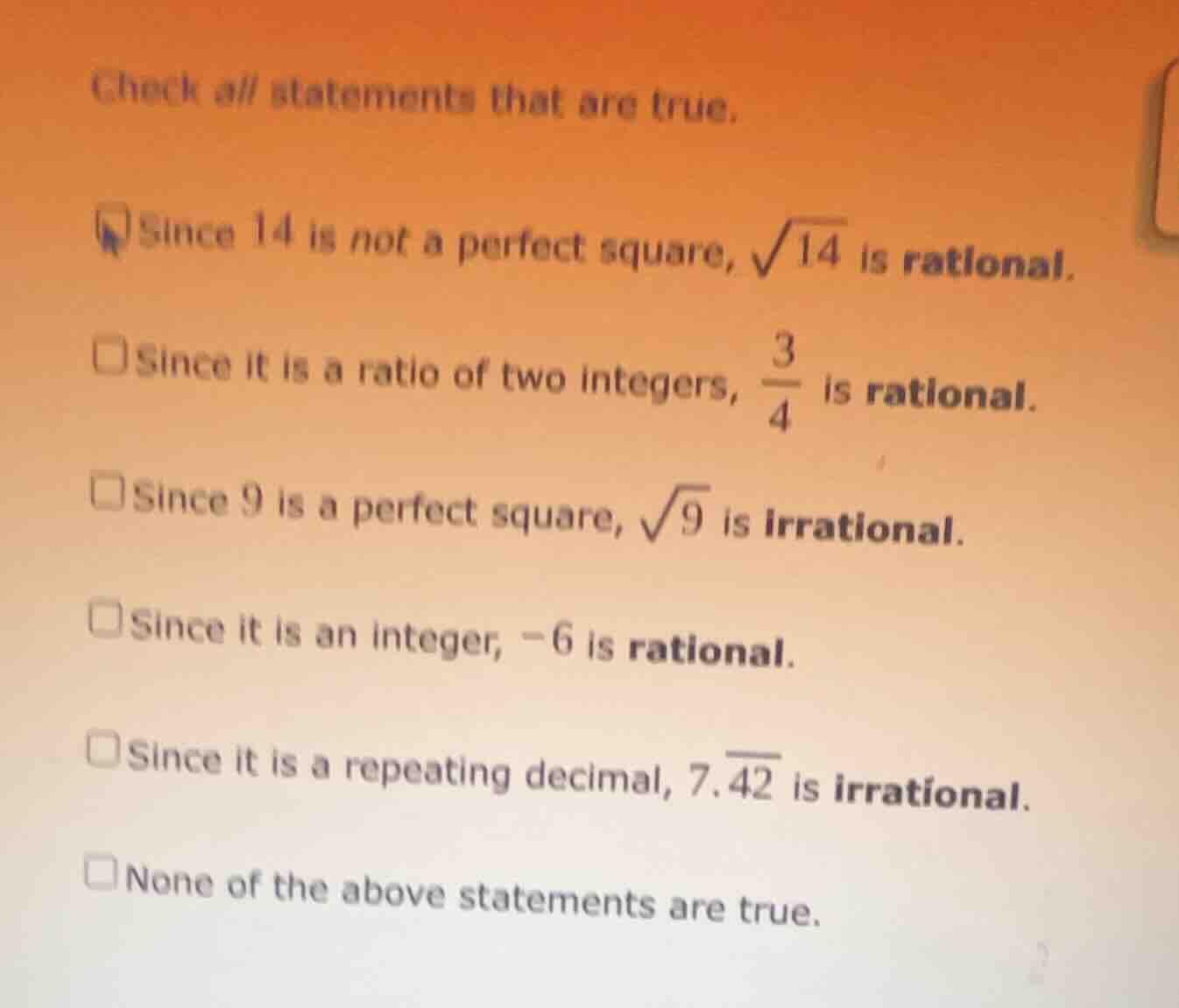
check all statements that are true.
since 14 is not a perfect square, \\(\sqrt{14}\\) is rational.
since it is a ratio of two integers, \\(\frac{3}{4}\\) is rational.
since 9 is a perfect square, \\(\sqrt{9}\\) is irrational.
since it is an integer, \\(-6\\) is rational.
since it is a repeating decimal, \\(7.\overline{42}\\) is irrational.
none of the above statements are true.
Step1: Define rational/irrational numbers
Rational numbers can be written as $\frac{p}{q}$ where $p,q$ are integers, $q
eq0$; they include integers, fractions, terminating/repeating decimals. Irrational numbers cannot be written this way, e.g., square roots of non-perfect squares.
Step2: Evaluate statement 1
$\sqrt{14}$: 14 is not a perfect square, so $\sqrt{14}$ is irrational. Statement is false.
Step3: Evaluate statement 2
$\frac{3}{4}$: Ratio of integers 3 and 4, fits rational definition. Statement is true.
Step4: Evaluate statement 3
$\sqrt{9}=3$, an integer (rational). Statement is false.
Step5: Evaluate statement 4
$-6$: Integers are rational ($\frac{-6}{1}$). Statement is true.
Step6: Evaluate statement 5
$7.\overline{42}$: Repeating decimals are rational. Statement is false.
Step7: Evaluate final option
True statements exist, so this is false.

Snap & solve any problem in the app
Get step-by-step solutions on Sovi AI
Photo-based solutions with guided steps
Explore more problems and detailed explanations
- Since it is a ratio of two integers, $\frac{3}{4}$ is rational.
- Since it is an integer, $-6$ is rational.