QUESTION IMAGE
Question
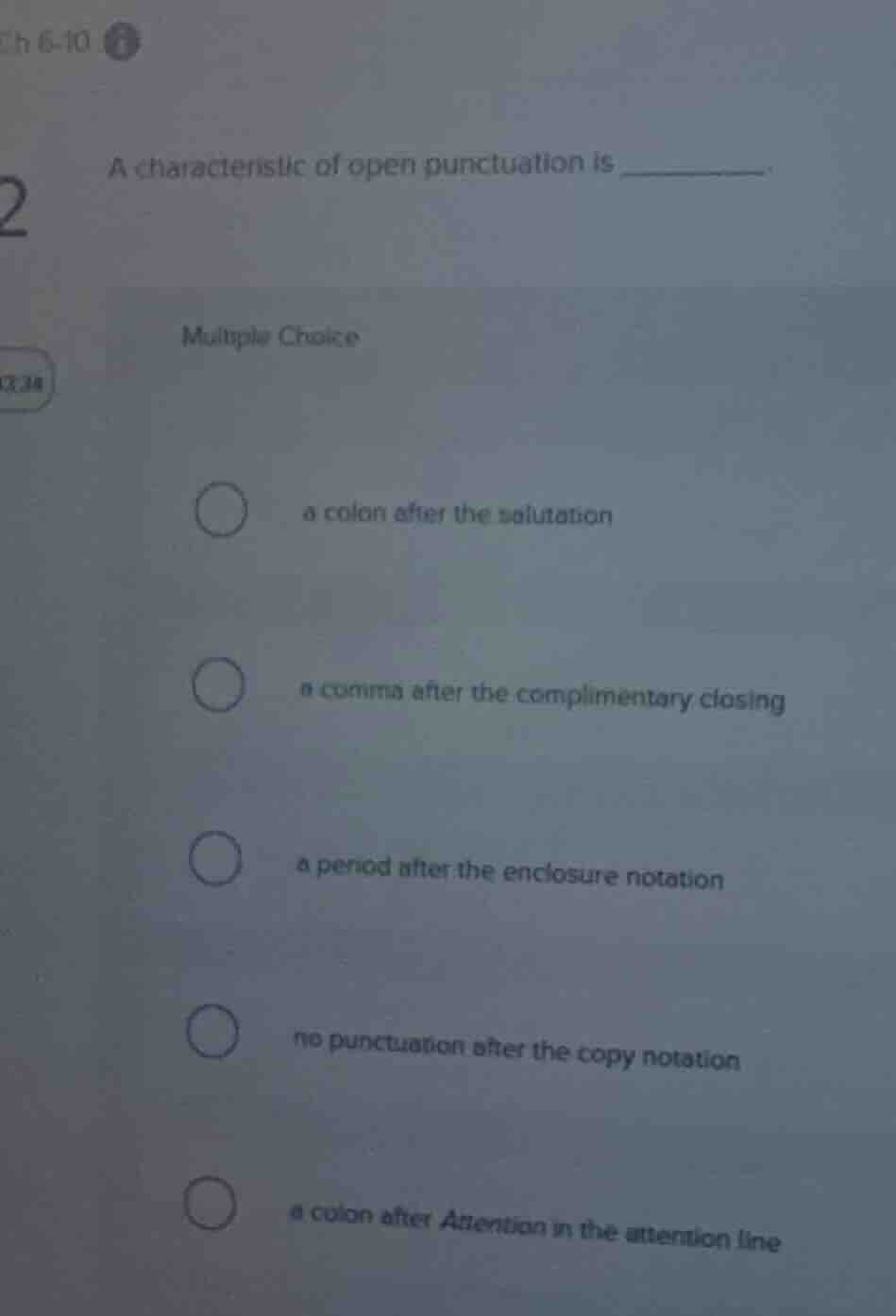
a characteristic of open punctuation is _______
multiple choice
a colon after the salutation
a comma after the complimentary closing
a period after the enclosure notation
no punctuation after the copy notation
a colon after attention in the attention line
Define open punctuation style
In professional business correspondence, punctuation styles dictate how salutations and complimentary closings are formatted. Professional Correspondence guidelines define "open punctuation" as a style where no punctuation marks (such as colons or commas) are used after the salutation or the complimentary closing.
Compare with mixed punctuation
By contrast, "mixed punctuation" (the most common style) requires a colon after the salutation (e.g., Dear Mr. Smith:) and a comma after the complimentary closing (e.g., Sincerely,).
Evaluate the given options
- a colon after the salutation: This is a characteristic of mixed punctuation, not open punctuation.
- a comma after the complimentary closing: This is a characteristic of mixed punctuation, not open punctuation.
- a period after the enclosure notation: Enclosure notations do not typically end with a period in standard business letter formats, and this is not the defining characteristic of open punctuation.
- no punctuation after the copy notation: Copy notations (such as cc:) generally retain their internal punctuation, and this does not define the open punctuation style.
- a colon after Attention in the attention line: In open punctuation, the attention line does not use a colon after the word "Attention" (e.g., Attention John Doe instead of Attention: John Doe). This omission of punctuation is a direct characteristic of the open punctuation style.

Snap & solve any problem in the app
Get step-by-step solutions on Sovi AI
Photo-based solutions with guided steps
Explore more problems and detailed explanations
- a colon after the salutation
- a comma after the complimentary closing
- a period after the enclosure notation
- no punctuation after the copy notation
- a colon after Attention in the attention line (Correct answer)