QUESTION IMAGE
Question
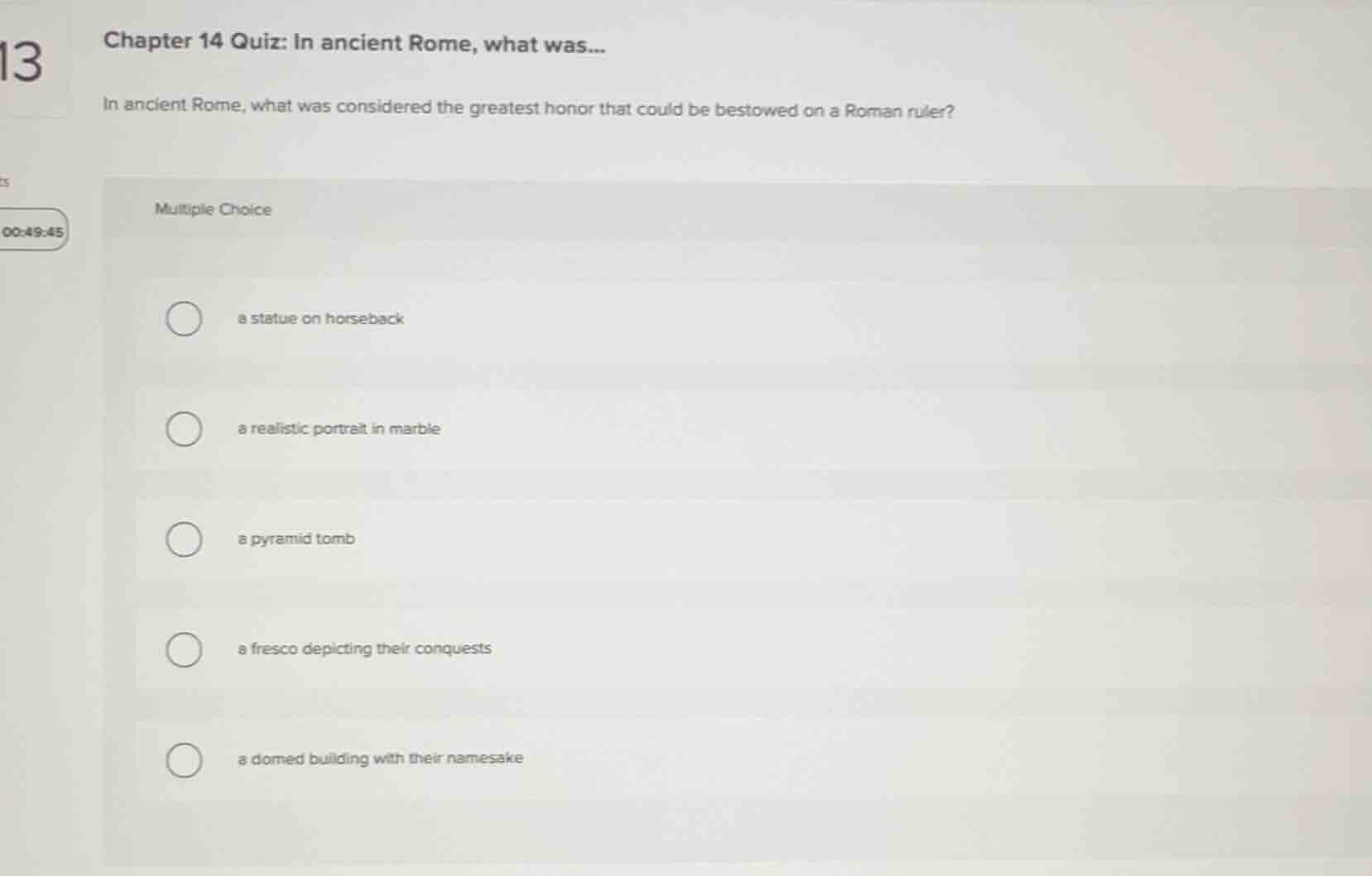
chapter 14 quiz: in ancient rome, what was...
in ancient rome, what was considered the greatest honor that could be bestowed on a roman ruler?
multiple choice
a statue on horseback
a realistic portrait in marble
a pyramid tomb
a fresco depicting their conquests
a domed building with their namesake
Identify the historical context
In ancient Rome, public honors were highly regulated and served as powerful political tools. The question asks for the greatest honor that could be bestowed on a Roman ruler in terms of artistic or architectural commemoration.
Analyze the options
- A statue on horseback (Equestrian statue): In Roman culture, an equestrian statue (such as the famous surviving Equestrian Statue of Marcus Aurelius) was the ultimate symbol of military leadership, authority, and supreme imperial power. Bestowing an equestrian statue was considered the highest honor.
- A realistic portrait in marble: While common for patricians and emperors (veristic or idealized portraiture), it was a standard commemorative practice rather than the single greatest honor.
- A pyramid tomb: This is characteristic of ancient Egyptian rulers, not Roman rulers (with rare exceptions like the Pyramid of Cestius, which was a private tomb, not a standard imperial honor).
- A fresco depicting their conquests: Frescoes were interior wall decorations and did not carry the supreme public prestige of monumental bronze or marble statuary.
- A domed building with their namesake: While emperors built grand monuments, a public equestrian statue remained the most exclusive and traditional honor decreed by the Senate.
Connect to mastered concepts
Using the Roman Architecture and Ancient Greek Art knowledge points, we can trace how Roman commemorative practices evolved from Greek athletic and civic statuary into grand imperial monuments. The bronze equestrian monument represented the pinnacle of these public honors, combining military triumph with civic leadership.

Snap & solve any problem in the app
Get step-by-step solutions on Sovi AI
Photo-based solutions with guided steps
Explore more problems and detailed explanations
- (A) a statue on horseback (Correct answer)
- (B) a realistic portrait in marble
- (C) a pyramid tomb
- (D) a fresco depicting their conquests
- (E) a domed building with their namesake