QUESTION IMAGE
Question
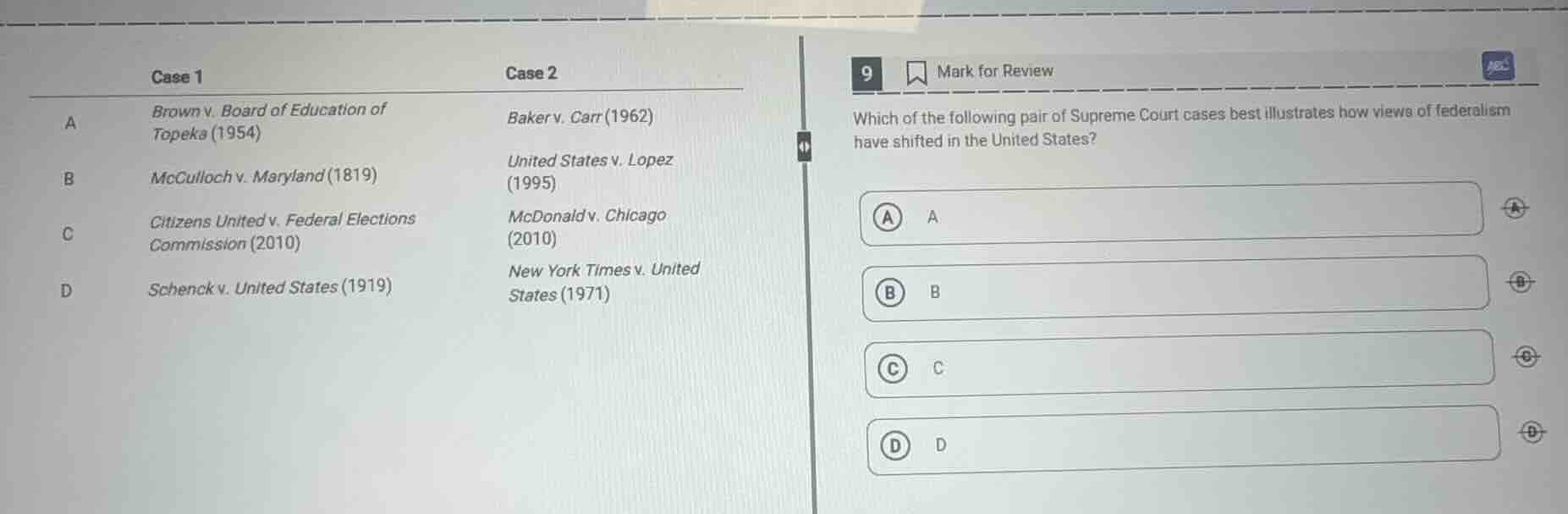
case 1 case 2
a brown v. board of education of topeka (1954) baker v. carr (1962)
b mcculloch v. maryland (1819) united states v. lopez (1995)
c citizens united v. federal elections commission (2010) mcdonald v. chicago (2010)
d schenck v. united states (1919) new york times v. united states (1971)
9 mark for review
which of the following pair of supreme court cases best illustrates how views of federalism have shifted in the united states?
a a
b b
c c
d d
Brief Explanations
- Option A: Brown v. Board of Ed (1954) focused on school desegregation (equal protection), while Baker v. Carr (1962) addressed voting rights (one-person, one-vote). Neither centers on federalism shifts.
- Option B: McCulloch v. Maryland (1819) expanded federal power, ruling Congress has implied powers and states cannot tax federal institutions. United States v. Lopez (1995) restricted federal power, striking down a federal gun law under the Commerce Clause, marking a shift back to stronger state authority in federalism.
- Option C: Citizens United v. FEC (2010) dealt with campaign finance (free speech), and McDonald v. Chicago (2010) applied the 2nd Amendment to states. These do not illustrate federalism shifts.
- Option D: Schenck v. United States (1919) limited free speech during wartime, and New York Times v. United States (1971) upheld press freedom (Pentagon Papers). These relate to civil liberties, not federalism.

Snap & solve any problem in the app
Get step-by-step solutions on Sovi AI
Photo-based solutions with guided steps
Explore more problems and detailed explanations
B. McCulloch v. Maryland (1819); United States v. Lopez (1995)