QUESTION IMAGE
Question
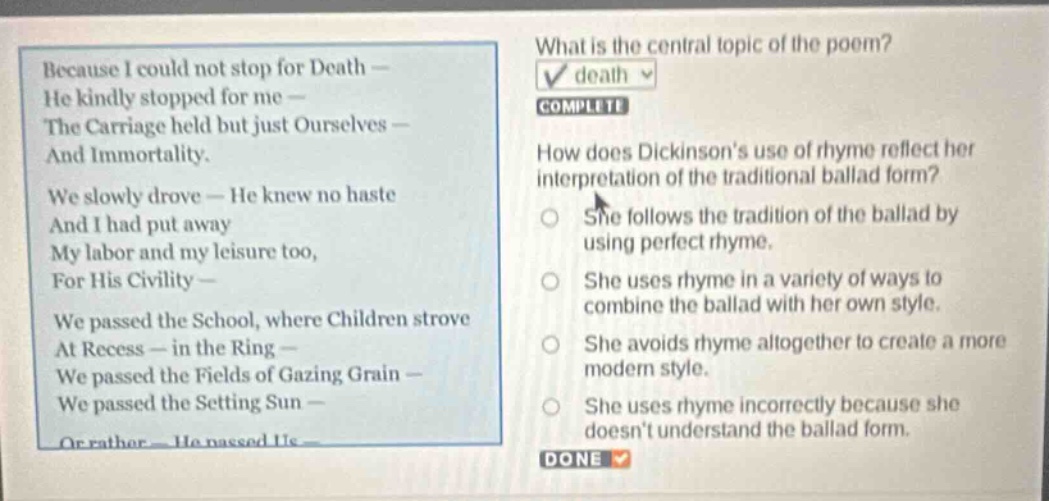
because i could not stop for death -
he kindly stopped for me -
the carriage held but just ourselves -
and immortality.
we slowly drove - he knew no haste
and i had put away
my labor and my leisure too,
for his civility -
we passed the school, where children strove
at recess - in the ring -
we passed the fields of gazing grain -
we passed the setting sun -
or rather - he passed us -
what is the central topic of the poem?
death
how does dickinsons use of rhyme reflect her interpretation of the traditional ballad form?
- she follows the tradition of the ballad by using perfect rhyme.
- she uses rhyme in a variety of ways to combine the ballad with her own style.
- she avoids rhyme altogether to create a more modern style.
- she uses rhyme incorrectly because she doesnt understand the ballad form.
⚡ Using what you learned: close reading methods for poetic texts
Step 1: Analyze the traditional ballad form
The traditional ballad stanza is typically a quatrain (four-line stanza) written in alternating lines of iambic tetrameter and iambic trimeter. Traditionally, it follows an ABCB rhyme scheme with perfect, exact rhymes.
Step 2: Examine Dickinson's rhyme scheme in the poem
Looking at the provided stanzas of Emily Dickinson's "Because I could not stop for Death":
- In the first stanza, the end words are Death (A), me (B), Ourselves (C), and Immortality (B). The rhyme between me and Immortality is an identical/slant rhyme rather than a traditional perfect rhyme.
- In the second stanza, the end words are haste (A), away (B), too (C), and Civility (B). Here, away and Civility do not form a perfect rhyme; they form a slant rhyme (or slant/imperfect rhyme).
- In the third stanza, the end words are strove (A), Ring (B), Grain (C), and Sun (B). The words Ring and Sun do not rhyme perfectly, but share a subtle nasal consonant sound (slant rhyme).
Step 3: Evaluate the options
- Option 1: "She follows the tradition of the ballad by using perfect rhyme." — Incorrect, as she frequently uses slant (imperfect) rhymes instead of perfect rhymes.
- Option 2: "She uses rhyme in a variety of ways to combine the ballad with her own style." — Correct. Dickinson adapts the traditional ABCB ballad structure by incorporating slant rhymes and varying her rhyme choices, blending the classic form with her unique poetic voice.
- Option 3: "She avoids rhyme altogether to create a more modern style." — Incorrect, she does use rhyme, just not exclusively perfect rhyme.
- Option 4: "She uses rhyme incorrectly because she doesn't understand the ballad form." — Incorrect, her variations are deliberate artistic choices, not mistakes.

Snap & solve any problem in the app
Get step-by-step solutions on Sovi AI
Photo-based solutions with guided steps
Explore more problems and detailed explanations
She uses rhyme in a variety of ways to combine the ballad with her own style.