Sovi.AI - AI Math Tutor

Scan to solve math questions

QUESTION IMAGE

based on \economy\ from walden, which most likely describes thoreaus at…

Question

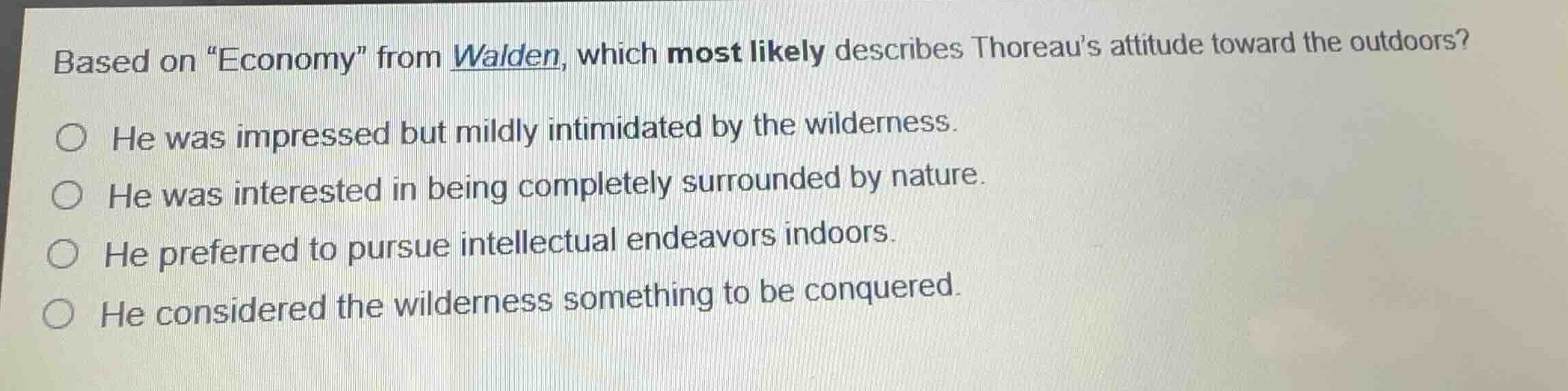
based on \economy\ from walden, which most likely describes thoreaus attitude toward the outdoors?

he was impressed but mildly intimidated by the wilderness.
he was interested in being completely surrounded by nature.
he preferred to pursue intellectual endeavors indoors.
he considered the wilderness something to be conquered.

Explanation:

Response

<pre_analysis>
{
"quality": "clear",
"question_count": 1,
"skills_matched": [
"direct_cot",
"multiple_choice_formatter",
"explain_then_answer",
"tutor"
],
"needs_drawing": false,
"concepts_used": [
"Transcendentalist Philosophy"
],
"new_concepts": [
"Walden Analysis",
"Thoreau's Philosophy"
],
"current_concepts": [
"Transcendentalist Philosophy",
"Walden Analysis",
"Thoreau's Philosophy"
]
}
</pre_analysis>

<reasoning>

Analyze Thoreau's core philosophy

In "Economy" from Walden, Henry David Thoreau outlines his experiment in simple living. As a key figure in Transcendentalist Philosophy, his primary goal was to strip away the non-essential, artificial complications of modern society to discover the essential facts of life.

Evaluate his relationship with nature

Thoreau did not view nature as a hostile force to be feared or conquered, nor did he prefer to stay indoors. Instead, he sought a direct, deliberate, and immersive relationship with the natural world, believing that living simply in nature allows for spiritual and intellectual clarity.

Assess the given options

  • "He was impressed but mildly intimidated by the wilderness": Incorrect. Thoreau did not express intimidation; he felt at home and at peace in nature.
  • "He was interested in being completely surrounded by nature": Correct. This aligns perfectly with his decision to build a cabin by Walden Pond to live deliberately and intimately with nature.
  • "He preferred to pursue intellectual endeavors indoors": Incorrect. He believed true intellectual and spiritual growth occurred through outdoor contemplation and physical labor.
  • "He considered the wilderness something to be conquered": Incorrect. Conquering nature is an industrial/utilitarian mindset, which directly opposes Transcendentalist values of harmony with nature.

</reasoning>

<answer>
<mcq-option>He was impressed but mildly intimidated by the wilderness.</mcq-option>
<mcq-correct>He was interested in being completely surrounded by nature.</mcq-correct>
<mcq-option>He preferred to pursue intellectual endeavors indoors.</mcq-option>
<mcq-option>He considered the wilderness something to be conquered.</mcq-option>
</answer>

<post_analysis>
{
"subject": "Social Science",
"question_type": "Multiple Choice",
"knowledge_point": [
"Social Science",
"Others",
"Transcendentalist Philosophy"
]
}
</post_analysis>

Answer:

<pre_analysis>
{
"quality": "clear",
"question_count": 1,
"skills_matched": [
"direct_cot",
"multiple_choice_formatter",
"explain_then_answer",
"tutor"
],
"needs_drawing": false,
"concepts_used": [
"Transcendentalist Philosophy"
],
"new_concepts": [
"Walden Analysis",
"Thoreau's Philosophy"
],
"current_concepts": [
"Transcendentalist Philosophy",
"Walden Analysis",
"Thoreau's Philosophy"
]
}
</pre_analysis>

<reasoning>

Analyze Thoreau's core philosophy

In "Economy" from Walden, Henry David Thoreau outlines his experiment in simple living. As a key figure in Transcendentalist Philosophy, his primary goal was to strip away the non-essential, artificial complications of modern society to discover the essential facts of life.

Evaluate his relationship with nature

Thoreau did not view nature as a hostile force to be feared or conquered, nor did he prefer to stay indoors. Instead, he sought a direct, deliberate, and immersive relationship with the natural world, believing that living simply in nature allows for spiritual and intellectual clarity.

Assess the given options

  • "He was impressed but mildly intimidated by the wilderness": Incorrect. Thoreau did not express intimidation; he felt at home and at peace in nature.
  • "He was interested in being completely surrounded by nature": Correct. This aligns perfectly with his decision to build a cabin by Walden Pond to live deliberately and intimately with nature.
  • "He preferred to pursue intellectual endeavors indoors": Incorrect. He believed true intellectual and spiritual growth occurred through outdoor contemplation and physical labor.
  • "He considered the wilderness something to be conquered": Incorrect. Conquering nature is an industrial/utilitarian mindset, which directly opposes Transcendentalist values of harmony with nature.

</reasoning>

<answer>
<mcq-option>He was impressed but mildly intimidated by the wilderness.</mcq-option>
<mcq-correct>He was interested in being completely surrounded by nature.</mcq-correct>
<mcq-option>He preferred to pursue intellectual endeavors indoors.</mcq-option>
<mcq-option>He considered the wilderness something to be conquered.</mcq-option>
</answer>

<post_analysis>
{
"subject": "Social Science",
"question_type": "Multiple Choice",
"knowledge_point": [
"Social Science",
"Others",
"Transcendentalist Philosophy"
]
}
</post_analysis>