QUESTION IMAGE
Question
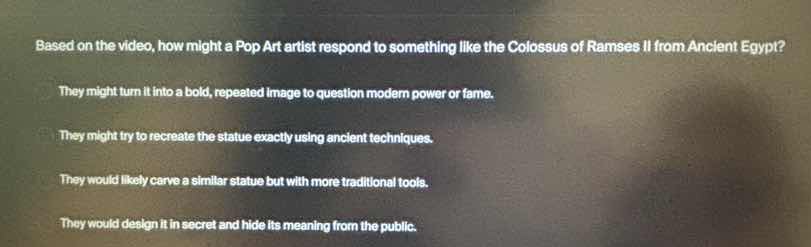
based on the video, how might a pop art artist respond to something like the colossus of ramses ii from ancient egypt?
they might turn it into a bold, repeated image to question modern power or fame.
they might try to recreate the statue exactly using ancient techniques.
they would likely carve a similar statue but with more traditional tools.
they would design it in secret and hide its meaning from the public.
<pre_analysis>
{
"quality": "clear",
"question_count": 1,
"skills_matched": [
"direct_cot",
"multiple_choice_formatter",
"explain_then_answer",
"quick"
],
"needs_drawing": false,
"concepts_used": [
"Art Movements",
"Art Analysis"
],
"new_concepts": [
"Pop Art",
"Artistic Appropriation"
],
"current_concepts": [
"Art Movements",
"Art Analysis",
"Pop Art",
"Artistic Appropriation"
]
}
</pre_analysis>
<reasoning>
Analyze Pop Art characteristics
Pop Art utilizes mass-media imagery, repetition, and bold commercial aesthetics to critique or highlight contemporary culture, celebrity, power, and consumerism.
Evaluate the options against Pop Art practices
- Option 1 aligns with Pop Art's signature techniques (bold, repeated imagery like Andy Warhol's silkscreens) and thematic concerns (questioning fame, power, and icons).
- Options 2 and 3 describe traditional or academic replication methods, which contradict Pop Art's focus on modern mass production.
- Option 4 contradicts the public, mass-accessible nature of Pop Art.
</reasoning>
<answer>
<mcq-correct>They might turn it into a bold, repeated image to question modern power or fame.</mcq-correct>
<mcq-option>They might try to recreate the statue exactly using ancient techniques.</mcq-option>
<mcq-option>They would likely carve a similar statue but with more traditional tools.</mcq-option>
<mcq-option>They would design it in secret and hide its meaning from the public.</mcq-option>
</answer>
<post_analysis>
{
"subject": "Arts",
"question_type": "Multiple Choice",
"knowledge_point": [
"Arts",
"Art History",
"Pop Art"
]
}
</post_analysis>
Snap & solve any problem in the app
Get step-by-step solutions on Sovi AI
Photo-based solutions with guided steps
Explore more problems and detailed explanations
<pre_analysis>
{
"quality": "clear",
"question_count": 1,
"skills_matched": [
"direct_cot",
"multiple_choice_formatter",
"explain_then_answer",
"quick"
],
"needs_drawing": false,
"concepts_used": [
"Art Movements",
"Art Analysis"
],
"new_concepts": [
"Pop Art",
"Artistic Appropriation"
],
"current_concepts": [
"Art Movements",
"Art Analysis",
"Pop Art",
"Artistic Appropriation"
]
}
</pre_analysis>
<reasoning>
Analyze Pop Art characteristics
Pop Art utilizes mass-media imagery, repetition, and bold commercial aesthetics to critique or highlight contemporary culture, celebrity, power, and consumerism.
Evaluate the options against Pop Art practices
- Option 1 aligns with Pop Art's signature techniques (bold, repeated imagery like Andy Warhol's silkscreens) and thematic concerns (questioning fame, power, and icons).
- Options 2 and 3 describe traditional or academic replication methods, which contradict Pop Art's focus on modern mass production.
- Option 4 contradicts the public, mass-accessible nature of Pop Art.
</reasoning>
<answer>
<mcq-correct>They might turn it into a bold, repeated image to question modern power or fame.</mcq-correct>
<mcq-option>They might try to recreate the statue exactly using ancient techniques.</mcq-option>
<mcq-option>They would likely carve a similar statue but with more traditional tools.</mcq-option>
<mcq-option>They would design it in secret and hide its meaning from the public.</mcq-option>
</answer>
<post_analysis>
{
"subject": "Arts",
"question_type": "Multiple Choice",
"knowledge_point": [
"Arts",
"Art History",
"Pop Art"
]
}
</post_analysis>