QUESTION IMAGE
Question
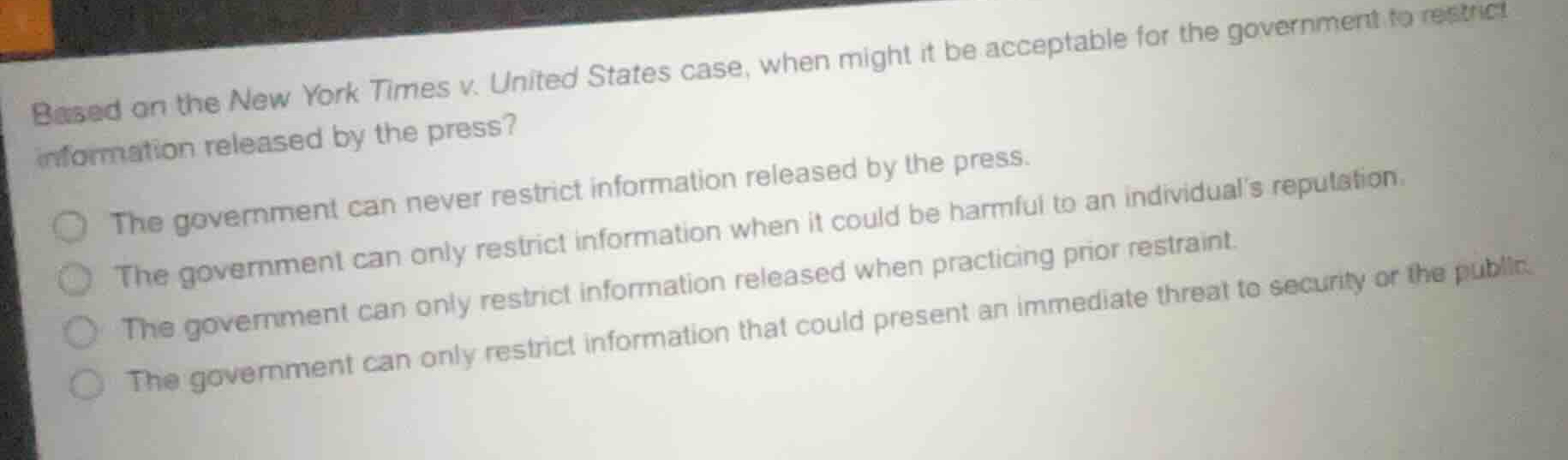
based on the new york times v. united states case, when might it be acceptable for the government to restrict information released by the press?
the government can never restrict information released by the press.
the government can only restrict information when it could be harmful to an individuals reputation.
the government can only restrict information released when practicing prior restraint.
the government can only restrict information that could present an immediate threat to security or the public.
Analyze the constitutional question
The question asks when the government might restrict press information based on New York Times Co. v. United States (1971).
Evaluate the legal precedent
In this landmark ruling, the Supreme Court addressed "prior restraint" regarding the publication of the Pentagon Papers. The Court established a heavy presumption against the constitutional validity of any government-imposed prior restraint on expression.
Determine the narrow exception
The Court ruled that to justify prior restraint, the government must prove publication would cause "grave, direct, and immediate danger" to national security or the public.
Compare the given options
- Option 1 suggests a total ban on restriction, which is incorrect because narrow exceptions exist.
- Option 2 mentions individual reputation, which is handled by libel laws after publication, not prior restraint.
- Option 3 is circular and logically incorrect.
- Option 4 correctly identifies the immediate threat to security or the public exception.

Snap & solve any problem in the app
Get step-by-step solutions on Sovi AI
Photo-based solutions with guided steps
Explore more problems and detailed explanations
- (A) The government can never restrict information released by the press.
- (B) The government can only restrict information when it could be harmful to an individual's reputation.
- (C) The government can only restrict information released when practicing prior restraint.
- (D) The government can only restrict information that could present an immediate threat to security or the public. (Correct answer)