QUESTION IMAGE
Question
base your answer to questions
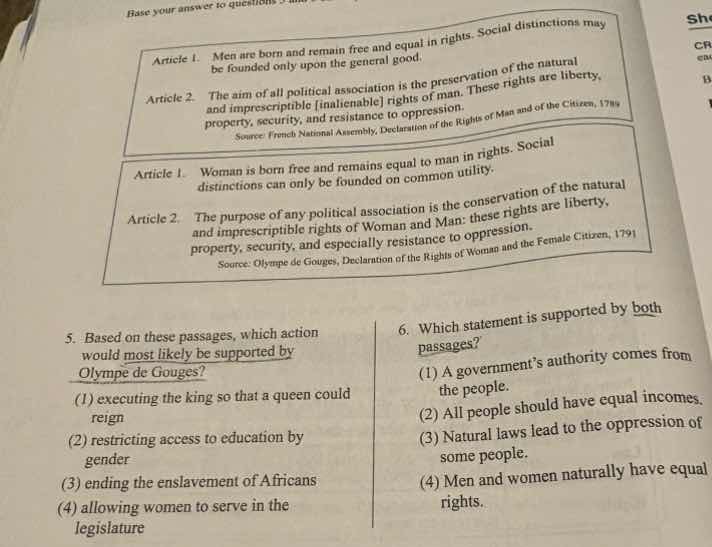
article 1. men are born and remain free and equal in rights. social distinctions may be founded only upon the general good.
article 2. the aim of all political association is the preservation of the natural and imprescriptible inalienable rights of man. these rights are liberty, property, security, and resistance to oppression.
source: french national assembly, declaration of the rights of man and of the citizen, 1789
article 1. woman is born free and remains equal to man in rights. social distinctions can only be founded on common utility.
article 2. the purpose of any political association is the conservation of the natural and imprescriptible rights of woman and man: these rights are liberty, property, security, and especially resistance to oppression.
source: olympe de gouges, declaration of the rights of woman and the female citizen, 1791
- based on these passages, which action would most likely be supported by olympe de gouges?
(1) executing the king so that a queen could reign
(2) restricting access to education by gender
(3) ending the enslavement of africans
(4) allowing women to serve in the legislature
- which statement is supported by both passages?
(1) a government’s authority comes from the people.
(2) all people should have equal incomes.
(3) natural laws lead to the oppression of some people.
(4) men and women naturally have equal rights.
For question 5: Olympe de Gouges' text argues women have equal rights to men, so she would support actions expanding women's political participation. Option 4 aligns with this, while the others contradict her equality stance.
For question 6: Both passages open with the core claim that all people (men in the first, women and men in the second) are born free and equal in rights. The other options are not supported by both texts.

Snap & solve any problem in the app
Get step-by-step solutions on Sovi AI
Photo-based solutions with guided steps
Explore more problems and detailed explanations
- (4) allowing women to serve in the legislature
- (4) Men and women naturally have equal rights.