QUESTION IMAGE
Question
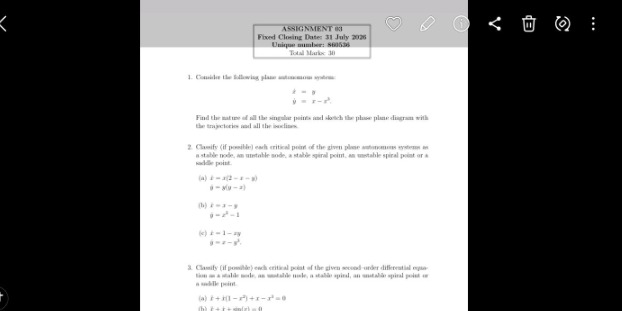
assignment 03
fixed closing date: 31 july 2026
unique number: 860536
total marks: 30
- consider the following plane autonomous system:
\\\
\\
find the nature of all the singular points and sketch the phase plane diagram with the trajectories and all the isoclines.
- classify (if possible) each critical point of the given plane autonomous systems as a stable node, an unstable node, a stable spiral point, an unstable spiral point or a saddle point.
(a) \\(\dot{x} = x(2 - x - y)\\), \\(\dot{y} = y(y - x)\\)
(b) \\(\dot{x} = x - y\\), \\(\dot{y} = x^2 - 1\\)
(c) \\(\dot{x} = 1 - xy\\), \\(\dot{y} = x - y^3\\)
- classify (if possible) each critical point of the given second-order differential equation as a stable node, an unstable node, a stable spiral, an unstable spiral point or a saddle point.
(a) \\(\ddot{x} + \dot{x}(1 - x^2) + x - x^3 = 0\\)
(b) \\(\ddot{x} + \dot{x} + \sin(x) = 0\\)
🆕 New Concept Discovered: Stability of Autonomous Systems
Analyzing nonlinear systems using local linearization and Jacobian matrices.
Step 1: Find the critical points of system (a)
The system is given by:
From the second equation, either \( y = 0 \) or \( y = x \).
- Case 1: If \( y = 0 \), substitute into the first equation:
This gives the critical points: \((0, 0)\) and \((2, 0)\).
- Case 2: If \( y = x \), substitute into the first equation:
This gives the critical points: \((0, 0)\) (already found) and \((1, 1)\).
The critical points are \((0, 0)\), \((2, 0)\), and \((1, 1)\).
Step 2: Linearize system (a) using the Jacobian matrix
Let \( f(x, y) = 2x - x^2 - xy \) and \( g(x, y) = y^2 - xy \).
The Jacobian matrix \( J(x, y) \) is:
- At \((0, 0)\):
The eigenvalues are \(\lambda_1 = 2\) and \(\lambda_2 = 0\). Since one eigenvalue is zero, the linear test is inconclusive.
- At \((2, 0)\):
This is an upper triangular matrix, so the eigenvalues are \(\lambda_1 = -2\) and \(\lambda_2 = -2\). Since both eigenvalues are real, negative, and equal, and the matrix is non-diagonalizable (it has only one linearly independent eigenvector), this is a stable node (specifically, a degenerate stable node).
- At \((1, 1)\):
The characteristic equation is:
Since the eigenvalues are real and have opposite signs, this is a saddle point.
---
Step 3: Find and classify the critical points of system (b)
The system is given by:
The critical points are \((1, 1)\) and \((-1, -1)\).
Let \( f(x, y) = x - y \) and \( g(x, y) = x^2 - 1 \).
The Jacobian matrix is:
- At \((1, 1)\):
The characteristic equation is:
Using the quadratic formula:
Since the eigenvalues are complex conjugates with a positive real part (\(\text{Re}(\lambda) = \frac{1}{2} > 0\)), this is an unstable spiral point.
- At \((-1, -1)\):
The characteristic equation is:
The eigenvalues are \(\lambda_1 = 2\) and \(\lambda_2 = -1\). Since the eigenvalues are real and of opposite signs, this is a saddle point.
---
Step 4: Find and classify the critical points of system (c)
The system is given by:
Substitute \( x = y^3 \) into \( xy = 1 \):
-…

Snap & solve any problem in the app
Get step-by-step solutions on Sovi AI
Photo-based solutions with guided steps
Explore more problems and detailed explanations
System (a)
- \((2, 0)\): Stable node
- \((1, 1)\): Saddle point
- \((0, 0)\): Inconclusive by linearization (one zero eigenvalue)
System (b)
- \((1, 1)\): Unstable spiral point
- \((-1, -1)\): Saddle point
System (c)
- \((1, 1)\): Stable node
- \((-1, -1)\): Saddle point