QUESTION IMAGE
Question
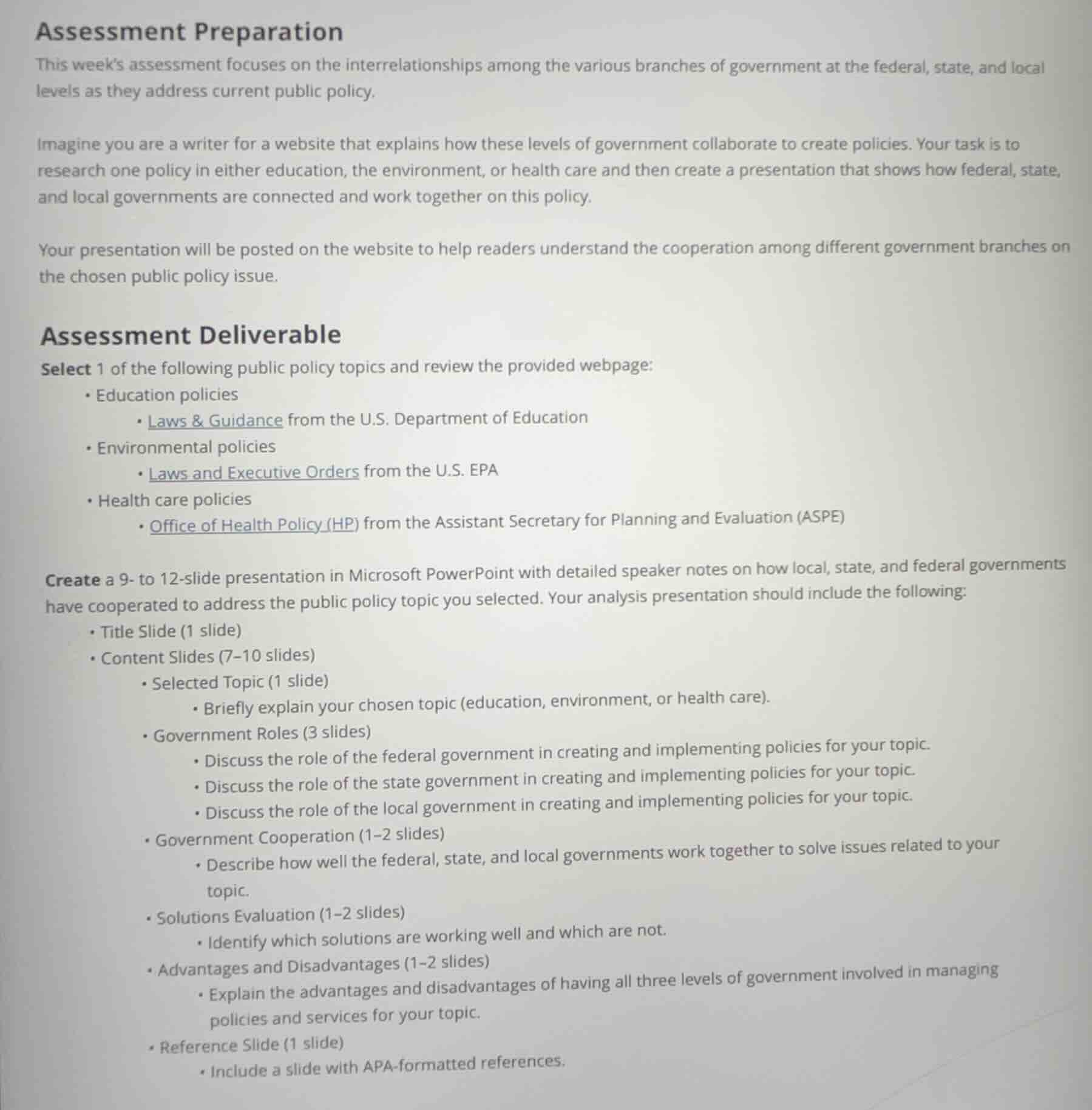
assessment preparation
this weeks assessment focuses on the interrelationships among the various branches of government at the federal, state, and local levels as they address current public policy.
imagine you are a writer for a website that explains how these levels of government collaborate to create policies. your task is to research one policy in either education, the environment, or health care and then create a presentation that shows how federal, state, and local governments are connected and work together on this policy.
your presentation will be posted on the website to help readers understand the cooperation among different government branches on the chosen public policy issue.
assessment deliverable
select 1 of the following public policy topics and review the provided webpage:
- education policies
- laws & guidance from the u.s. department of education
- environmental policies
- laws and executive orders from the u.s. epa
- health care policies
- office of health policy (hp) from the assistant secretary for planning and evaluation (aspe)
create a 9- to 12-slide presentation in microsoft powerpoint with detailed speaker notes on how local, state, and federal governments have cooperated to address the public policy topic you selected. your analysis presentation should include the following:
- title slide (1 slide)
- content slides (7-10 slides)
- selected topic (1 slide)
- briefly explain your chosen topic (education, environment, or health care).
- government roles (3 slides)
- discuss the role of the federal government in creating and implementing policies for your topic.
- discuss the role of the state government in creating and implementing policies for your topic.
- discuss the role of the local government in creating and implementing policies for your topic.
- government cooperation (1-2 slides)
- describe how well the federal, state, and local governments work together to solve issues related to your topic.
- solutions evaluation (1-2 slides)
- identify which solutions are working well and which are not.
- advantages and disadvantages (1-2 slides)
- explain the advantages and disadvantages of having all three levels of government involved in managing policies and services for your topic.
- reference slide (1 slide)
- include a slide with apa-formatted references.
Select a public policy topic
Using the Public Policy Analysis knowledge point, we select environmental policy as our focus. This topic offers a clear view of how federal, state, and local governments interact. The U.S. Environmental Protection Agency (EPA) sets national standards, while state and local agencies implement and enforce them.
Outline the federal government role
Using the Federalism knowledge point, we analyze the federal role. The federal government, primarily through the EPA, establishes baseline environmental standards under major legislation like the Clean Air Act and Clean Water Act. It provides funding, conducts research, and sets national compliance targets.
Outline the state government role
Using the Federalism knowledge point, we analyze the state role. State governments design State Implementation Plans (SIPs) to meet federal standards. They issue permits to local industries, monitor environmental quality, and have the authority to set stricter standards than the federal baseline.
Outline the local government role
Using the Federalism knowledge point, we analyze the local role. Municipal and county governments handle direct implementation. They manage local waste systems, enforce zoning laws, operate water treatment facilities, and execute local sustainability initiatives.
Evaluate intergovernmental cooperation
Using the Intergovernmental Cooperation knowledge point, we evaluate how these levels work together. Cooperation is essential but can face challenges like unfunded mandates or jurisdictional disputes. Successful collaboration relies on shared data, joint funding agreements, and clear divisions of regulatory authority.

Snap & solve any problem in the app
Get step-by-step solutions on Sovi AI
Photo-based solutions with guided steps
Explore more problems and detailed explanations
To successfully complete your assessment deliverable, here is a structured outline for your 9- to 12-slide PowerPoint presentation on Environmental Policy:
- Slide 1: Title Slide
- Title: Intergovernmental Cooperation in Environmental Policy
- Subtitle: How Federal, State, and Local Governments Collaborate to Protect Our Natural Resources
- Speaker Notes: Introduce yourself and explain that this presentation analyzes the cooperative framework of environmental governance in the United States.
- Slide 2: Selected Topic (Environmental Policy)
- Content: Overview of Environmental Policy in the U.S.
- Key Points: Focus on air and water quality standards set by the EPA.
- Speaker Notes: Explain why environmental policy is a prime example of shared governance, requiring coordinated action across all levels of government to protect public health.
- Slide 3: Federal Government Role
- Content: Setting National Standards and Funding
- Key Points: The role of the EPA; major legislation like the Clean Air Act; federal grants and research.
- Speaker Notes: Discuss how the federal government sets the baseline rules and provides financial resources, but relies on lower levels of government for execution.
- Slide 4: State Government Role
- Content: Implementation, Permitting, and Enforcement
- Key Points: State environmental agencies; State Implementation Plans (SIPs); monitoring and enforcement of federal standards.
- Speaker Notes: Detail how states adapt federal guidelines into specific state-level rules, issuing permits to businesses and monitoring compliance.
- Slide 5: Local Government Role
- Content: Direct Action and Community Management
- Key Points: Municipal waste management; local water treatment; zoning laws and green initiatives.
- Speaker Notes: Explain that local governments are on the front lines, directly operating the infrastructure (like water plants) that keeps communities clean and safe.
- Slide 6: Government Cooperation
- Content: How the Three Levels Work Together
- Key Points: Shared data networks; joint funding projects; cooperative enforcement actions.
- Speaker Notes: Describe the collaborative mechanisms, highlighting how communication flows between local inspectors, state regulators, and federal administrators.
- Slide 7: Solutions Evaluation
- Content: What is Working and What is Not
- Key Points:
- Working: Successful reduction in major pollutants through shared standards.
- Not Working: Challenges with unfunded mandates and regulatory delays.
- Speaker Notes: Evaluate the effectiveness of this cooperative model, noting that while it ensures national consistency, it can strain local budgets.
- Slide 8: Advantages and Disadvantages
- Content: The Pros and Cons of Shared Governance
- Key Points:
- Advantages: Local flexibility, pooled resources, and consistent national baselines.
- Disadvantages: Bureaucratic overlap, potential political conflict, and unequal enforcement across states.
- Speaker Notes: Weigh the benefits of decentralized implementation against the challenges of coordination and political friction.
- Slide 9: Reference Slide
- Content: APA-Formatted References
- Key Points: Include citations for the U.S. EPA website and academic sources on federalism and environmental policy.
- Speaker Notes: Conclude the presentation by highlighting the credible sources used to research this intergovernmental framework.