QUESTION IMAGE
Question
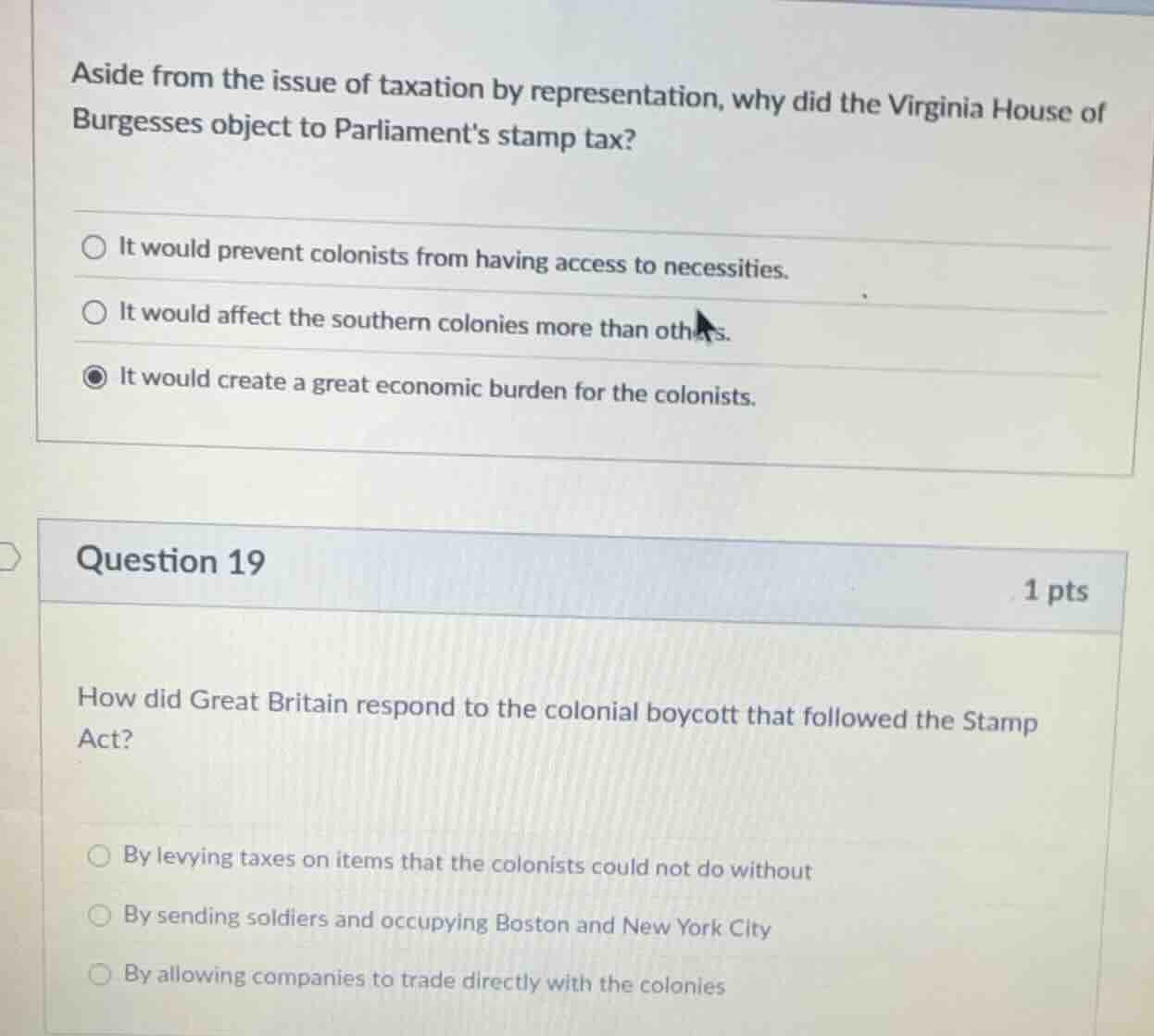
aside from the issue of taxation by representation, why did the virginia house of burgesses object to parliaments stamp tax?
- it would prevent colonists from having access to necessities.
- it would affect the southern colonies more than others.
- it would create a great economic burden for the colonists.
question 19
how did great britain respond to the colonial boycott that followed the stamp act?
- by levying taxes on items that the colonists could not do without
- by sending soldiers and occupying boston and new york city
- by allowing companies to trade directly with the colonies
🆕 New Concept Discovered: Cause-and-Effect in Historical Policy
Analyzing how governments and citizens react to economic and political conflicts.
Step 1: Analyze the Stamp Act Boycott
Following the passage of the Stamp Act of 1765, American colonists organized widespread boycotts of British goods to protest "taxation without representation." This economic pressure severely hurt British merchants and manufacturers, who then petitioned Parliament to repeal the act.
Step 2: Identify the British Response
In response to the economic damage caused by the boycotts, Great Britain repealed the Stamp Act in 1766. However, to raise revenue and assert its authority over the colonies, Parliament quickly passed the Townshend Acts in 1767. These acts levied new taxes on imported goods that the colonists could not easily produce themselves and relied upon, such as glass, lead, paint, paper, and tea.
Step 3: Evaluate the Options
- By levying taxes on items that the colonists could not do without: This is correct. After repealing the Stamp Act, Britain passed the Townshend Acts to tax essential imported goods.
- By sending soldiers and occupying Boston and New York City: While troops were eventually sent to Boston in 1768 to enforce customs regulations, this was a direct reaction to the protests against the subsequent Townshend Acts, not the immediate legislative response to the Stamp Act boycott itself.
- By allowing companies to trade directly with the colonies: This does not describe the primary legislative response to the boycott.

Snap & solve any problem in the app
Get step-by-step solutions on Sovi AI
Photo-based solutions with guided steps
Explore more problems and detailed explanations
By levying taxes on items that the colonists could not do without