QUESTION IMAGE
Question
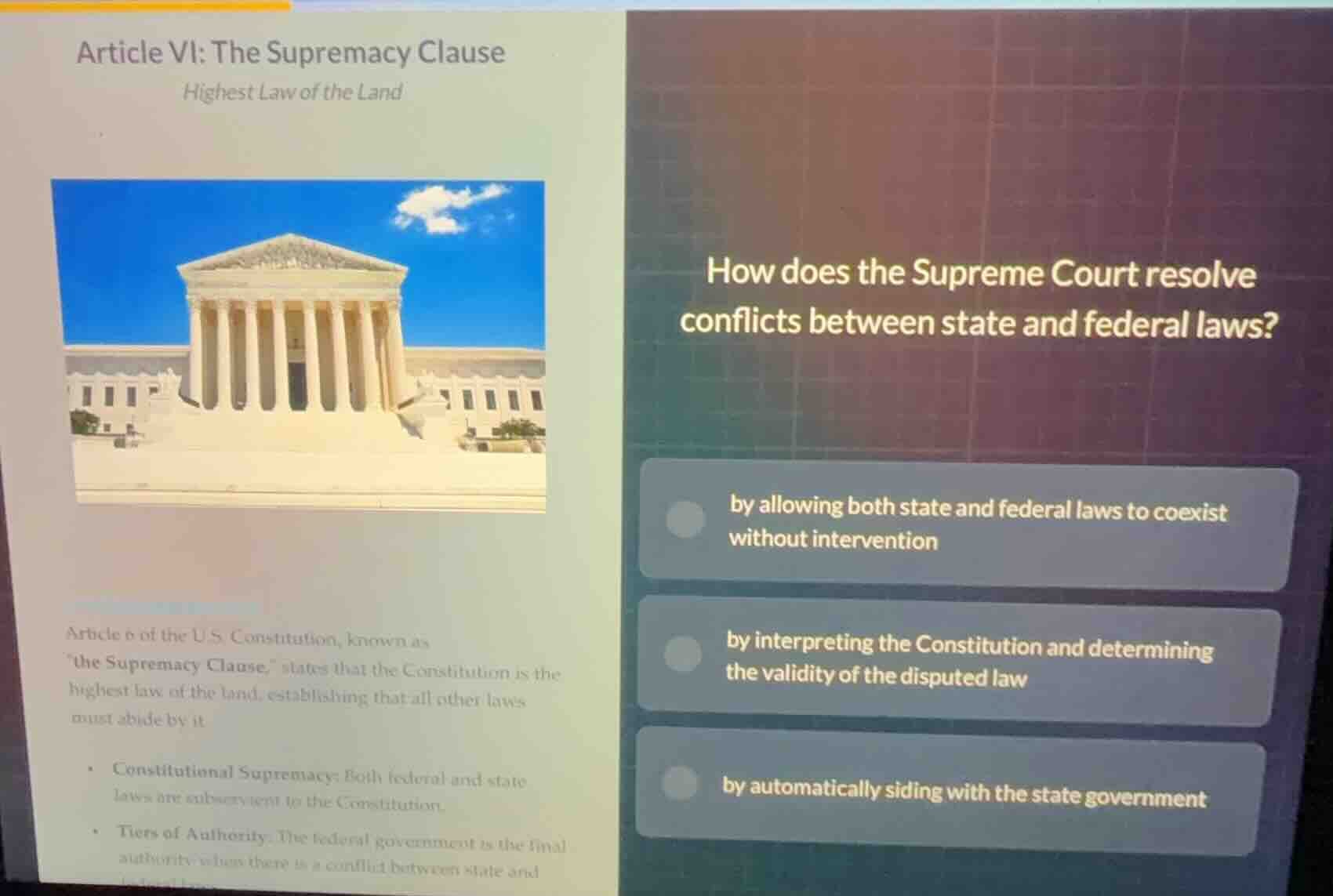
article vi: the supremacy clause
highest law of the land
article 6 of the u.s. constitution, known as
the supremacy clause, states that the constitution is the
highest law of the land, establishing that all other laws
must abide by it
- constitutional supremacy: both federal and state
laws are subservient to the constitution.
- tiers of authority: the federal government is the final
authority when there is a conflict between state and
how does the supreme court resolve
conflicts between state and federal laws?
by allowing both state and federal laws to coexist
without intervention
by interpreting the constitution and determining
the validity of the disputed law
by automatically siding with the state government
The Supremacy Clause establishes the U.S. Constitution, and federal laws made under it, as the supreme law of the land. When state and federal laws conflict, the Supreme Court interprets the Constitution to assess which law aligns with it, determining the validity of the disputed law. The other options are incorrect: conflicting laws cannot coexist without intervention, and the Court does not automatically side with state government.

Snap & solve any problem in the app
Get step-by-step solutions on Sovi AI
Photo-based solutions with guided steps
Explore more problems and detailed explanations
by interpreting the Constitution and determining the validity of the disputed law