QUESTION IMAGE
Question
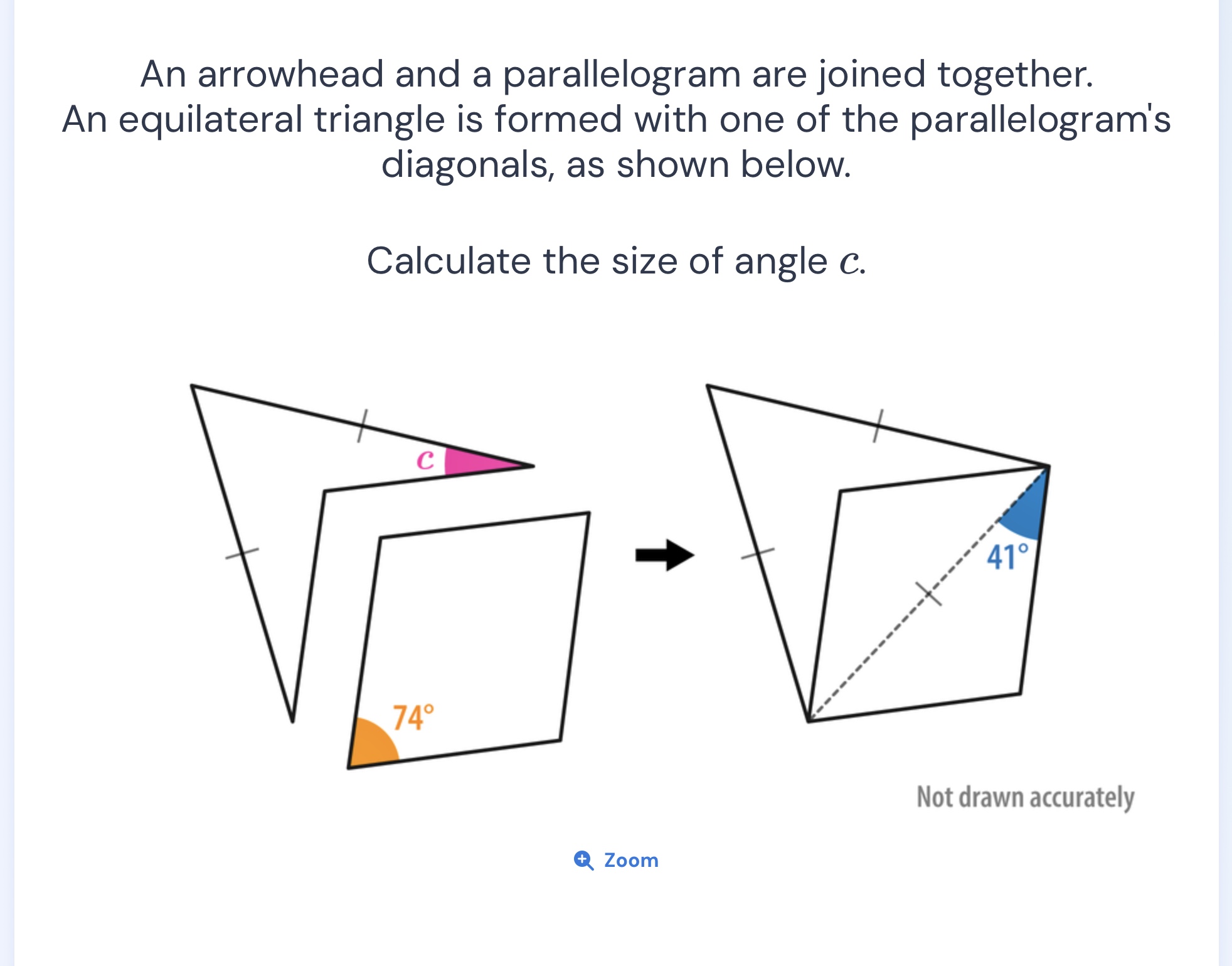
an arrowhead and a parallelogram are joined together. an equilateral triangle is formed with one of the parallelograms diagonals, as shown below.
calculate the size of angle (c).
⚡ Using what you learned: properties of triangles · properties of quadrilaterals
Step 1: Analyze the equilateral triangle
The dashed line represents a diagonal of the parallelogram. We are told that an equilateral triangle is formed with this diagonal.
Looking at the tick marks on the joined figure:
- The two outer sides of the arrowhead have single tick marks.
- The diagonal of the parallelogram also has a single tick mark.
- Since they form an equilateral triangle, all three sides of this triangle are equal in length, and each of its interior angles is \( 60^\circ \).
Step 2: Find the angles of the parallelogram
The bottom-left interior angle of the parallelogram is given as \( 74^\circ \).
- Opposite angles in a parallelogram are equal, so the top-right interior angle is also \( 74^\circ \).
- The diagonal splits this top-right corner into two parts. One part is given as \( 41^\circ \).
- Therefore, the other part of this angle (inside the left triangle of the parallelogram) is:
Step 3: Determine the angle of the equilateral triangle
Since the triangle formed by the two outer sides of the arrowhead and the diagonal is equilateral, its interior angle at the top-right vertex is:
Step 4: Calculate angle c
The top-right vertex of the combined shape is made up of three adjacent angles that share this vertex:
- The angle inside the equilateral triangle: \( 60^\circ \)
- The angle \( c \) from the arrowhead
- The angle inside the parallelogram: \( 33^\circ \)
From the first diagram, we can see that the top-right angle of the equilateral triangle is composed of the angle \( c \) plus the upper angle of the split parallelogram corner:
Solving for \( c \):

Snap & solve any problem in the app
Get step-by-step solutions on Sovi AI
Photo-based solutions with guided steps
Explore more problems and detailed explanations
\( 27^\circ \) (or \( 27 \))