QUESTION IMAGE
Question
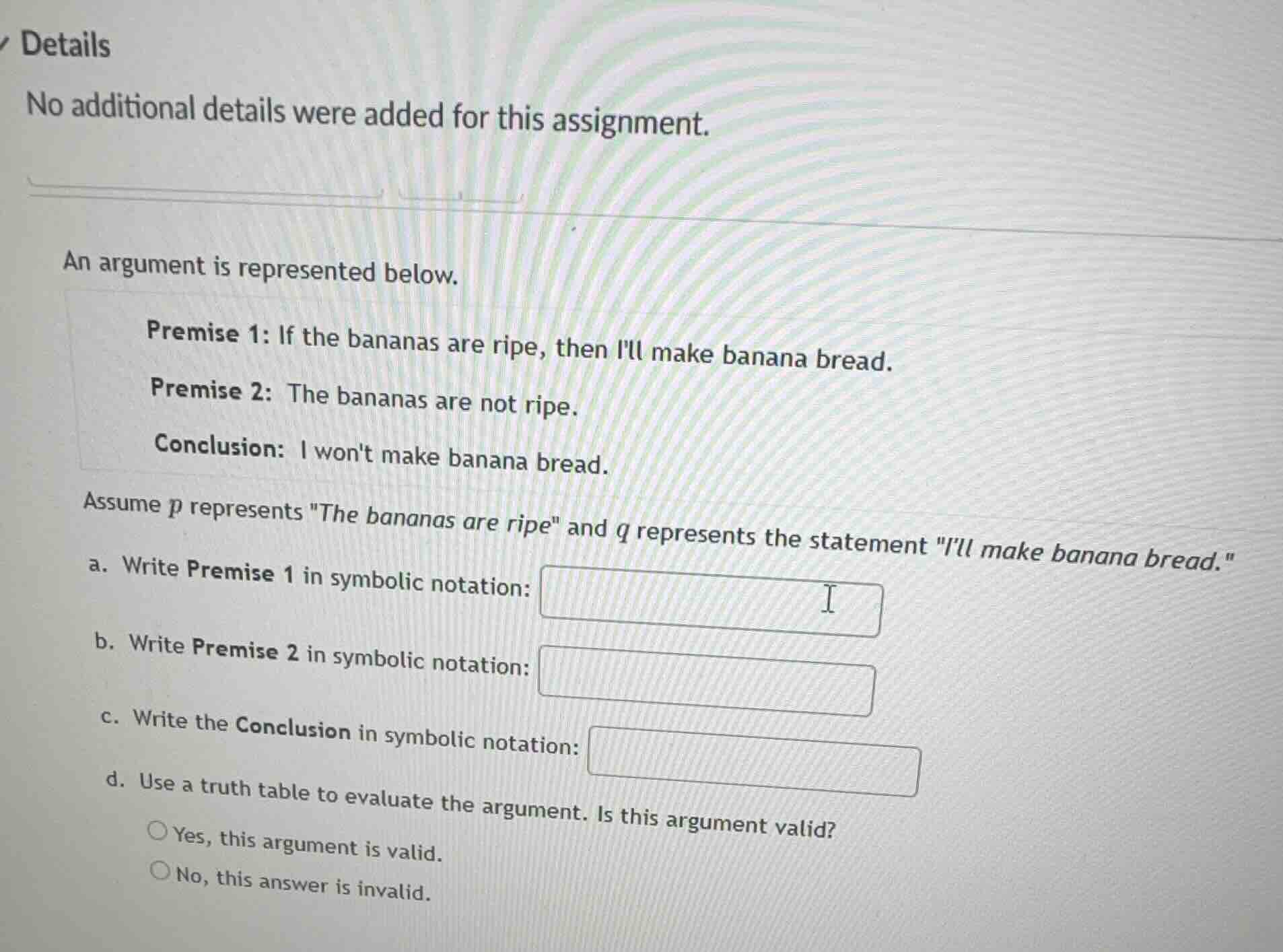
an argument is represented below.
premise 1: if the bananas are ripe, then ill make banana bread.
premise 2: the bananas are not ripe.
conclusion: i wont make banana bread.
assume \\(p\\) represents \the bananas are ripe\ and \\(q\\) represents the statement \ill make banana bread.\
a. write premise 1 in symbolic notation:
b. write premise 2 in symbolic notation:
c. write the conclusion in symbolic notation:
d. use a truth table to evaluate the argument. is this argument valid?
yes, this argument is valid.
no, this answer is invalid.
Translate premises and conclusion to symbolic form
Evaluate argument validity using truth table
Determine validity from critical rows

Snap & solve any problem in the app
Get step-by-step solutions on Sovi AI
Photo-based solutions with guided steps
Explore more problems and detailed explanations
Question a
Write Premise 1 in symbolic notation: <blank>\(p
ightarrow q\)</blank>
Question b
Write Premise 2 in symbolic notation: <blank>\(\sim p\)</blank>
Question c
Write the Conclusion in symbolic notation: <blank>\(\sim q\)</blank>
Question d
- Yes, this argument is valid.
- No, this answer is invalid. (Correct answer)