QUESTION IMAGE
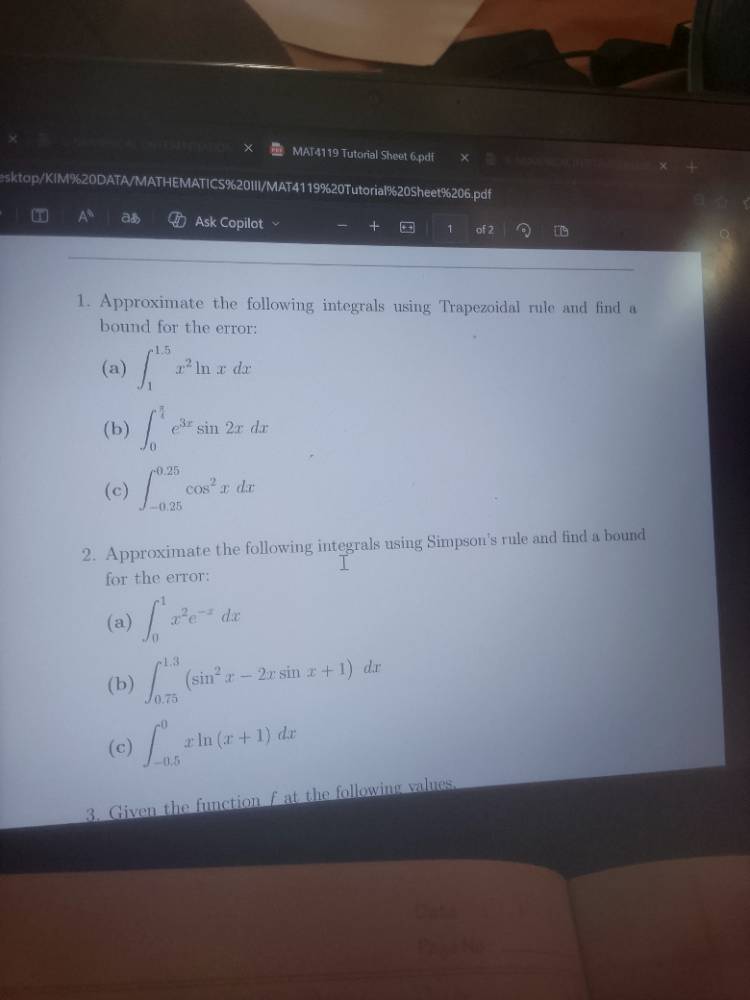
Question
- approximate the following integrals using trapezoidal rule and find a bound for the error:
(a) \\(\int_{1}^{1.5} x^2 \ln x \\, dx\\)
(b) \\(\int_{0}^{\pi} e^{3x} \sin 2x \\, dx\\)
(c) \\(\int_{-0.25}^{0.25} \cos^2 x \\, dx\\)
- approximate the following integrals using simpsons rule and find a bound for the error:
(a) \\(\int_{0}^{1} x^2 e^{-x} \\, dx\\)
(b) \\(\int_{0.75}^{1.3} (\sin^2 x - 2x \sin x + 1) \\, dx\\)
(c) \\(\int_{-0.5}^{0} x \ln(x + 1) \\, dx\\)
- given the function \\(f\\) at the following values:
🆕 New Concept Discovered: Trapezoidal Rule and Error Bound
Approximating integrals using linear segments and bounding the error
We will solve Question 1(a): Approximate the integral \( \int_{1}^{1.5} x^2 \ln x \, dx \) using the Trapezoidal rule and find a bound for the error.
For a single interval \([a, b]\) (where \( n = 1 \)), the Trapezoidal rule is:
The error bound for the single-interval Trapezoidal rule is given by:
---
Step 1: Apply the Trapezoidal Rule
Identify the parameters from the integral \( \int_{1}^{1.5} x^2 \ln x \, dx \):
- \( f(x) = x^2 \ln x \)
- \( a = 1 \)
- \( b = 1.5 \)
- Step size \( h = b - a = 1.5 - 1 = 0.5 \)
Evaluate the function at the endpoints:
- \( f(1) = 1^2 \ln(1) = 0 \)
- \( f(1.5) = (1.5)^2 \ln(1.5) = 2.25 \times 0.4054651 = 0.9122965 \)
Apply the formula:
---
Step 2: Find the Second Derivative of \( f(x) \)
To calculate the error bound, we need the second derivative of \( f(x) = x^2 \ln x \).
First derivative \( f'(x) \) using the product rule:
Second derivative \( f''(x) \):
---
Step 3: Find the Maximum of \( |f''(x)| \) on \( [1, 1.5] \)
Since \( \ln x \) is a strictly increasing function for \( x > 0 \), the second derivative \( f''(x) = 2 \ln x + 3 \) is also strictly increasing on the interval \( [1, 1.5] \).
Thus, the maximum value of \( |f''(x)| \) on this interval occurs at the right endpoint, \( x = 1.5 \):
---
Step 4: Calculate the Error Bound
Substitute the values into the error bound formula:
---

Snap & solve any problem in the app
Get step-by-step solutions on Sovi AI
Photo-based solutions with guided steps
Explore more problems and detailed explanations
- Trapezoidal Approximation: \( \approx 0.228074 \)
- Error Bound: \( \le 0.039697 \)