Sovi.AI - AI Math Tutor

Scan to solve math questions

QUESTION IMAGE

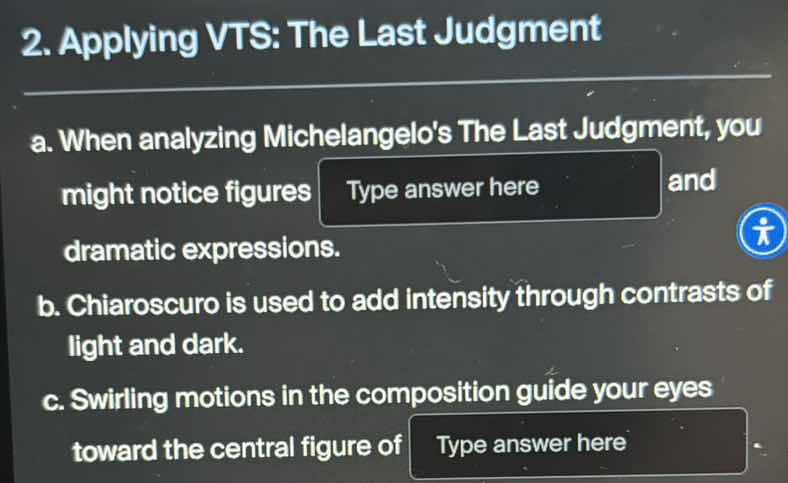
2. applying vts: the last judgment a. when analyzing michelangelos the …

Question

  1. applying vts: the last judgment

a. when analyzing michelangelos the last judgment, you might notice figures type answer here and dramatic expressions.

b. chiaroscuro is used to add intensity through contrasts of light and dark.

c. swirling motions in the composition guide your eyes toward the central figure of type answer here

Explanation:

Response

<pre_analysis>
{
"quality": "clear",
"question_count": 2,
"skills_matched": [
"direct_cot",
"blank_filling_formatter",
"explain_then_answer",
"quick"
],
"needs_drawing": false,
"concepts_used": [],
"new_concepts": [
"The Last Judgment",
"Michelangelo Buonarroti",
"Mannerist Composition"
],
"current_concepts": [
"VTS Methodology",
"The Last Judgment",
"Michelangelo Buonarroti",
"Chiaroscuro"
]
}
</pre_analysis>

<reasoning>

Identify the visual characteristics of figures in Michelangelo's The Last Judgment

Michelangelo's fresco The Last Judgment in the Sistine Chapel is renowned for its depiction of highly muscular, dynamic, and twisted figures. In the context of Visual Thinking Strategies (VTS) and art analysis, observers typically notice the muscular, twisting, or dynamic poses of the figures alongside their dramatic expressions. The most common art historical descriptor for these characteristic figures is "muscular" (or "dynamic"/"twisting").

Identify the central figure of the composition

The entire composition of The Last Judgment is structured in a swirling, circular motion that revolves around the prominent central figure of Christ (or Jesus Christ), who is depicted as a powerful, commanding judge.
</reasoning>

<answer>

Question 2.a

When analyzing Michelangelo's The Last Judgment, you might notice figures <blank>muscular</blank> and dramatic expressions.

Question 2.c

Swirling motions in the composition guide your eyes toward the central figure of <blank>Christ</blank>.
</answer>

<post_analysis>
{
"subject": "Arts",
"question_type": "Fill-in-the-blank",
"knowledge_point": [
"Arts",
"Art History",
"High Renaissance Art"
]
}
</post_analysis>

Answer:

<pre_analysis>
{
"quality": "clear",
"question_count": 2,
"skills_matched": [
"direct_cot",
"blank_filling_formatter",
"explain_then_answer",
"quick"
],
"needs_drawing": false,
"concepts_used": [],
"new_concepts": [
"The Last Judgment",
"Michelangelo Buonarroti",
"Mannerist Composition"
],
"current_concepts": [
"VTS Methodology",
"The Last Judgment",
"Michelangelo Buonarroti",
"Chiaroscuro"
]
}
</pre_analysis>

<reasoning>

Identify the visual characteristics of figures in Michelangelo's The Last Judgment

Michelangelo's fresco The Last Judgment in the Sistine Chapel is renowned for its depiction of highly muscular, dynamic, and twisted figures. In the context of Visual Thinking Strategies (VTS) and art analysis, observers typically notice the muscular, twisting, or dynamic poses of the figures alongside their dramatic expressions. The most common art historical descriptor for these characteristic figures is "muscular" (or "dynamic"/"twisting").

Identify the central figure of the composition

The entire composition of The Last Judgment is structured in a swirling, circular motion that revolves around the prominent central figure of Christ (or Jesus Christ), who is depicted as a powerful, commanding judge.
</reasoning>

<answer>

Question 2.a

When analyzing Michelangelo's The Last Judgment, you might notice figures <blank>muscular</blank> and dramatic expressions.

Question 2.c

Swirling motions in the composition guide your eyes toward the central figure of <blank>Christ</blank>.
</answer>

<post_analysis>
{
"subject": "Arts",
"question_type": "Fill-in-the-blank",
"knowledge_point": [
"Arts",
"Art History",
"High Renaissance Art"
]
}
</post_analysis>