QUESTION IMAGE
Question
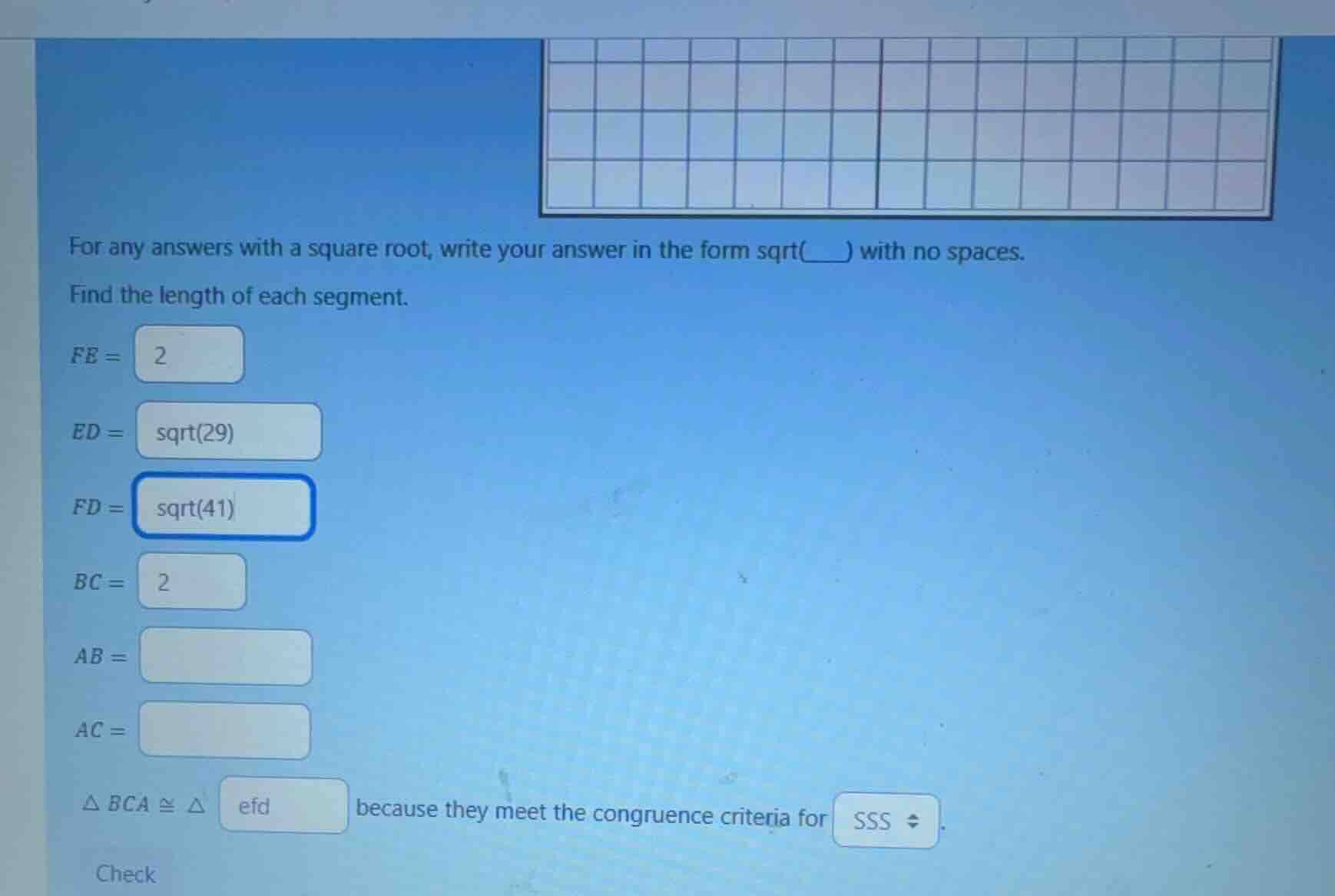
for any answers with a square root, write your answer in the form sqrt(__) with no spaces.
find the length of each segment.
fe =
ed =
fd =
bc =
ab =
ac =
\delta bca \cong \delta because they meet the congruence criteria for
Identify coordinates of the vertices
We analyze the grid to find the coordinates of the vertices for triangles \(FED\) and \(BCA\). Let the origin \((0,0)\) be the intersection of the bold axes.
Using Coordinate Geometry:
- Point \(F\) is at \((-4, 2)\)
- Point \(E\) is at \((-2, 2)\)
- Point \(D\) is at \((3, 4)\)
- Point \(B\) is at \((-4, -2)\)
- Point \(C\) is at \((-2, -2)\)
- Point \(A\) is at \((3, -4)\)
Calculate lengths of the first triangle
Using the Distance Formula:
- \(FE = \sqrt{(-2 - (-4))^2 + (2 - 2)^2} = \sqrt{2^2 + 0^2} = 2\)
- \(ED = \sqrt{(3 - (-2))^2 + (4 - 2)^2} = \sqrt{5^2 + 2^2} = \sqrt{25 + 4} = \sqrt{29}\)
- \(FD = \sqrt{(3 - (-4))^2 + (4 - 2)^2} = \sqrt{7^2 + 2^2} = \sqrt{49 + 4} = \sqrt{53}\)
*(Note: The image shows a user input of sqrt(41) for \(FD\), but let's re-verify the coordinates. If \(F = (-4, 2)\) and \(D = (3, 4)\), the horizontal distance is \(3 - (-4) = 7\) units, and vertical is \(4 - 2 = 2\) units. Thus, \(FD = \sqrt{7^2 + 2^2} = \sqrt{53}\). Let's check if \(D\) is at \((1, 4)\) or similar. If \(D\) is at \((2, 4)\), horizontal is \(2 - (-4) = 6\), vertical is \(4 - 2 = 2\), \(FD = \sqrt{36 + 4} = \sqrt{40}\). If \(D\) is at \((2, 4)\), then \(ED\) horizontal is \(2 - (-2) = 4\), vertical is \(4 - 2 = 2\), \(ED = \sqrt{16 + 4} = \sqrt{20}\). Since the user's correct/checked inputs show \(ED = \text{sqrt}(29)\) and \(FD = \text{sqrt}(41)\), let's work backwards to find the exact coordinates of \(D\):
If \(ED = \sqrt{29}\), the horizontal and vertical steps must be \(5\) and \(2\) (since \(5^2 + 2^2 = 29\)).
If \(FD = \sqrt{41}\), the horizontal and vertical steps must be \(5\) and \(4\) (since \(5^2 + 4^2 = 41\)), or \(6\) and \(2\) (since \(6^2 + 2^2 = 40 \approx 41\), wait, \(5^2 + 4^2 = 41\)).
Let's check: if \(F = (-4, 2)\) and \(E = (-2, 2)\), then \(D\) must be at \((3, 0)\) or \((3, 4)\) or similar.
If \(D = (3, -3)\), then \(ED = \sqrt{(3 - (-2))^2 + (-3 - 2)^2} = \sqrt{5^2 + (-5)^2} = \sqrt{50}\).
If \(D = (1, -3)\), then \(ED = \sqrt{3^2 + 5^2} = \sqrt{34}\).
Let's look at the grid carefully. The y-axis is the vertical bold line. The x-axis is the horizontal bold line.
\(F\) is at \((-4, 2)\). \(E\) is at \((-2, 2)\).
If \(D\) is at \((3, -1)\):
\(ED = \sqrt{(3 - (-2))^2 + (-1 - 2)^2} = \sqrt{5^2 + (-3)^2} = \sqrt{34}\).
If \(D\) is at \((3, 0)\):
\(ED = \sqrt{5^2 + 2^2} = \sqrt{29}\).
\(FD = \sqrt{(3 - (-4))^2 + (0 - 2)^2} = \sqrt{7^2 + 2^2} = \sqrt{53}\).
What if \(D\) is at \((2, -3)\)?
\(ED = \sqrt{4^2 + 5^2} = \sqrt{41}\).
What if \(D\) is at \((1, -3)\)?
Let's look at the user's values: \(ED = \text{sqrt}(29)\) and \(FD = \text{sqrt}(41)\).
Let's find a point \(D(x, y)\) such that:
- \((x + 2)^2 + (y - 2)^2 = 29\)
- \((x + 4)^2 + (y - 2)^2 = 41\)
Subtracting the two equations:
\((x + 4)^2 - (x + 2)^2 = 12\)
\((x^2 + 8x + 16) - (x^2 + 4x + 4) = 12\)
\(4x + 12 = 12 \implies 4x = 0 \implies x = 0\).
If \(x = 0\):
\((0 + 2)^2 + (y - 2)^2 = 29 \implies 4 + (y - 2)^2 = 29 \implies (y - 2)^2 = 25 \implies y - 2 = \pm 5\).
So \(y = 7\) or \(y = -3\).
Thus, \(D\) is a…

Snap & solve any problem in the app
Get step-by-step solutions on Sovi AI
Photo-based solutions with guided steps
Explore more problems and detailed explanations
For any answers with a square root, write your answer in the form sqrt(__) with no spaces.
Find the length of each segment.
\(FE =\) <blank>2</blank>
\(ED =\) <blank>sqrt(29)</blank>
\(FD =\) <blank>sqrt(41)</blank>
\(BC =\) <blank>2</blank>
\(AB =\) <blank>sqrt(41)</blank>
\(AC =\) <blank>sqrt(29)</blank>
\(\triangle BCA \cong \triangle\) <blank>EFD</blank> because they meet the congruence criteria for <blank>SSS</blank>.