QUESTION IMAGE
Question
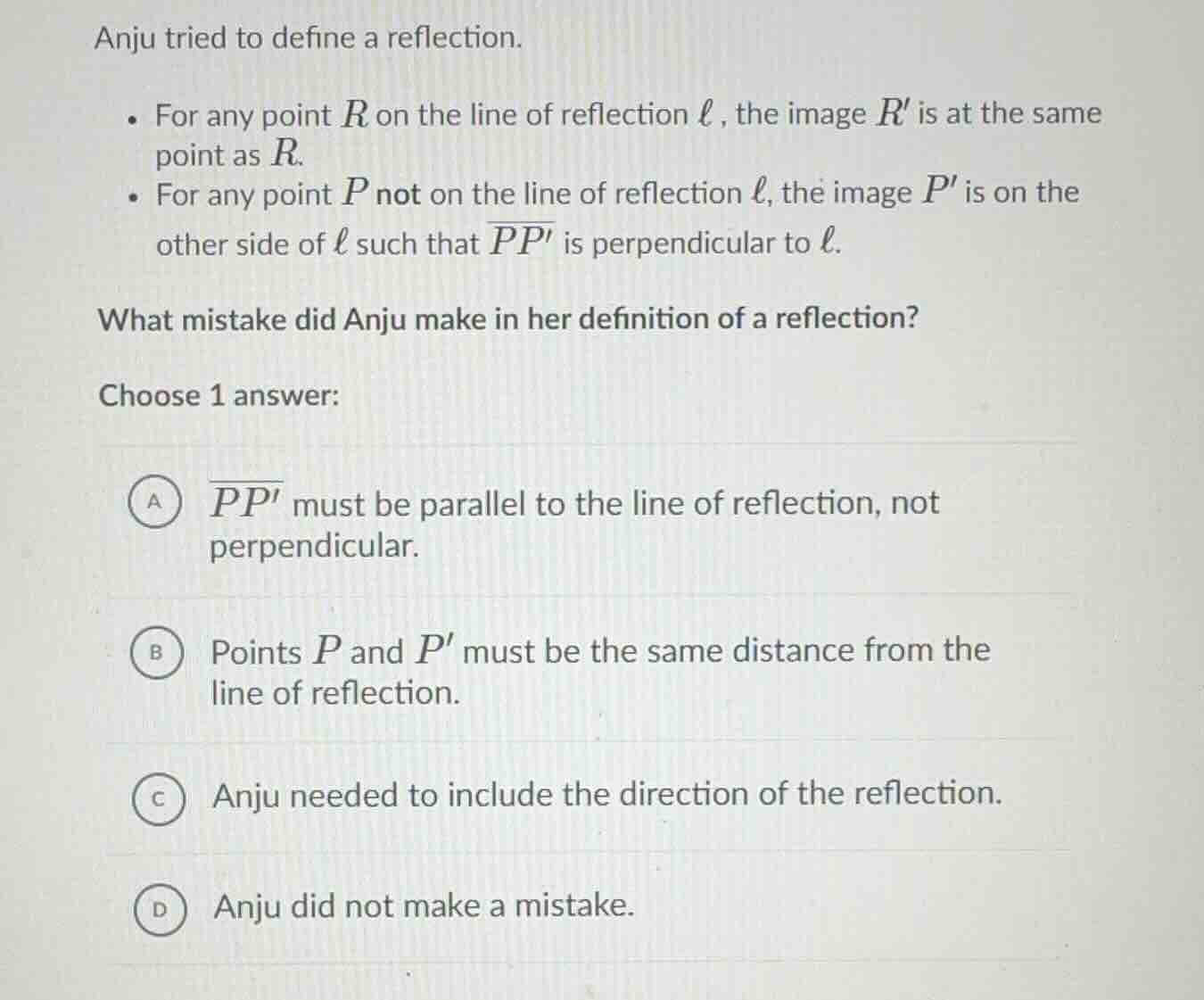
anju tried to define a reflection.
- for any point \\(r\\) on the line of reflection \\(\ell\\), the image \\(r\\) is at the same point as \\(r\\).
- for any point \\(p\\) not on the line of reflection \\(\ell\\), the image \\(p\\) is on the other side of \\(\ell\\) such that \\(\overline{pp}\\) is perpendicular to \\(\ell\\).
what mistake did anju make in her definition of a reflection?
choose 1 answer:
(a) \\(\overline{pp}\\) must be parallel to the line of reflection, not perpendicular.
(b) points \\(p\\) and \\(p\\) must be the same distance from the line of reflection.
(c) anju needed to include the direction of the reflection.
(d) anju did not make a mistake.
<pre_analysis>
{
"quality": "clear",
"question_count": 1,
"skills_matched": [
"direct_cot",
"multiple_choice_formatter",
"explain_then_answer",
"tutor",
"mastery_adaptive_brevity"
],
"needs_drawing": false,
"concepts_used": [
"Line of Reflection",
"Geometric Transformations",
"Perpendicular Lines Definition"
],
"new_concepts": [
"Definition of Reflection"
],
"current_concepts": [
"Line of Reflection",
"Geometric Transformations",
"Perpendicular Lines Definition",
"Definition of Reflection"
]
}
</pre_analysis>
<reasoning>
Analyze the proposed definition
Using the Geometric Transformations and Line of Reflection knowledge points
Anju's definition states:
- For any point \(R\) on the line of reflection \(\ell\), the image \(R'\) is at the same point as \(R\). (This is correct).
- For any point \(P\) not on \(\ell\), the image \(P'\) is on the other side of \(\ell\) such that \(\overline{PP'}\) is perpendicular to \(\ell\).
Identify the missing condition
Using the Perpendicular Lines Definition knowledge point
While \(\overline{PP'}\) must be perpendicular to \(\ell\), this condition alone does not uniquely define \(P'\). There are infinitely many points on the perpendicular line on the other side of \(\ell\). To define a reflection uniquely, the distance from \(P\) to \(\ell\) must equal the distance from \(P'\) to \(\ell\). That is, \(\ell\) must be the perpendicular bisector of \(\overline{PP'}\).
Evaluate the given options
- Option A: Incorrect, because \(\overline{PP'}\) must be perpendicular, not parallel.
- Option B: Correct, because it identifies the missing requirement that \(P\) and \(P'\) must be equidistant from \(\ell\).
- Option C: Incorrect, because reflections do not have a "direction" parameter like translations or rotations.
- Option D: Incorrect, because a mistake was made.
</reasoning>
<answer>
<mcq-option>(A) \(\overline{PP'}\) must be parallel to the line of reflection, not perpendicular.</mcq-option>
<mcq-correct>(B) Points \(P\) and \(P'\) must be the same distance from the line of reflection.</mcq-correct>
<mcq-option>(C) Anju needed to include the direction of the reflection.</mcq-option>
<mcq-option>(D) Anju did not make a mistake.</mcq-option>
</answer>
<post_analysis>
{
"subject": "Mathematics",
"question_type": "Multiple Choice",
"knowledge_point": [
"Mathematics",
"Geometry",
"Geometric Transformations"
]
}
</post_analysis>
Snap & solve any problem in the app
Get step-by-step solutions on Sovi AI
Photo-based solutions with guided steps
Explore more problems and detailed explanations
<pre_analysis>
{
"quality": "clear",
"question_count": 1,
"skills_matched": [
"direct_cot",
"multiple_choice_formatter",
"explain_then_answer",
"tutor",
"mastery_adaptive_brevity"
],
"needs_drawing": false,
"concepts_used": [
"Line of Reflection",
"Geometric Transformations",
"Perpendicular Lines Definition"
],
"new_concepts": [
"Definition of Reflection"
],
"current_concepts": [
"Line of Reflection",
"Geometric Transformations",
"Perpendicular Lines Definition",
"Definition of Reflection"
]
}
</pre_analysis>
<reasoning>
Analyze the proposed definition
Using the Geometric Transformations and Line of Reflection knowledge points
Anju's definition states:
- For any point \(R\) on the line of reflection \(\ell\), the image \(R'\) is at the same point as \(R\). (This is correct).
- For any point \(P\) not on \(\ell\), the image \(P'\) is on the other side of \(\ell\) such that \(\overline{PP'}\) is perpendicular to \(\ell\).
Identify the missing condition
Using the Perpendicular Lines Definition knowledge point
While \(\overline{PP'}\) must be perpendicular to \(\ell\), this condition alone does not uniquely define \(P'\). There are infinitely many points on the perpendicular line on the other side of \(\ell\). To define a reflection uniquely, the distance from \(P\) to \(\ell\) must equal the distance from \(P'\) to \(\ell\). That is, \(\ell\) must be the perpendicular bisector of \(\overline{PP'}\).
Evaluate the given options
- Option A: Incorrect, because \(\overline{PP'}\) must be perpendicular, not parallel.
- Option B: Correct, because it identifies the missing requirement that \(P\) and \(P'\) must be equidistant from \(\ell\).
- Option C: Incorrect, because reflections do not have a "direction" parameter like translations or rotations.
- Option D: Incorrect, because a mistake was made.
</reasoning>
<answer>
<mcq-option>(A) \(\overline{PP'}\) must be parallel to the line of reflection, not perpendicular.</mcq-option>
<mcq-correct>(B) Points \(P\) and \(P'\) must be the same distance from the line of reflection.</mcq-correct>
<mcq-option>(C) Anju needed to include the direction of the reflection.</mcq-option>
<mcq-option>(D) Anju did not make a mistake.</mcq-option>
</answer>
<post_analysis>
{
"subject": "Mathematics",
"question_type": "Multiple Choice",
"knowledge_point": [
"Mathematics",
"Geometry",
"Geometric Transformations"
]
}
</post_analysis>