QUESTION IMAGE
Question
analyzing historical details to support a claim
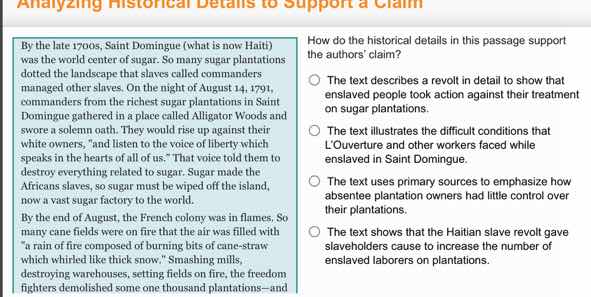
by the late 1700s, saint domingue (what is now haiti) was the world center of sugar. so many sugar plantations dotted the landscape that slaves called commanders managed other slaves. on the night of august 14, 1791, commanders from the richest sugar plantations in saint domingue gathered. they would rise up against their white owners. in a place called alligator woods and swore a solemn oath in a place called alligator woods and speak in the “hearts of all of us.” that voice told them to destroy everything related to sugar. sugar made the africans slaves, so sugar must be wiped off the island, now a vast sugar factory to the world.
by the end of august, the french colony was in flames. so many cane fields were on fire that the air was filled with “a rain of fire like that of burning cane - straw which whirled composed thick.” smashing mills, destroying warehouses, setting them on fire, the freedom fighters demolished some one thousand plantations - and
how do the historical details in this passage support the authors claim?
the text describes a revolt in detail to show that enslaved people took action against their treatment on sugar plantations.
the text illustrates the difficult conditions that louverture and other workers faced while enslaved in saint domingue.
the text uses primary sources to emphasize how absentee plantation owners had little control over their plantations.
the text shows that the haitian slave revolt gave slaveholders cause to increase the number of enslaved laborers on plantations.
To solve this, we analyze each option:
- First Option: The passage details the August 14, 1791 revolt (e.g., enslaved people gathering, the call to destroy sugar, and the resulting fires). This shows enslaved people acting against their treatment on sugar plantations.
- Second Option: The text focuses on the revolt, not conditions of work (like labor or environment) for Toussaint and others. Eliminate.
- Third Option: The text does not use primary sources (no direct quotes from plantation owners or records of their “control”). It describes the revolt, not owner control. Eliminate.
- Fourth Option: The passage shows the revolt destroyed plantations, so slaveholders would not increase enslaved labor (they lost plantations). This is incorrect.
The passage details the 1791 slave revolt in Saint Domingue, including how enslaved people gathered, were called to destroy sugar (a symbol of their oppression), and the resulting destruction of plantations. This directly shows enslaved people taking action against their treatment on sugar plantations. Other options are incorrect: the text does not focus on work conditions (second), use primary sources about owner control (third), or suggest slaveholders increased labor (fourth).

Snap & solve any problem in the app
Get step-by-step solutions on Sovi AI
Photo-based solutions with guided steps
Explore more problems and detailed explanations
A. The text describes a revolt in detail to show that enslaved people took action against their treatment on sugar plantations