QUESTION IMAGE
Question
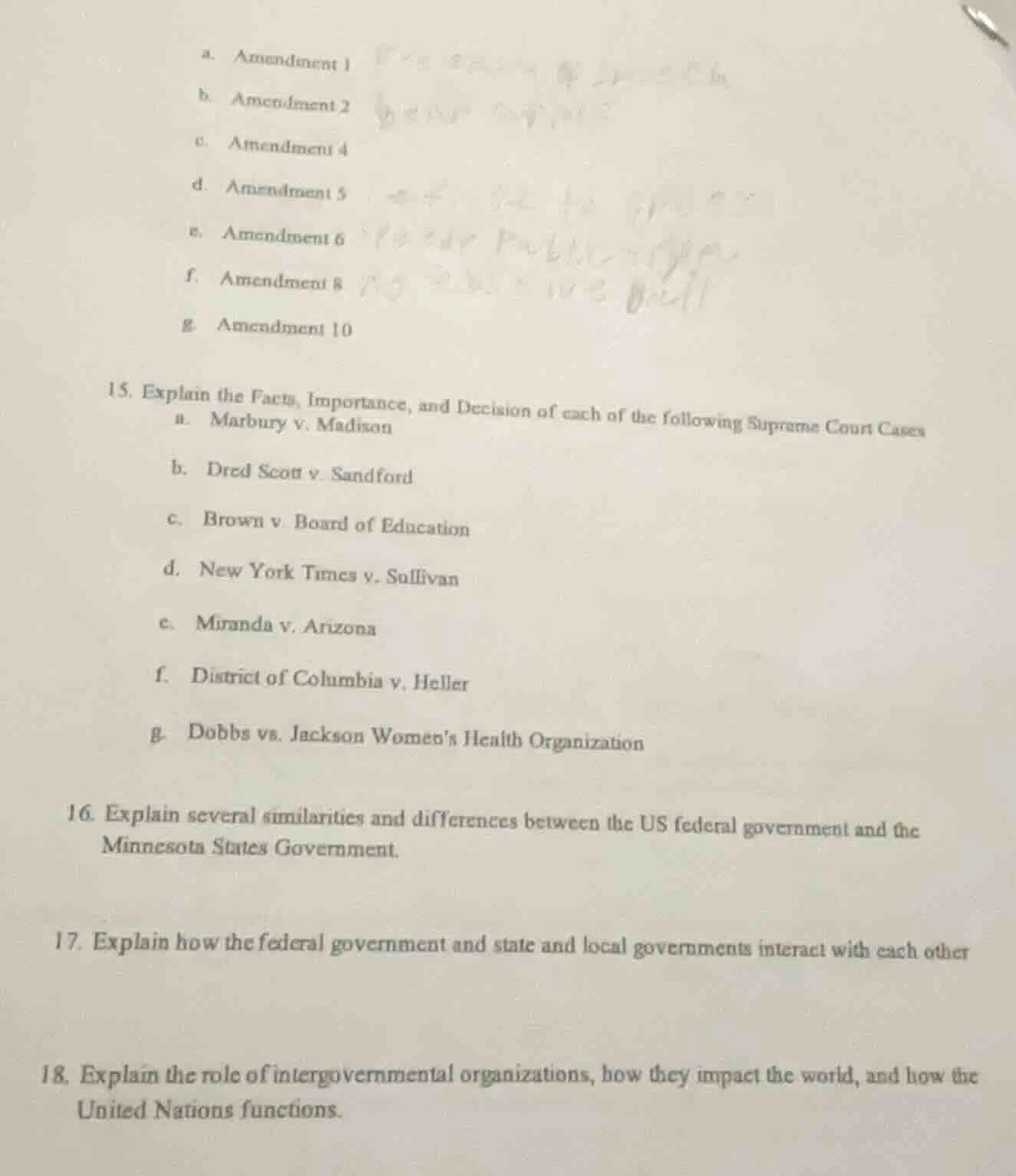
a. amendment 1
b. amendment 2
c. amendment 4
d. amendment 5
e. amendment 6
f. amendment 8
g. amendment 10
- explain the facts, importance, and decision of each of the following supreme court cases
a. marbury v. madison
b. dred scott v. sandford
c. brown v. board of education
d. new york times v. sullivan
e. miranda v. arizona
f. district of columbia v. heller
g. dobbs vs. jackson womens health organization
- explain several similarities and differences between the us federal government and the minnesota states government.
- explain how the federal government and state and local governments interact with each other
- explain the role of intergovernmental organizations, how they impact the world, and how the united nations functions.
Question 15a: Marbury v. Madison
Brief Explanations
- Facts: William Marbury was appointed as a justice of the peace by President John Adams. But Thomas Jefferson, the new president, instructed James Madison (Secretary of State) not to deliver Marbury’s commission. Marbury sought a writ of mandamus from the Supreme Court to compel Madison to deliver it.
- Importance: This case established the principle of judicial review, meaning the Supreme Court can declare laws (or actions) unconstitutional. It defined the power of the judiciary to check the other branches.
- Decision: The Court ruled that while Marbury had a right to his commission, the Judiciary Act of 1789 (which he used to seek the writ) was unconstitutional. So, the Court couldn't issue the writ, establishing judicial review.
Brief Explanations
- Facts: Dred Scott, an enslaved person, lived in free states/territories (Illinois, Wisconsin Territory) and then sued for freedom, claiming residence in free areas made him free.
- Importance: It was a major precedent before the Civil War, denying citizenship to African Americans and invalidating the Missouri Compromise, worsening sectional tensions.
- Decision: The Court ruled Scott wasn't a citizen (so couldn't sue), that enslaved people were property, and the Missouri Compromise was unconstitutional (Congress couldn't ban slavery in territories).
Brief Explanations
- Facts: Several cases (including Brown) challenged racial segregation in public schools, claiming "separate but equal" was unequal.
- Importance: Overturned Plessy v. Ferguson’s "separate but equal" doctrine in education, a key moment in the Civil Rights Movement, advancing racial integration.
- Decision: The Court unanimously ruled that racial segregation in public schools was unconstitutional as it violated the Equal Protection Clause of the 14th Amendment.

Snap & solve any problem in the app
Get step-by-step solutions on Sovi AI
Photo-based solutions with guided steps
Explore more problems and detailed explanations
- Facts: Marbury sought commission delivery; Madison refused.
- Importance: Established judicial review.
- Decision: Judiciary Act 1789 unconstitutional; no writ issued.