QUESTION IMAGE
Question
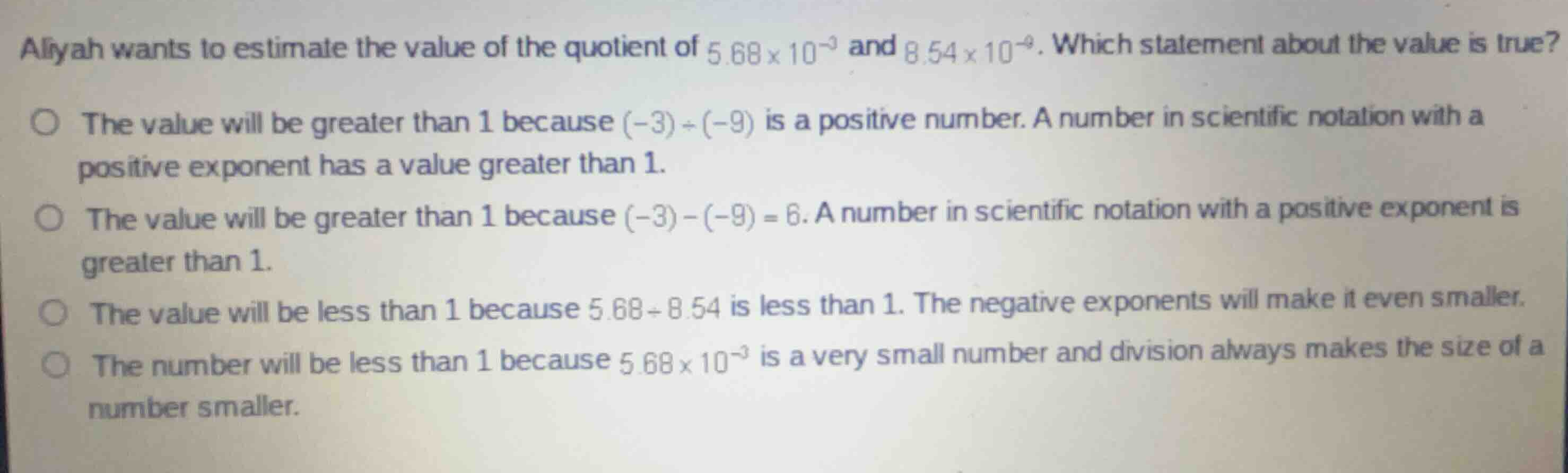
aliyah wants to estimate the value of the quotient of (5.68 \times 10^{-3}) and (8.54 \times 10^{-9}). which statement about the value is true?
- the value will be greater than 1 because ((-3) \div (-9)) is a positive number. a number in scientific notation with a positive exponent has a value greater than 1.
- the value will be greater than 1 because ((-3) - (-9) = 6). a number in scientific notation with a positive exponent is greater than 1.
- the value will be less than 1 because (5.68 \div 8.54) is less than 1. the negative exponents will make it even smaller.
- the number will be less than 1 because (5.68 \times 10^{-3}) is a very small number and division always makes the size of a number smaller.
Set up the quotient expression
$$
Q = \frac{5.68 \times 10^{-3}}{8.54 \times 10^{-9}}
$$
Apply exponent rules to the powers of ten
$$
\frac{10^{-3}}{10^{-9}} = 10^{-3 - (-9)} = 10^{-3 + 9} = 10^6
$$
Estimate the final value
$$
Q = \frac{5.68}{8.54} \times 10^6 \approx 0.665 \times 10^6 = 6.65 \times 10^5
$$
$$
6.65 \times 10^5 > 1
$$

Snap & solve any problem in the app
Get step-by-step solutions on Sovi AI
Photo-based solutions with guided steps
Explore more problems and detailed explanations
- The value will be greater than 1 because \((-3) \div (-9)\) is a positive number. A number in scientific notation with a positive exponent has a value greater than 1.
- The value will be greater than 1 because \((-3) - (-9) = 6\). A number in scientific notation with a positive exponent is greater than 1. (Correct answer)
- The value will be less than 1 because \(5.68 \div 8.54\) is less than 1. The negative exponents will make it even smaller.
- The number will be less than 1 because \(5.68 \times 10^{-3}\) is a very small number and division always makes the size of a number smaller.