QUESTION IMAGE
Question
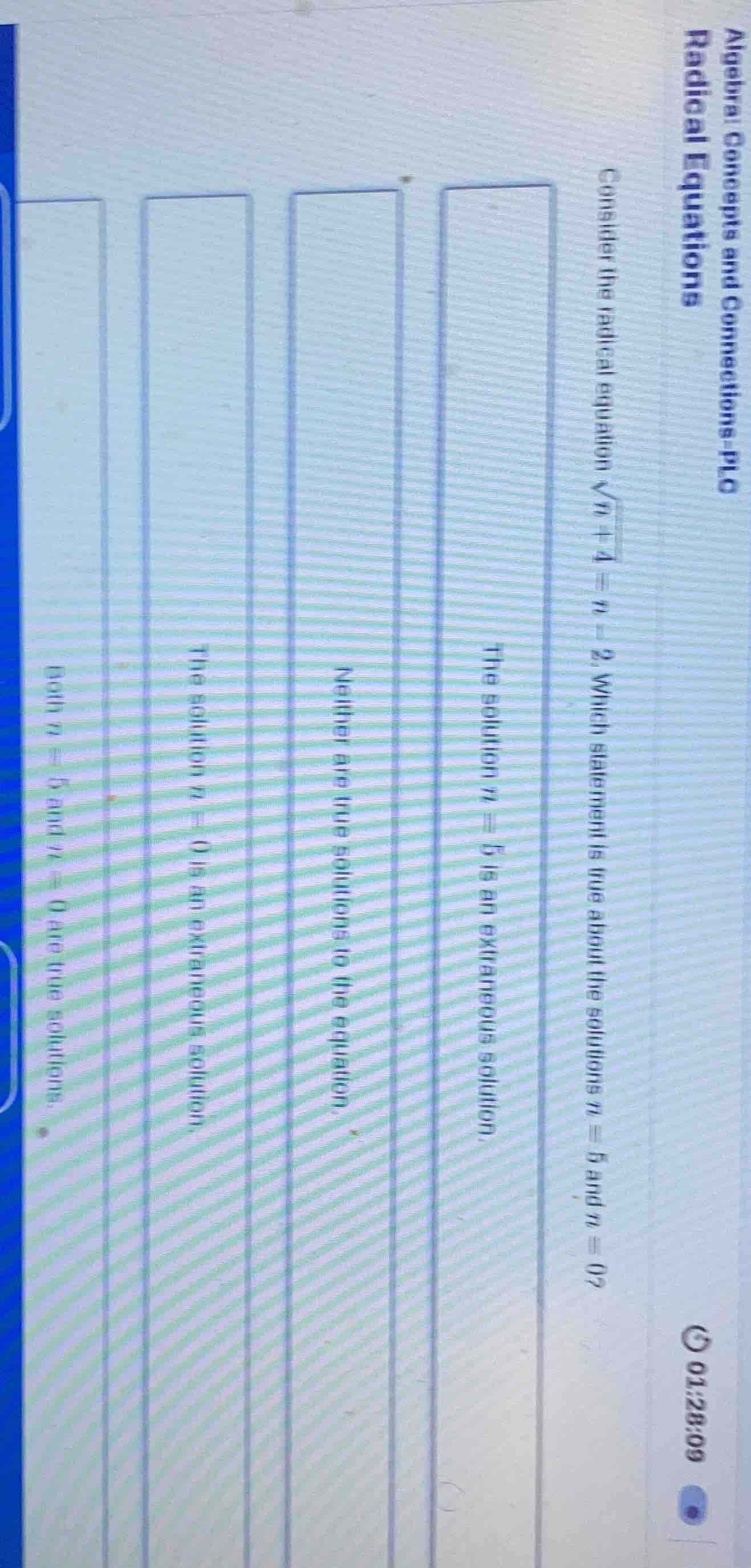
algebra: concepts and connections - plo radical equations consider the radical equation \\(\sqrt{n + 4} = n - 2\\). which statement is true about the solutions \\(n = 5\\) and \\(n = 0\\)? the solution \\(n = 5\\) is an extraneous solution. neither are true solutions to the equation. the solution \\(n = 0\\) is an extraneous solution. both \\(n = 5\\) and \\(n = 0\\) are true solutions.
Step1: Square both sides
$$(\sqrt{n+4})^2=(n-2)^2$$
$$n+4=n^2-4n+4$$
Step2: Rearrange to quadratic form
$$n^2-5n=0$$
$$n(n-5)=0$$
Step3: Solve for n
$$n=0 \text{ or } n=5$$
Step4: Check n=0 in original equation
$$\sqrt{0+4}=0-2$$
$$2=-2 \quad \text{(False, extraneous)}$$
Step5: Check n=5 in original equation
$$\sqrt{5+4}=5-2$$
$$3=3 \quad \text{(True, valid)}$$

Snap & solve any problem in the app
Get step-by-step solutions on Sovi AI
Photo-based solutions with guided steps
Explore more problems and detailed explanations
The solution $n = 0$ is an extraneous solution.