QUESTION IMAGE
Question
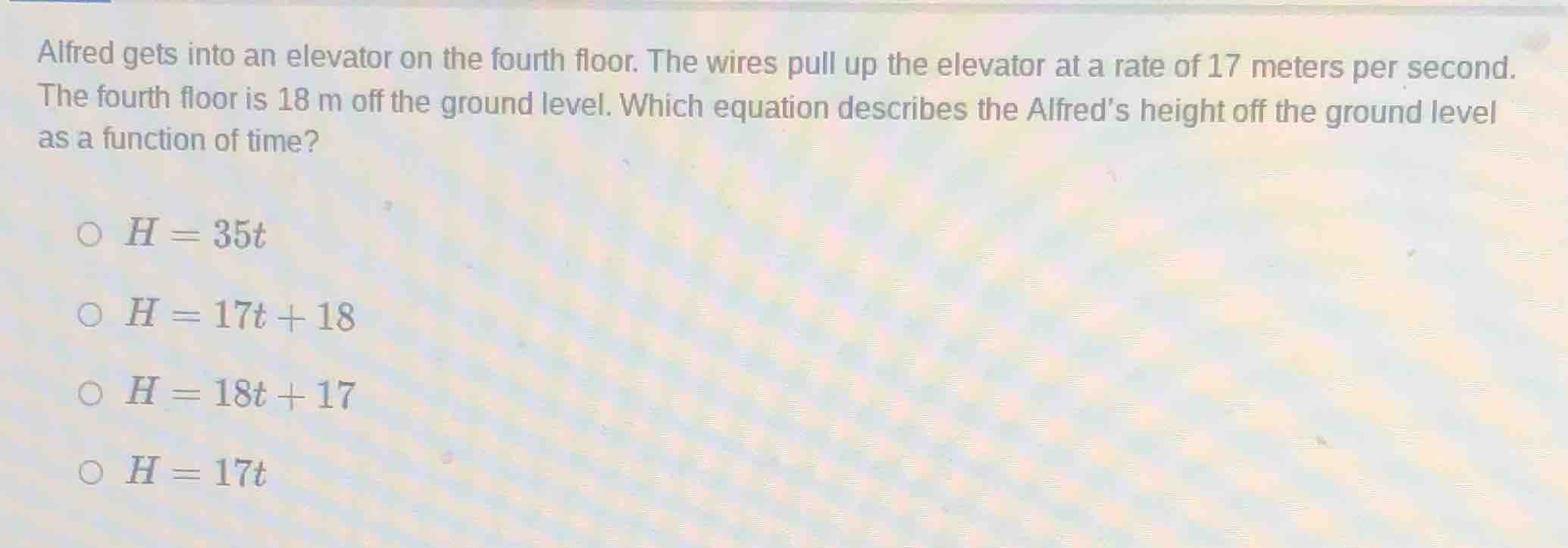
alfred gets into an elevator on the fourth floor. the wires pull up the elevator at a rate of 17 meters per second. the fourth floor is 18 m off the ground level. which equation describes the alfreds height off the ground level as a function of time?
\\(h = 35t\\)
\\(h = 17t + 18\\)
\\(h = 18t + 17\\)
\\(h = 17t\\)
Identify the initial value
The problem states that Alfred starts on the fourth floor, which is \(18\text{ m}\) off the ground level. This represents the initial height when time \(t = 0\). Thus, the vertical intercept (or initial value) is \(18\).
Identify the rate of change
The elevator is pulled up at a rate of \(17\text{ meters per second}\). Since the elevator is moving upward, this rate of change is positive. Thus, the slope (or rate of change) is \(17\).
Formulate the linear equation
Using the slope-intercept form of a linear equation, \(y = mx + b\), we can write the height \(H\) as a function of time \(t\):

Snap & solve any problem in the app
Get step-by-step solutions on Sovi AI
Photo-based solutions with guided steps
Explore more problems and detailed explanations
- (A) \(H = 35t\)
- (B) \(H = 17t + 18\) (Correct answer)
- (C) \(H = 18t + 17\)
- (D) \(H = 17t\)