QUESTION IMAGE
Question
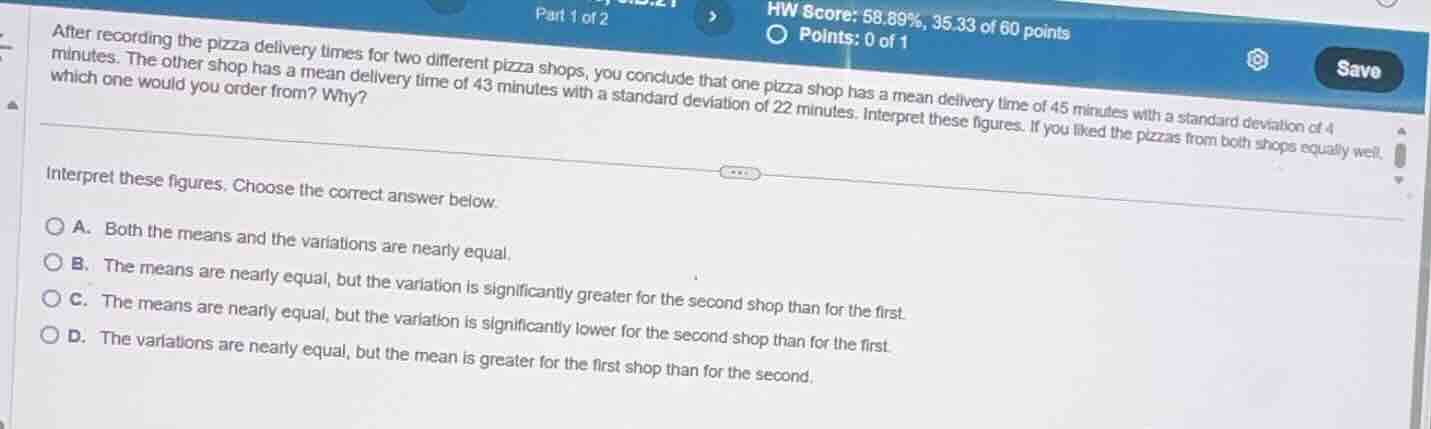
after recording the pizza delivery times for two different pizza shops, you conclude that one pizza shop has a mean delivery time of 45 minutes with a standard deviation of 4 minutes. the other shop has a mean delivery time of 43 minutes with a standard deviation of 22 minutes. interpret these figures. if you liked the pizzas from both shops equally well, which one would you order from? why?
interpret these figures. choose the correct answer below.
a. both the means and the variations are nearly equal.
b. the means are nearly equal, but the variation is significantly greater for the second shop than for the first.
c. the means are nearly equal, but the variation is significantly lower for the second shop than for the first.
d. the variations are nearly equal, but the mean is greater for the first shop than for the second.
Identify the given statistics
Using the Measures of Center knowledge point
Compare the means of both shops
The mean delivery times are \(45\text{ minutes}\) and \(43\text{ minutes}\). Since the difference is only \(2\text{ minutes}\), the means are nearly equal.
Compare the variations of both shops
The standard deviation measures the variation or spread of the delivery times.
- Shop 1 has a standard deviation of \(\sigma_1 = 4\text{ minutes}\).
- Shop 2 has a standard deviation of \(\sigma_2 = 22\text{ minutes}\).
Comparing these values:
Thus, the variation is significantly greater for the second shop than for the first shop.
Match with the correct option
Combining our findings:
- The means are nearly equal (\(45\) vs. \(43\) minutes).
- The variation is significantly greater for the second shop (\(22\) minutes) than for the first shop (\(4\) minutes).
This matches option B.

Snap & solve any problem in the app
Get step-by-step solutions on Sovi AI
Photo-based solutions with guided steps
Explore more problems and detailed explanations
- (A) Both the means and the variations are nearly equal.
- (B) The means are nearly equal, but the variation is significantly greater for the second shop than for the first. (Correct answer)
- (C) The means are nearly equal, but the variation is significantly lower for the second shop than for the first.
- (D) The variations are nearly equal, but the mean is greater for the first shop than for the second.