QUESTION IMAGE
Question
adapted from \adolescent sleep patterns and daytime sleepiness\
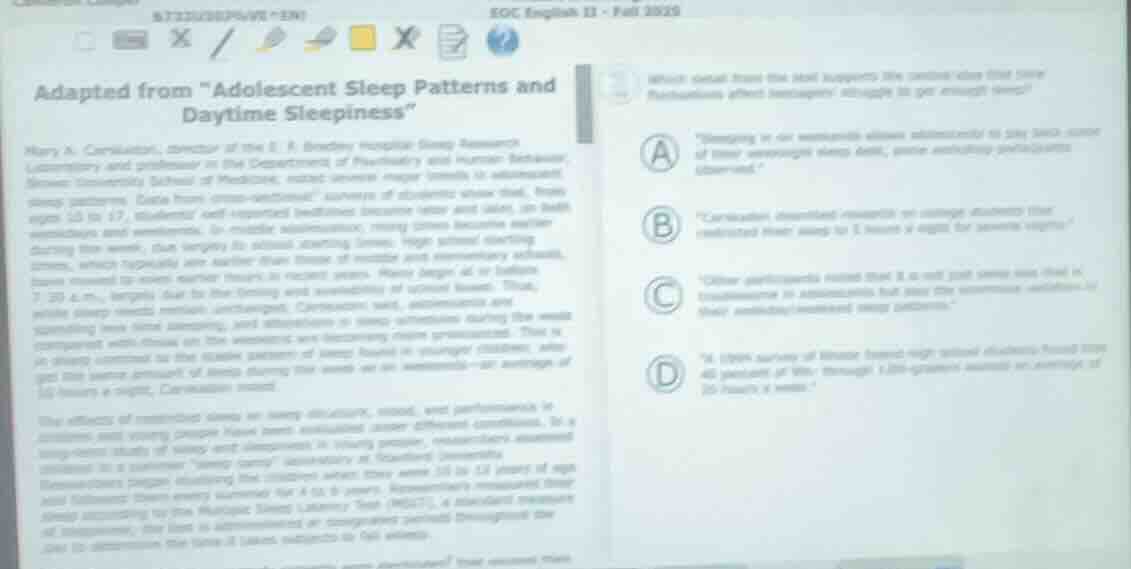
mary a. carskadon, director of the e. p. bradley hospital sleep research laboratory and professor in the department of psychiatry and human behavior, brown university school of medicine, noted: \some of my clients are adolescent sleep patients. data from cross - sectional surveys of students show that, from ages 13 to 19, students self - reported bedtimes become later and later, on both weekdays and weekends. in middle adolescence, rising times become earlier during the week, but slightly to modestly later on weekends because of later bedtimes. with the opening of school starting times, high school starting times, which typically are earlier than those of mixed and larger elementary schools, have moved even earlier in recent years. teens are at a loss of about 1.33 hours of sleep per school night, carskadon said. mixed - age survey results show that, by 7:30 a.m., typical, due to the timing and scheduling of school - based and work - sleep schedules, adolescents are becoming more sleep - deprived. this is especially true in the morning, and the situation is becoming more pronounced. the sleep - deprived state on school days is comparable with the sleep pattern of being bored in younger children, and yet the same amount of sleep during the week or on weekends — an average of 10 hours a night, carskadon noted.
the effects of restricted sleep or sleep deprivation, mood, and performance in children and young people have been evaluated under different conditions. in a long - term study of sleep - deprived adolescents in young people, researchers assessed tolerance to a program sleep camp where they were 10 to 12 hours of age and followed them every summer for 4 to 6 years. researchers measured their sleep and daytime sleepiness. dilemma test (mslt), a standard measure of sleepiness, the loss is diminishing as compared with previous years throughout the...
which detail from the text supports the central idea that time restrictions affect teenagers ability to get enough sleep?
a \sleeping in on weekends allows adolescents to get back most of their average sleep debt, some sleeping participants observed.\
b \carnegie sponsored research on college students that restricted their sleep to 4 hours a night for several nights.\
c \other participants noted that it is not just some kids that is troublesome in adolescence but also the hormones and the... their weekday - weekend sleep patterns.\
d \a 1996 survey of rhode island high school students found that 40 percent of 9th - through 12th - graders averaged an average of 6.5 hours a night.\
To solve this question, we need to determine which option best supports the central idea that time restrictions affect teenagers’ ability to get enough sleep. Let's analyze each option:
- Option A: Talks about sleeping on weekends to make up for lost sleep, not about time restrictions affecting sleep. Eliminate A.
- Option B: Describes a study where participants (college students, not teenagers) had restricted sleep. The focus is on college students, not teenagers, so it does not directly support the idea about teenagers. Eliminate B.
- Option C: Discusses participants noting non - time - related factors (not time restrictions) affecting sleep patterns. Eliminate C.
- Option D: A 1998 survey of Maine high school students found 40% of 9th - 12th graders averaged 6.5 hours of sleep, showing that school - related time restrictions (like early start times, heavy workloads) likely contribute to insufficient sleep for teenagers. This directly supports the central idea.

Snap & solve any problem in the app
Get step-by-step solutions on Sovi AI
Photo-based solutions with guided steps
Explore more problems and detailed explanations
D. A 1998 survey of Maine - based high school students found that 40 percent of 9th through 12th - graders averaged 6.5 hours a night.