QUESTION IMAGE
Question
i. activity no. 2: leron-leron sinta
ii. objective(s): determine the emerging concepts, techniques, and processes of a creative work from a selected creative industry.
iii. materials needed: ballpen, picture, worksheet, video of the philippine madrigal singers
iv. instructions:
watch the video performance of the philippine madrigal singers then identify the emerging concept, techniques, and processes used. write it in the spaces provided for each item.
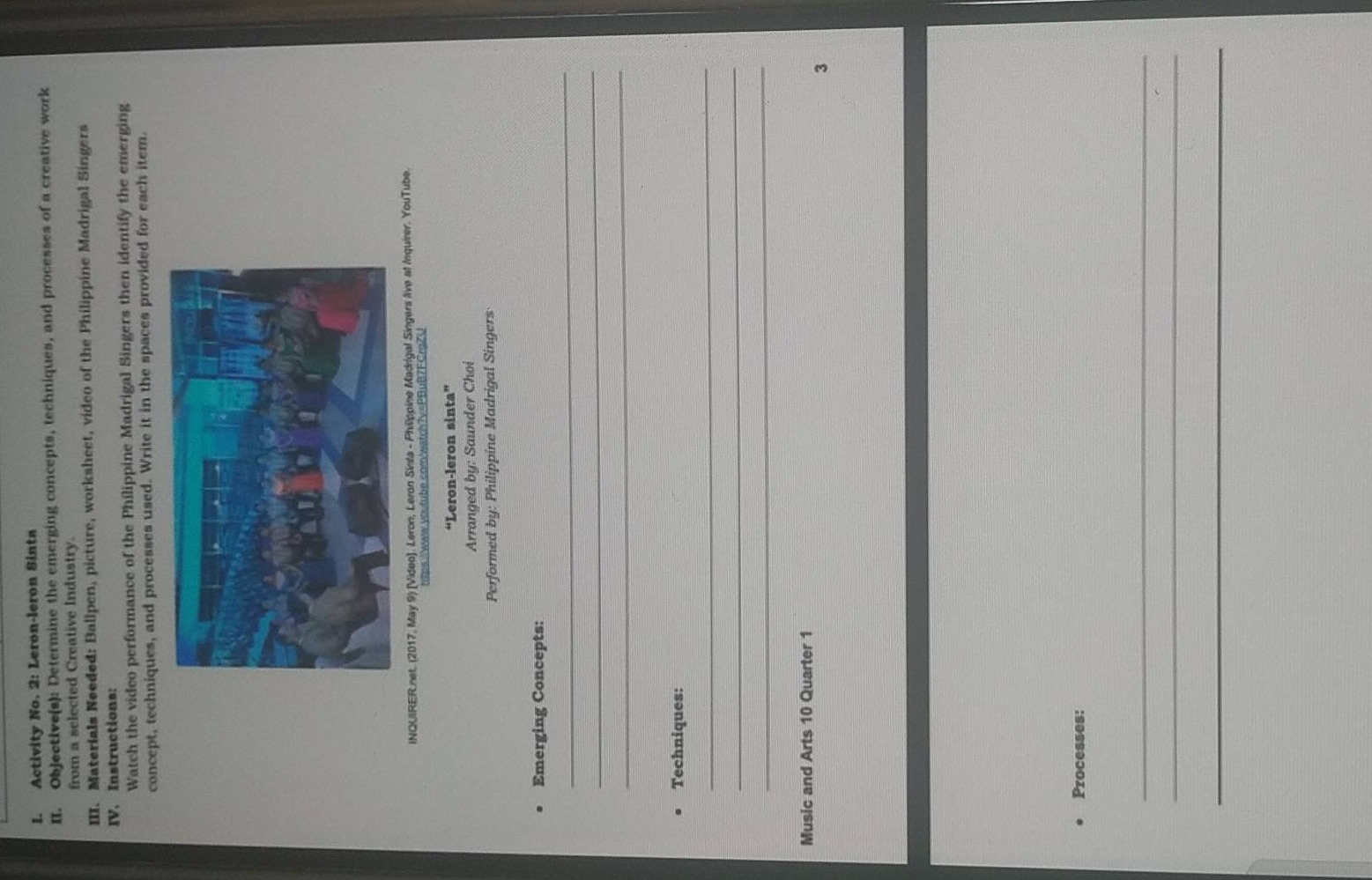
\leron-leron sinta\
arranged by: saunder choi
performed by: philippine madrigal singers
- emerging concepts:
__________________________________________________
__________________________________________________
__________________________________________________
- techniques:
__________________________________________________
__________________________________________________
__________________________________________________
- processes:
__________________________________________________
__________________________________________________
__________________________________________________
🆕 New Concept Discovered: Choral Performance Analysis
Analyzing how vocal ensembles arrange, interpret, and execute musical works.
Step 1: Identify Emerging Concepts
The performance of "Leron, Leron Sinta" arranged by Saunder Choi and performed by the Philippine Madrigal Singers (Madz) showcases several modern musical and artistic concepts:
- Contemporary Choral Arranging: Taking a traditional, simple Filipino folk song and transforming it into a complex, multi-layered choral masterpiece using modern harmonies, syncopation, and vocal textures.
- Cultural Preservation and Innovation: Merging traditional Filipino heritage (folklore and folk music) with global, contemporary classical choral standards to make it relevant to modern audiences.
- A Cappella Excellence: Performing entirely without instrumental accompaniment, relying solely on the human voice to create rhythm, harmony, melody, and atmospheric soundscapes.
Step 2: Identify Techniques
The Philippine Madrigal Singers are world-renowned for their unique performance style and technical mastery. Key techniques observed in this performance include:
- Semicircular Seating/Standing Arrangement: The singers perform sitting down in a semi-circle without a visible conductor. This requires intense listening, eye contact, and internal pulse synchronization among the members.
- Vocal Polyphony and Counterpoint: Using multiple independent vocal lines that weave in and out, creating a rich, complex texture rather than simple homophonic singing.
- Extended Vocal Techniques: Incorporating non-traditional vocal sounds such as rhythmic speech, percussive vocalizations, and dynamic swells to mimic instruments or add dramatic flair.
- Dynamic Contrast and Precision: Seamlessly shifting from extremely soft, delicate tones (pianissimo) to powerful, resonant climaxes (fortissimo) with perfect vocal blend and intonation.
Step 3: Identify Processes
The creation and execution of this creative work involve several distinct phases:
- Arrangement and Adaptation: The arranger, Saunder Choi, deconstructs the original melody of "Leron, Leron Sinta" and reconstructs it with new harmonic progressions, rhythmic variations, and voice-leading structures.
- Rehearsal and Internalization: Because they perform without a conductor, the singers undergo a rigorous rehearsal process to internalize the tempo, pitch, cues, and emotional expression of the piece.
- Collaborative Performance: During the live performance, the singers continuously adjust their volume, tone, and timing in real-time by listening closely to one another, achieving a unified collective sound.
---

Snap & solve any problem in the app
Get step-by-step solutions on Sovi AI
Photo-based solutions with guided steps
Explore more problems and detailed explanations
Here are the completed sections for your worksheet:
- Emerging Concepts:
- Contemporary Choral Arranging: Transforming a traditional Filipino folk song into a complex, multi-layered modern choral work.
- Cultural Preservation through Innovation: Elevating local heritage to the global stage by blending folk melodies with contemporary classical elements.
- A Cappella Artistry: Creating a complete musical landscape using only the human voice without any instrumental accompaniment.
- Techniques:
- Semicircular Seating (No Conductor): Performing in a semi-circle while seated, relying on eye contact, mutual cues, and active listening instead of a traditional conductor.
- Vocal Polyphony: Weaving multiple independent melodic lines together to create a rich, complex harmonic texture.
- Extended Vocalizations: Using rhythmic speech, vocal percussion, and dramatic dynamic swells to add texture and excitement to the folk song.
- Processes:
- Deconstruction and Recomposition: The arranger reimagines the simple folk melody with advanced harmonies and rhythmic structures.
- Collaborative Internalization: The ensemble rehearses intensively to memorize and internalize the tempo, pitch, and cues without external direction.
- Real-Time Synchronization: During the performance, the singers actively listen and adjust to one another to maintain perfect blend, balance, and expression.