QUESTION IMAGE
Question
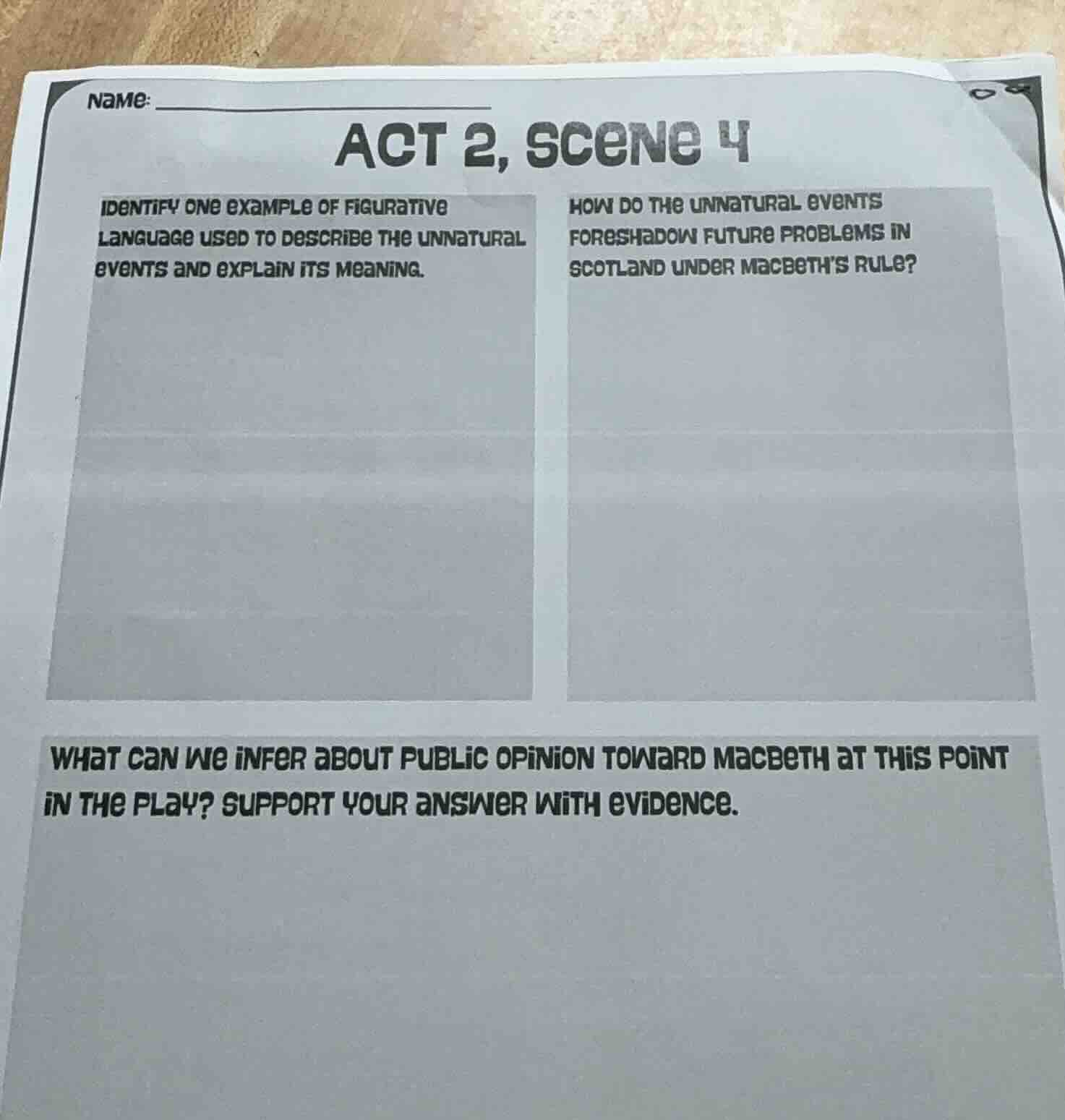
act 2, scene 4
identify one example of figurative language used to describe the unnatural events and explain its meaning.
how do the unnatural events foreshadow future problems in scotland under macbeths rule?
what can we infer about public opinion toward macbeth at this point in the play? support your answer with evidence.
Analyze figurative language in Act 2, Scene 4
- Example: The Old Man describes Duncan's horses eating each other: "'Tis said they eat each other."
- Device: Personification/Metaphor representing the breakdown of natural order.
- Meaning: The unnatural behavior of the horses symbolizes how Macbeth's murder of Duncan has violated the natural hierarchy and turned countrymen against one another.
Analyze foreshadowing of future problems
- Unnatural events: Darkness during the day ("darkness does the face of earth entomb"), a falcon killed by an owl, and Duncan's horses turning wild and eating each other.
- Foreshadowing: These disruptions in nature mirror the political chaos, moral darkness, and civil warfare that will plague Scotland under Macbeth's tyrannical, illegitimate rule.
Infer public opinion toward Macbeth
- Inference: Public opinion is deeply unsettled, suspicious, and fearful, though people are hesitant to speak out directly.
- Evidence: Macduff decides not to attend Macbeth's coronation at Scone, choosing instead to return home to Fife ("No, cousin, I'll to Fife"), signaling his silent protest and lack of trust in the new king.

Snap & solve any problem in the app
Get step-by-step solutions on Sovi AI
Photo-based solutions with guided steps
Explore more problems and detailed explanations
Question 1
- Figurative Language Example: "Darkness does the face of earth entomb, / When living light should kiss it" (Act 2, Scene 4, Lines 9–10).
- Meaning: This personification of darkness burying the earth symbolizes how Duncan's murder has cast a moral and spiritual shadow over Scotland, choking out the rightful, "living" light of Duncan's reign.
Question 2
- Foreshadowing: The unnatural disruptions in nature—such as daytime darkness, a mousing owl killing a towering falcon, and Duncan's horses eating one another—foreshadow the political chaos, rebellion, and self-destructive tyranny that will consume Scotland under Macbeth's unnatural rule.
Question 3
- Inference: The public and nobility are deeply suspicious, uneasy, and quietly resistant to Macbeth's sudden rise to power.
- Evidence: Macduff refuses to attend Macbeth's coronation at Scone, stating, "No, cousin, I'll to Fife" (Act 2, Scene 4, Line 36), which reveals his silent distrust and refusal to support the new king.