QUESTION IMAGE
Question
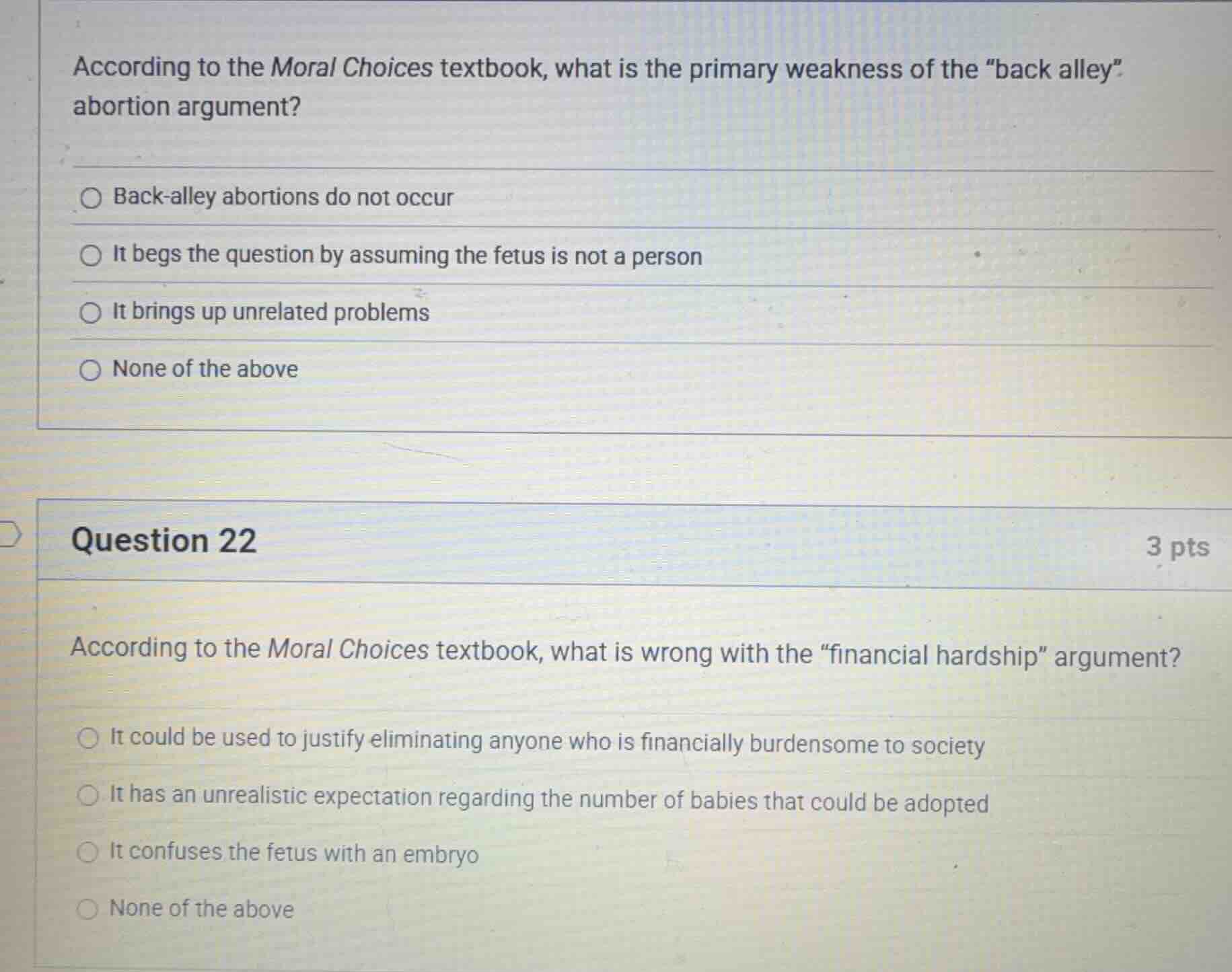
according to the moral choices textbook, what is the primary weakness of the \back alley\ abortion argument?
- back-alley abortions do not occur
- it begs the question by assuming the fetus is not a person
- it brings up unrelated problems
- none of the above
question 22 (3 pts)
according to the moral choices textbook, what is wrong with the \financial hardship\ argument?
- it could be used to justify eliminating anyone who is financially burdensome to society
- it has an unrealistic expectation regarding the number of babies that could be adopted
- it confuses the fetus with an embryo
- none of the above
🆕 New Concept Discovered: Begging the Question in Ethical Arguments
Assuming the conclusion you are trying to prove
Step 1: Analyze the "Back-Alley" Argument Question
The first question asks for the primary weakness of the "back-alley" abortion argument according to the Moral Choices textbook by Scott Rae.
The "back-alley" argument asserts that making abortion illegal does not stop abortions; it only drives them underground, making them unsafe and dangerous for women. Therefore, the argument concludes, abortion should remain legal to ensure women's safety.
According to the textbook's critique, this argument assumes that the fetus is not a person with a right to life. If the fetus were a person, then the danger to the mother during an illegal act would not justify legalizing the termination of that person's life. By assuming from the outset that the fetus does not have the moral status of a person, the argument commits the logical fallacy of "begging the question" (assuming what it needs to prove).
Therefore, the correct option is: It begs the question by assuming the fetus is not a person.
Step 2: Analyze the "Financial Hardship" Argument Question
The second question asks what is wrong with the "financial hardship" argument according to the textbook.
The "financial hardship" argument suggests that abortion is permissible if raising the child would cause severe financial distress to the parents or family.
The textbook critiques this by pointing out the logical consequence of using financial burden as a justification for ending a life. If financial hardship justifies ending the life of a fetus, the same logic could be applied to justify eliminating other human beings who are financially burdensome to their families or society (such as the elderly, disabled, or impoverished).
Therefore, the correct option is: It could be used to justify eliminating anyone who is financially burdensome to society.

Snap & solve any problem in the app
Get step-by-step solutions on Sovi AI
Photo-based solutions with guided steps
Explore more problems and detailed explanations
- First Question: It begs the question by assuming the fetus is not a person
- Question 22: It could be used to justify eliminating anyone who is financially burdensome to society