QUESTION IMAGE
Question
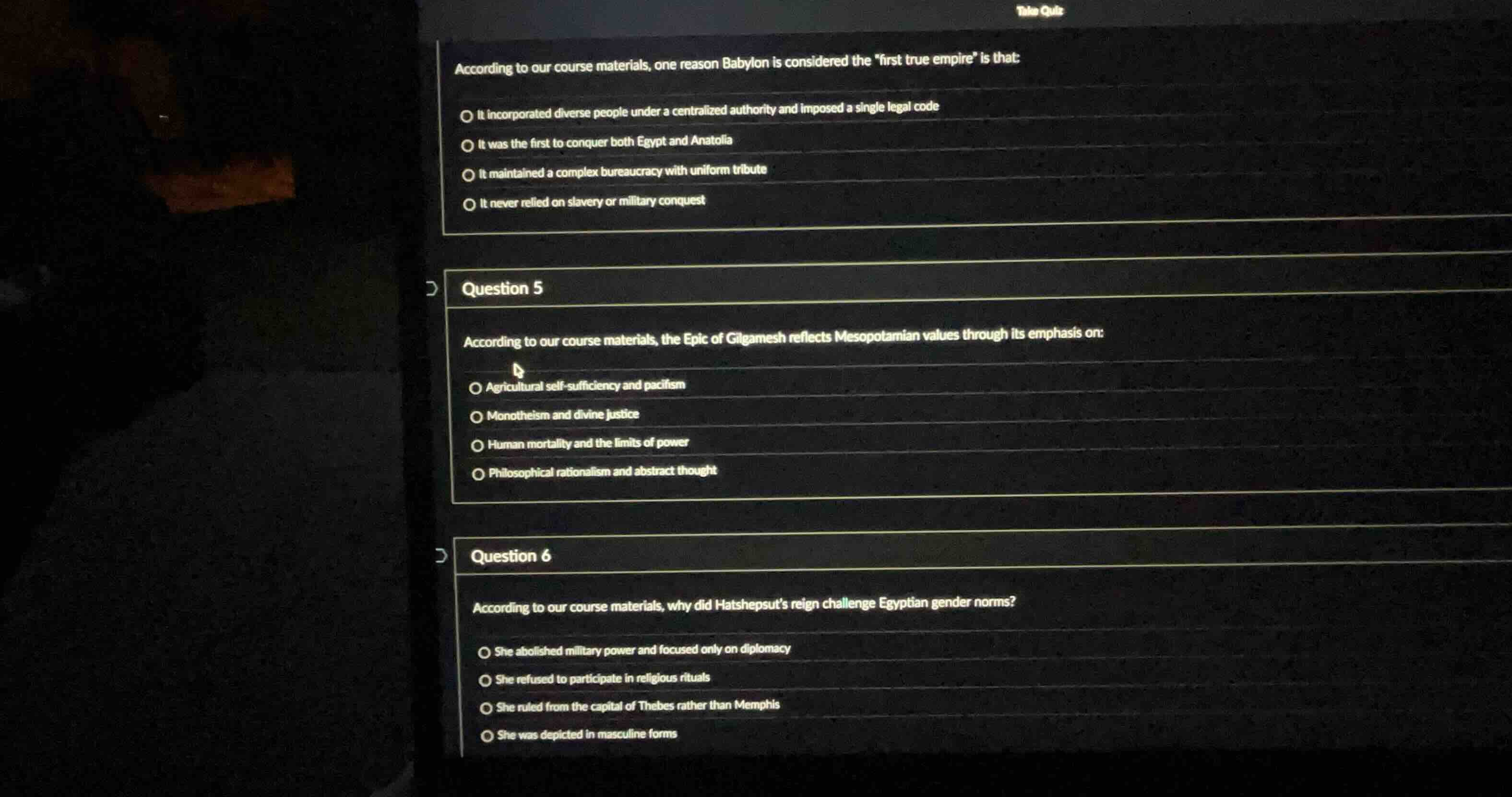
according to our course materials, one reason babylon is considered the \first true empire\ is that:
- it incorporated diverse people under a centralized authority and imposed a single legal code
- it was the first to conquer both egypt and anatolia
- it maintained a complex bureaucracy with uniform tribute
- it never relied on slavery or military conquest
question 5
according to our course materials, the epic of gilgamesh reflects mesopotamian values through its emphasis on:
- agricultural self-sufficiency and pacifism
- monotheism and divine justice
- human mortality and the limits of power
- philosophical rationalism and abstract thought
question 6
according to our course materials, why did hatshepsuts reign challenge egyptian gender norms?
- she abolished military power and focused only on diplomacy
- she refused to participate in religious rituals
- she ruled from the capital of thebes rather than memphis
- she was depicted in masculine forms
Analyze the first question on Babylon
The first question asks why Babylon is considered the "first true empire." An empire is defined by incorporating diverse populations under a centralized authority. Babylon achieved this and imposed a single legal code (the Code of Hammurabi) to unify these diverse groups.
Analyze Question 5 on the Epic of Gilgamesh
The Epic of Gilgamesh is a Mesopotamian epic poem. A central theme of the epic is Gilgamesh's quest for immortality after the death of Enkidu, which ultimately highlights human mortality and the limits of even a semi-divine king's power.
Analyze Question 6 on Hatshepsut
Hatshepsut was a female pharaoh of Egypt. To legitimize her rule within traditional Egyptian gender norms, she was frequently depicted in masculine forms, including wearing the traditional pharaonic false beard and kilt in official statues and reliefs.

Snap & solve any problem in the app
Get step-by-step solutions on Sovi AI
Photo-based solutions with guided steps
Explore more problems and detailed explanations
Question 4
- (A) It incorporated diverse people under a centralized authority and imposed a single legal code (Correct answer)
- (B) It was the first to conquer both Egypt and Anatolia
- (C) It maintained a complex bureaucracy with uniform tribute
- (D) It never relied on slavery or military conquest
Question 5
- (A) Agricultural self-sufficiency and pacifism
- (B) Monotheism and divine justice
- (C) Human mortality and the limits of power (Correct answer)
- (D) Philosophical rationalism and abstract thought
Question 6
- (A) She abolished military power and focused only on diplomacy
- (B) She refused to participate in religious rituals
- (C) She ruled from the capital of Thebes rather than Memphis
- (D) She was depicted in masculine forms (Correct answer)