QUESTION IMAGE
Question
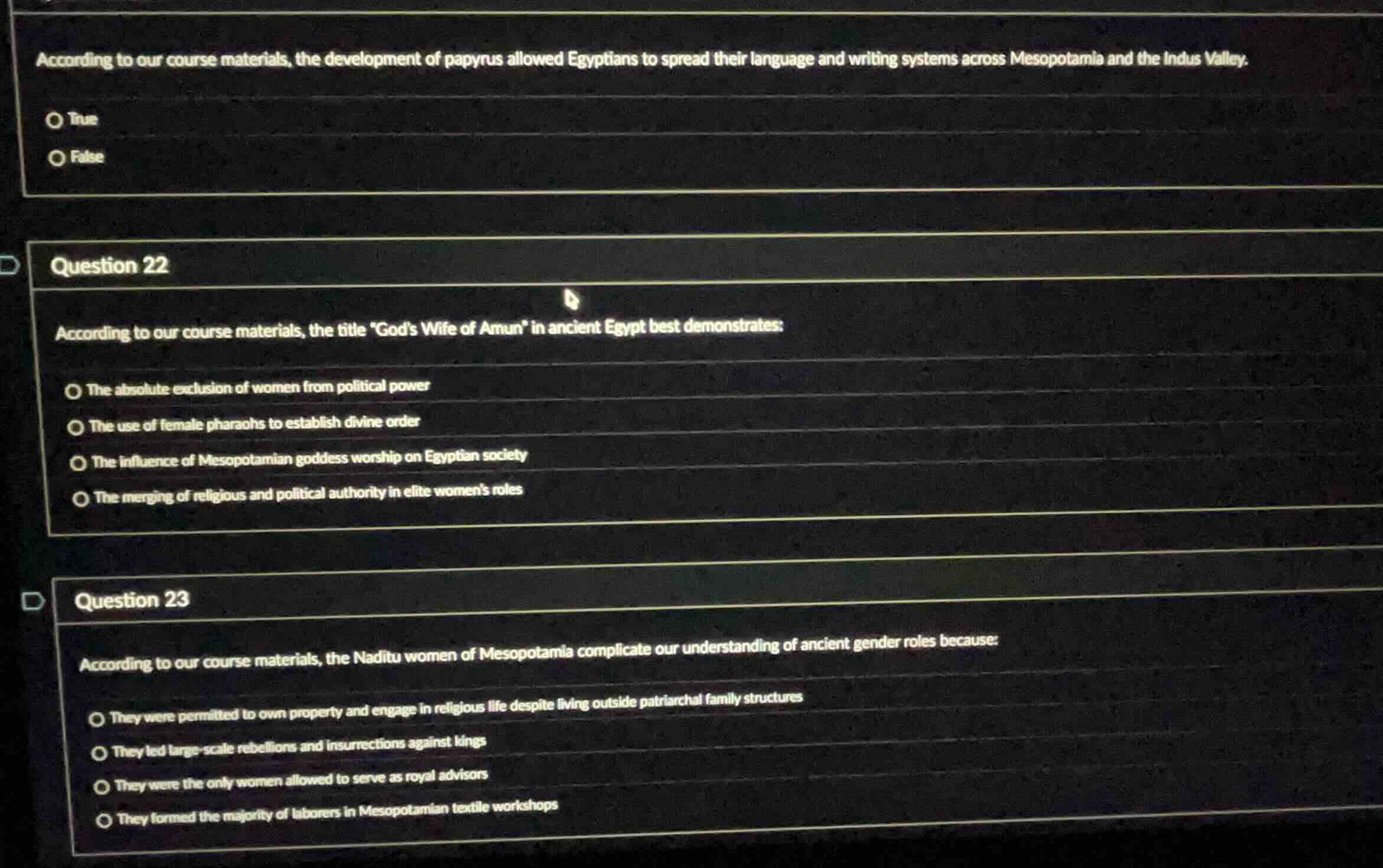
according to our course materials, the development of papyrus allowed egyptians to spread their language and writing systems across mesopotamia and the indus valley.
true
false
question 22
according to our course materials, the title \gods wife of amun\ in ancient egypt best demonstrates:
the absolute exclusion of women from political power
the use of female pharaohs to establish divine order
the influence of mesopotamian goddess worship on egyptian society
the merging of religious and political authority in elite womens roles
question 23
according to our course materials, the naditu women of mesopotamia complicate our understanding of ancient gender roles because:
they were permitted to own property and engage in religious life despite living outside patriarchal family structures
they led large-scale rebellions and insurrections against kings
they were the only women allowed to serve as royal advisors
they formed the majority of laborers in mesopotamian textile workshops
<pre_analysis>
{
"quality": "clear",
"question_count": 3,
"skills_matched": [
"direct_cot",
"multiple_choice_formatter",
"explain_then_answer",
"quick"
],
"needs_drawing": false,
"concepts_used": [],
"new_concepts": [
"God's Wife of Amun",
"Naditu Women",
"Papyrus Distribution"
],
"current_concepts": [
"Egyptian Writing Systems",
"New Kingdom Egypt",
"Mesopotamian Statecraft",
"Neolithic Gender Roles"
]
}
</pre_analysis>
<reasoning>
Analyze the papyrus statement
The statement claims papyrus allowed Egyptians to spread their language and writing systems across Mesopotamia and the Indus Valley. This is historically incorrect; Mesopotamia used cuneiform on clay tablets, and the Indus Valley had its own script. Papyrus was primarily used within Egypt and the Mediterranean basin.
Analyze Question 22
The title "God's Wife of Amun" was a high-ranking priestess role in ancient Egypt, often held by royal women. It combined immense religious prestige with political influence and economic power, demonstrating the merging of religious and political authority in elite women's roles.
Analyze Question 23
The Naditu were a class of independent women in Babylonian society (Mesopotamia) who lived in a temple complex. They could own property, engage in business contracts, and lived outside traditional patriarchal family structures, which complicates standard historical narratives of ancient gender roles.
</reasoning>
<answer>
Question 1
<mcq-option>True</mcq-option>
<mcq-correct>False</mcq-correct>
Question 22
<mcq-option>The absolute exclusion of women from political power</mcq-option>
<mcq-option>The use of female pharaohs to establish divine order</mcq-option>
<mcq-option>The influence of Mesopotamian goddess worship on Egyptian society</mcq-option>
<mcq-correct>The merging of religious and political authority in elite women's roles</mcq-correct>
Question 23
<mcq-correct>They were permitted to own property and engage in religious life despite living outside patriarchal family structures</mcq-correct>
<mcq-option>They led large-scale rebellions and insurrections against kings</mcq-option>
<mcq-option>They were the only women allowed to serve as royal advisors</mcq-option>
<mcq-option>They formed the majority of laborers in Mesopotamian textile workshops</mcq-option>
</answer>
<post_analysis>
{
"subject": "Social Science",
"question_type": "Multiple Choice",
"knowledge_point": [
"Social Science",
"History",
"Ancient Near East and Egypt"
]
}
</post_analysis>
Snap & solve any problem in the app
Get step-by-step solutions on Sovi AI
Photo-based solutions with guided steps
Explore more problems and detailed explanations
<pre_analysis>
{
"quality": "clear",
"question_count": 3,
"skills_matched": [
"direct_cot",
"multiple_choice_formatter",
"explain_then_answer",
"quick"
],
"needs_drawing": false,
"concepts_used": [],
"new_concepts": [
"God's Wife of Amun",
"Naditu Women",
"Papyrus Distribution"
],
"current_concepts": [
"Egyptian Writing Systems",
"New Kingdom Egypt",
"Mesopotamian Statecraft",
"Neolithic Gender Roles"
]
}
</pre_analysis>
<reasoning>
Analyze the papyrus statement
The statement claims papyrus allowed Egyptians to spread their language and writing systems across Mesopotamia and the Indus Valley. This is historically incorrect; Mesopotamia used cuneiform on clay tablets, and the Indus Valley had its own script. Papyrus was primarily used within Egypt and the Mediterranean basin.
Analyze Question 22
The title "God's Wife of Amun" was a high-ranking priestess role in ancient Egypt, often held by royal women. It combined immense religious prestige with political influence and economic power, demonstrating the merging of religious and political authority in elite women's roles.
Analyze Question 23
The Naditu were a class of independent women in Babylonian society (Mesopotamia) who lived in a temple complex. They could own property, engage in business contracts, and lived outside traditional patriarchal family structures, which complicates standard historical narratives of ancient gender roles.
</reasoning>
<answer>
Question 1
<mcq-option>True</mcq-option>
<mcq-correct>False</mcq-correct>
Question 22
<mcq-option>The absolute exclusion of women from political power</mcq-option>
<mcq-option>The use of female pharaohs to establish divine order</mcq-option>
<mcq-option>The influence of Mesopotamian goddess worship on Egyptian society</mcq-option>
<mcq-correct>The merging of religious and political authority in elite women's roles</mcq-correct>
Question 23
<mcq-correct>They were permitted to own property and engage in religious life despite living outside patriarchal family structures</mcq-correct>
<mcq-option>They led large-scale rebellions and insurrections against kings</mcq-option>
<mcq-option>They were the only women allowed to serve as royal advisors</mcq-option>
<mcq-option>They formed the majority of laborers in Mesopotamian textile workshops</mcq-option>
</answer>
<post_analysis>
{
"subject": "Social Science",
"question_type": "Multiple Choice",
"knowledge_point": [
"Social Science",
"History",
"Ancient Near East and Egypt"
]
}
</post_analysis>